
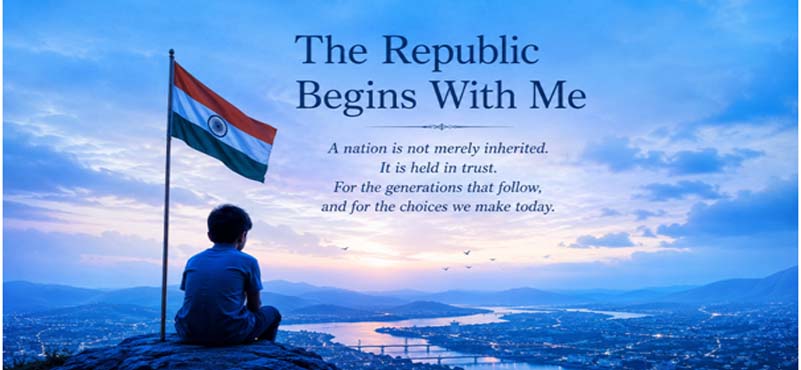
The Invisible Character That Builds Great Nations
World’s Favourite Conversation
Every democracy has its favourite conversation. We speak endlessly about what governments should do, how institutions have failed us, why the system is inefficient, corrupt or indifferent, and what rights citizens are entitled to expect. It is a conversation that echoes across drawing rooms, television studios, university campuses and social media. Yet hidden beneath this familiar chorus lies an uncomfortable silence. We seldom ask the question that matters just as much: What does my Republic expect of me?
Perhaps this silence exists because rights are pleasant to claim while duties require sacrifice. Rights promise entitlement; duties demand character. Yet history offers a simple lesson. Great nations have never been built merely because their constitutions were wise or their governments efficient. They have endured because ordinary men and women quietly accepted responsibilities that no law could compel and no court could enforce.
Near the end of The Little Prince, Antoine de Saint-Exupéry reminds us that “what is essential is invisible to the eye.” Those words were written about human relationships, yet they illuminate the life of nations with remarkable clarity. When we admire a country, we notice its visible achievements—its highways, universities, skyscrapers, armed forces, scientific discoveries and economic prosperity. These are the branches of the tree. Rarely do we pause to look beneath the surface, where the roots lie hidden. Trust, integrity, discipline, compassion, civic responsibility and respect for the common good are invisible qualities, but they nourish every visible success. Remove the roots and the tallest tree eventually falls. Strengthen them and even the fiercest storm cannot uproot it.
Mirror We Prefer Not to Face
This truth is often forgotten because we imagine governments and institutions as entities separate from ourselves. We criticise politicians, bureaucrats, judges, journalists and public servants as though they belong to another moral universe. They do not. Every institution is ultimately populated by ordinary citizens. The politician was once a child in a classroom. The civil servant once stood in a queue. The judge, the entrepreneur, the police officer and the teacher all emerged from the same society that produced the rest of us. Institutions do not descend from heaven; they rise from the habits of the people. A dishonest society cannot indefinitely produce honest institutions, just as a disciplined society rarely tolerates disorder for long. The macro is only the enlargement of the micro. National character is individual character multiplied millions of times.
Three Levels of Patriotism
It is therefore useful to think of patriotism not as a single emotion but as a journey through three increasingly profound stages.
- Patriotism of Sacrifice. This is the patriotism history remembers. It belongs to soldiers who guard frozen frontiers, police officers who confront danger, fire-fighters who enter burning buildings, doctors who battle epidemics and countless others who willingly place duty above personal safety. Their courage preserves the Republic in moments of crisis, and no grateful nation should ever forget its debt to them.
- Patriotism of Emotion. It is the stirring of the heart when the national anthem is played, when the tricolour rises against the morning sky, when an athlete wins an Olympic medal or when the nation celebrates moments of collective pride. This emotional bond is precious. It reminds us that we belong to something larger than ourselves. Yet emotion, however sincere, has never been sufficient to build a civilisation.
- Patriotism of Conduct. Yet there is a third form of patriotism, quieter than the first and more widespread than the second. It receives no medals, attracts no headlines and is rarely celebrated on ceremonial occasions. This patriotism is expressed not through extraordinary sacrifice but through ordinary integrity. It is found in the citizen who pays taxes honestly despite opportunities to evade them, in the motorist who stops at a red light even when no policeman is present, in the contractor who refuses to compromise on quality, in the teacher who prepares conscientiously, in the shopkeeper who returns the correct change, in the neighbour who protects public property as carefully as private property and in the young student who refuses to cheat even when success appears easier than honesty.
These acts seem insignificant when viewed individually. Together they create the moral atmosphere in which a republic either flourishes or decays.
The Republic is Built in Ordinary Moments
The Roman emperor and philosopher Marcus Aurelius, writing in Meditations, repeatedly returned to the idea that the health of a community depends upon the character of the individuals who compose it. He urged his readers to concern themselves first with governing their own conduct rather than the faults of others. Two thousand years later, the wisdom remains unchanged. We possess little control over the actions of governments, but complete control over our own conduct. That is where citizenship begins.
Lasting political freedom requires moral self-government. A nation could not remain truly free if its citizens lacked discipline, honesty and self-restraint. Political independence without civic character would merely exchange one form of weakness for another. Freedom, in its deepest sense, demanded responsibility.
The Question That Changes Everything
Perhaps, then, we have been asking the wrong question. Instead of asking what the country has done for us, we should occasionally ask a far more demanding one: If every citizen behaved exactly as I do, what kind of nation would emerge? Would it be cleaner, more trustworthy, more compassionate and more disciplined? Or would it simply magnify our own habits, our own excuses and our own indifference? Few questions are more revealing, because it transforms citizenship from a debate about others into a conversation with oneself.
Civilisations are rarely destroyed by spectacular catastrophes alone. More often, they erode through countless acts of everyday neglect—one dishonest transaction, one broken promise, one ignored law, one act of littering, one shortcut accepted because it seemed harmless. Their renewal follows the opposite path. Great republics are built through millions of invisible acts of responsibility repeated quietly, faithfully and consistently over generations. Every honest decision strengthens the roots. Every selfish compromise weakens them.
The Republic Begins With Me
The Republic, therefore, is not merely an inheritance received from previous generations. It is a trust placed in our hands for those yet to come. We are not simply citizens enjoying its benefits; we are stewards entrusted with its future. Long before the Republic speaks through Parliament, it speaks through its people. Every morning, in millions of unseen choices, a nation quietly becomes what its citizens choose to be.
The destiny of a country is not written only in its constitutions, ministries or monuments. It is written in the conscience of its people. The invisible architecture of character ultimately determines the visible architecture of national greatness. For the Republic does not begin in the capital, nor even in the Constitution itself. It begins wherever an ordinary citizen chooses duty over convenience, integrity over compromise and responsibility over entitlement.
The greatest question before any Republic is not whether its citizens love their country, but whether they deserve it. It is easy to ask what the nation owes us. The harder—and infinitely more important—question is what we owe the nation that has trusted us with its future. Rights may define our citizenship, but responsibilities define our worth. The Republic will not be judged by the promises of its governments alone; it will be judged by the character of its people.
For in the end, the nation I dream of will never be built by someone else. It will be built by millions of ordinary citizens, beginning with one. Beginning with me.
ABOUT THE AUTHOR
Lt Gen Rajeev Chaudhry (Retd) is a social observer and writes on contemporary national and international issues, strategic implications of infrastructure development towards national power, geo-moral dimension of international relations and leadership nuances in changing social construct.