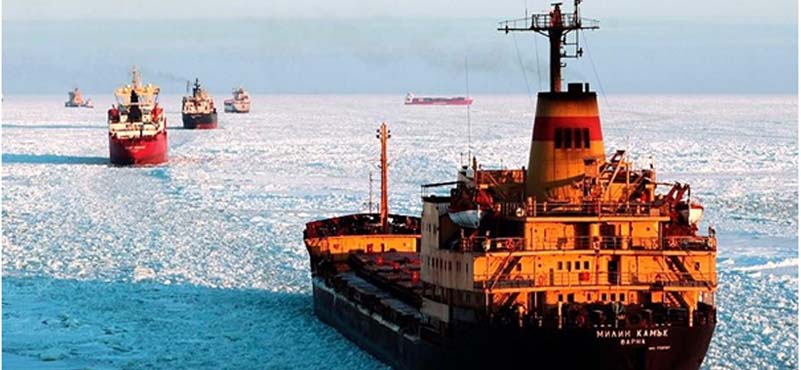
How the Arctic is Emerging as the Twenty-First Century’s New Geopolitical Battlefield
For centuries, the Arctic was nature’s fortress. Locked beneath an impenetrable shield of ice, it remained beyond the reach of commerce, conquest and competition. Explorers perished attempting to navigate its frozen waters, nations paid little attention to its vast emptiness, and strategists regarded it as a remote frontier of limited relevance.
Today, that reality is melting away—quite literally. The Arctic is warming nearly four times faster than the global average. As sea ice retreats and glaciers shrink, a new geopolitical landscape is emerging. Shipping routes once considered impossible are becoming navigable. Vast reserves of oil, gas and critical minerals are becoming accessible. Military planners are rediscovering the strategic value of the High North. What was once an environmental concern is rapidly becoming a geopolitical contest.
The Arctic is no longer merely a region. It is becoming a theatre of competition among great powers. Russia, the United States and China are positioning themselves for influence in a region that may profoundly shape global trade, energy security and military balance in the decades ahead.
The war for the last ice has begun.
Geography Rewrites Strategy
History has repeatedly demonstrated that geography shapes power. The Arctic is now offering one of the most dramatic examples of this principle.
As polar ice recedes, three maritime corridors are attracting increasing attention: the Northern Sea Route along Russia’s Northern coast, the Northwest Passage through the Canadian Arctic Archipelago and, potentially, a Transpolar Route across the central Arctic Ocean.
These routes could significantly reduce the distance between Asia and Europe. A voyage from East Asia to Northern Europe through the Arctic can be thousands of kilometres shorter than one through the Suez Canal. Reduced transit times translate into lower fuel consumption, lower costs and faster delivery schedules.
For centuries, global trade has depended upon a handful of strategic chokepoints such as the Suez Canal, the Strait of Malacca and the Panama Canal. The Arctic introduces the possibility of an alternative maritime geography. If the region becomes commercially viable on a larger scale, global shipping patterns could undergo a profound transformation.
In geopolitics, new routes create new rivalries.
The Prize Beneath the Ice
The Arctic is not merely a maritime opportunity. It is also a resource frontier.
The region is believed to contain substantial reserves of oil and natural gas, much of it yet to be fully explored or exploited. In addition, critical minerals essential for modern technologies—including rare earth elements required for batteries, renewable energy systems and advanced electronics—are attracting growing interest.
As the global transition towards clean energy accelerates, competition for strategic minerals is intensifying. Nations that control access to these resources could gain significant economic and technological advantages.
The Arctic therefore represents not only a transportation revolution but also a potential energy and resource revolution.
This combination of geography and resources explains why major powers are investing heavily in the region.
Russia’s Frozen Fortress
No country has more at stake in the Arctic than Russia.
Possessing the longest Arctic coastline, Russia regards the region as central to its economic and strategic future. It has invested heavily in Arctic infrastructure, modernised military installations, expanded airfields and strengthened its Northern Fleet.
Russia also possesses the world’s largest fleet of icebreakers, including nuclear-powered vessels capable of operating in extreme conditions. These assets provide Moscow with a significant advantage in maintaining access and influence across Arctic waters.
For Russia, the Arctic serves multiple purposes. It is a source of energy revenue, a strategic military buffer and a critical maritime corridor linking Europe and Asia. As Western sanctions and geopolitical pressures continue to reshape global alignments, the Arctic assumes even greater importance in Russian strategic calculations.
Moscow does not view the Arctic as a peripheral region. It views it as a strategic heartland.
America Returns to the High North
For many years, the United States treated the Arctic as a secondary concern. That perception is changing rapidly.
Washington increasingly recognises that the Arctic has become another arena of competition with both Russia and China. Investments in Arctic infrastructure, icebreaker capabilities and military presence are receiving renewed attention.
Alaska provides the United States with a significant Arctic foothold. From a military perspective, the Arctic represents one of the shortest routes between North America and Eurasia. Missile trajectories, early warning systems and strategic bomber routes all highlight the region’s enduring military significance.
The Arctic is no longer simply about climate. It is increasingly about deterrence and strategic balance.
China’s Polar Ambitions
Perhaps the most intriguing development is China’s growing Arctic engagement.
China has no Arctic coastline. Yet Beijing describes itself as a “Near-Arctic State” and has incorporated the region into its broader strategic vision through the concept of the Polar Silk Road.
Chinese investments, scientific research programmes and commercial partnerships indicate a long-term interest in Arctic affairs. Beijing recognises that future shipping routes, energy supplies and mineral resources could contribute to China’s economic and strategic objectives.
For many Arctic nations, China’s involvement presents both opportunities and concerns. Investments are welcome, but questions persist regarding long-term strategic intentions.
The Arctic illustrates an emerging reality of international politics: geography alone no longer determines influence. Economic power, technology and investment can extend a nation’s reach far beyond its physical borders.
A New Military Frontier
The Arctic is also witnessing a gradual but unmistakable process of militarisation.
The accession of Finland and Sweden to NATO has fundamentally altered the strategic map of Northern Europe. NATO’s Northern flank has expanded, while Russia has responded by reinforcing its Arctic posture.
Military exercises, surveillance systems, naval deployments and infrastructure development are increasing across the region. While open conflict remains unlikely, strategic competition is intensifying.
The Arctic’s importance stems not only from what lies within it but also from where it is located. It occupies a central position between major military powers. As geopolitical tensions increase elsewhere, the Arctic is becoming part of a broader global security equation.
The danger is not immediate war. The danger is a slow accumulation of strategic mistrust.
Why India Must Pay Attention
At first glance, the Arctic may appear distant from India’s strategic concerns. In reality, its future will influence several areas of direct relevance to India.
- First, Arctic shipping routes could reshape global trade patterns. As one of the world’s leading trading nations, India cannot remain indifferent to developments that may alter maritime economics.
- Second, Arctic energy production will affect global energy markets. Any major shifts in supply, pricing or transportation have implications for India’s energy security.
- Third, the Arctic plays a critical role in global climate systems. Changes in polar conditions influence weather patterns, sea levels and environmental stability far beyond the region itself.
India has already recognised these realities through its Arctic Policy and sustained scientific engagement. Indian researchers have been active in polar studies for years, contributing to understanding climate change and Arctic ecosystems.
However, scientific participation alone is insufficient. India must develop a deeper strategic understanding of Arctic developments and integrate them into long-term geopolitical planning.
From Observer to Stakeholder
India does not aspire to become an Arctic power, nor should it.
Yet India has every reason to become an informed and engaged stakeholder.
Partnerships with Nordic nations, investment in polar research, participation in Arctic governance mechanisms and studies of future shipping opportunities should form part of a broader national strategy. The objective is not territorial influence but strategic awareness.
The Arctic may seem remote today. Yet many of the defining issues of the twenty-first century—climate change, energy security, critical minerals, maritime connectivity and great-power competition—are converging there.
The region offers a glimpse of the future international order.
Conclusion
The Arctic is the only place on Earth where climate change is simultaneously erasing geography and creating geopolitics.
As the ice retreats, new sea lanes are opening. As resources become accessible, economic interests are expanding. As strategic competition intensifies, military attention is increasing. What was once a frozen wilderness is evolving into a dynamic arena of global significance.
The contest for influence has already begun. The question is not whether the Arctic will matter to the world. It will.
The question is whether nations such as India will recognise that the future strategic map of the twenty-first century may be drawn not only in the Indo-Pacific, but also in the waters of the rapidly changing Arctic Ocean.
The war for the last ice is not a conflict of armies. It is a contest of vision, access, influence and preparedness. And it has already started.
ABOUT THE AUTHOR

Lt Gen Rajeev Chaudhry (Retd) is a social observer and writes on contemporary national and international issues, strategic implications of infrastructure development towards national power, geo-moral dimension of international relations and leadership nuances in changing social construct.