Napoleon blamed the Russian winter. Hitler blamed the Russian winter. In reality, both were defeated by something much older and far more unforgiving—geography.
Throughout history, ambitious rulers have attempted to conquer maps with armies, wealth and technology. Some succeeded for a while, but none escaped the permanent realities imposed by nature. Mountains slowed them, deserts exhausted them, oceans protected their enemies and rivers shaped the direction of their campaigns. Technology changed, weapons evolved and empires rose and collapsed, but geography remained remarkably constant.
In the modern world, it has become fashionable to argue that geography no longer matters. Satellites circle the earth, missiles travel across continents, cyber warriors attack from thousands of kilometres away and artificial intelligence promises to transform warfare. Globalisation has created the illusion that distance has died and borders have become irrelevant.
Yet the events of the twenty-first century tell a different story. Wars are still fought over territory. Trade still depends upon ports and sea lanes. Energy still flows through narrow maritime chokepoints like Hormuz, Malacca and Bab el-Mandeb. Supply chains still follow physical routes. Nations continue to compete for mountains, islands, straits and strategic corridors.
Technology may accelerate history, economics may shape policy and ideology may inspire nations, but in the final reckoning geography imposes limits that even the greatest powers cannot escape.
For India, this truth has never been more relevant.
The Tyranny of Geography
A nation does not choose its neighbours, its mountains or its seas.
Russia has sought warm water ports for centuries because nature denied them. Britain’s island geography allowed it to build a maritime empire. The United States grew into a global power partly because the Atlantic and Pacific Oceans protected it from major invasions. China’s strategic thinking today is heavily influenced by the vulnerability of its trade routes and its limited direct access to the wider oceans.
Geography does not dictate policy, but it strongly influences the choices available to a nation. History repeatedly demonstrates that statesmen who understand geography succeed, while those who ignore it often pay a heavy price.
The French emperor believed military genius could overcome the vastness of Russia. Hitler believed mechanised warfare could defeat distance and climate. More recently, military planners across the world have discovered that logistics, terrain and access remain as important as advanced weapons.
Maps have longer memories than politicians.
The boundaries of mountains and oceans may not change within a human lifetime, but governments and alliances certainly do. Strategic planning, therefore, must begin with the permanent and not the temporary. Geography is that permanent factor.
India’s Twin Destiny
Few nations possess a geographical position as unique as India’s.
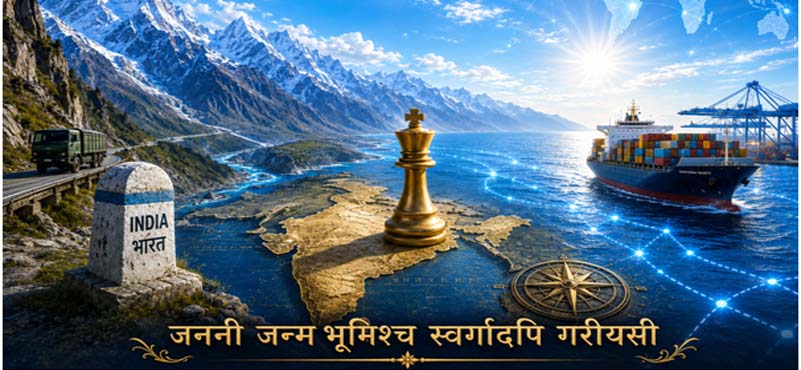
To the North rises the Himalayan wall, shared with two nuclear-armed neighbours. To the South stretches the Indian Ocean, one of the busiest maritime highways in the world. The Indian peninsula projects deep into these waters like a giant aircraft carrier anchored by nature itself.
India is neither exclusively a continental power nor purely a maritime one. It is both. This dual identity creates both opportunities and challenges.
For centuries, invasions into the Indian subcontinent came largely through the North-Western approaches. The Himalayas offered protection but never complete immunity. Mountain barriers delayed armies but could not entirely prevent conflict.
At the same time, India’s long coastline connected it to East Africa, the Middle East and Southeast Asia. Trade, culture and ideas travelled by sea long before the modern age of globalisation.
India’s strategic future cannot be built by looking only at the mountains or only at the oceans. It must simultaneously secure the Himalayas and influence the surrounding seas. Any imbalance would be strategically dangerous.
A nation that neglects its land frontiers invites pressure. A nation that neglects its maritime domain surrenders influence. India cannot afford either mistake.
The Himalayas Are Not a Wall
There was a time when mountains were considered almost impenetrable obstacles. That age has passed.
Modern roads, tunnels, airfields, missiles, drones and satellite surveillance have significantly reduced the protective value of natural barriers. The Himalayas still matter, but they are no longer an absolute shield. The strategic competition along the Northern frontier is no longer merely about soldiers facing each other across icy heights. It is equally about infrastructure, logistics and national will.
Roads can move armies. Railways can sustain campaigns. Airfields can alter the balance of power. In the mountains, logistics often determine outcomes more decisively than bravery. Military history offers countless examples where the side that maintained supplies ultimately prevailed over the side that merely possessed courage.
The Northern frontier, therefore, should not be viewed simply as a military problem. It is also an economic, technological and infrastructural challenge. A strong border is built not only by battalions but also by bridges, communication networks and resilient local communities.
Mountains are not obstacles. They are strategic negotiations conducted by nature.
The Indian Ocean Is India’s Natural Arena
If the Himalayas are India’s shield, the Indian Ocean is its sword.
A substantial portion of global commerce and energy supplies passes through these waters. The sea lanes connecting the Middle East, Africa and East Asia converge around the Indian peninsula. Vital maritime chokepoints link these routes to the wider global economy.
No nation can relocate its geography, and India’s location is an extraordinary strategic asset. The Indian Ocean does not surround India; India sits astride it. Control of the oceans has always translated into economic and political influence. History records that maritime powers often exercised authority far beyond their coastlines.
In the twenty-first century, this relationship has become even stronger. Energy security, international trade, undersea communication cables and naval presence are all interconnected. A disruption in maritime routes can affect economies thousands of kilometres away.
India’s island territories, its naval capabilities and its partnerships across the Indo-Pacific are therefore not merely matters of defence policy. They are essential components of national strategy.
The nation that understands the sea secures not only its coast but also its future.
Supply Chains Are the New Frontlines
The next great geopolitical contest may not begin with tanks crossing borders. It may begin with factories shutting down, shipping routes being disrupted or critical technologies becoming unavailable.
The map of the modern world contains new strategic landmarks. Semiconductor manufacturing centres. Rare earth mineral deposits. Energy pipelines. Ports. Data cables resting silently on the ocean floor. These have become as important as forts and fortifications once were.
The recent decades have shown how deeply interconnected the global economy has become. Nations have discovered that dependence can be transformed into vulnerability. Economic geography has become inseparable from national security.
A country that cannot secure critical supplies may find its strategic options shrinking rapidly during a crisis. Supply chains are, in many ways, the logistics columns of the twenty-first century. The ability to manufacture, transport and sustain essential resources has become a decisive element of power. The old battlefield has not disappeared; it has simply expanded.
Today, a port can be as strategically significant as a mountain pass and a semiconductor plant can be as valuable as an oil field.
The Indian Century Will Depend on Strategic Clarity
Geography provides opportunities, but it offers no guarantees. A favourable location can become a burden if it is neglected. Strategic advantages must be converted into national capability.
For India, this means strengthening infrastructure, investing in maritime power, building resilient supply chains, advancing technology and maintaining constructive international partnerships. National power is no longer measured solely by the number of divisions or warships. It is measured by the ability to integrate military strength with economic resilience and technological innovation.
India’s geographical position offers an opportunity that few nations possess. It stands at the crossroads of major trade routes, connects multiple regions and commands access to a strategically vital oceanic space. But geography rewards preparation, not complacency.
Nations that understand their geography shape history. Nations that ignore it become subjects of history. Strategic clarity demands that India think not merely in terms of election cycles but in terms of generations. Roads built today, ports developed today and technologies mastered today will determine the balance of power decades from now.
Great powers are rarely accidents. They are usually the result of a long-term understanding of geography and the patient conversion of that understanding into national strength.
Conclusion
The world is entering an age of artificial intelligence, quantum computing, autonomous weapons and space exploration. These developments will undoubtedly transform the character of warfare and diplomacy.
Yet ships will still sail through narrow straits. Armies will still contend for mountain passes. Energy will still travel along vulnerable routes. Trade will still depend upon secure oceans. Technology can compress time and distance, but it cannot abolish them.
Geography waits patiently while successive generations proclaim its irrelevance. Then, quietly and relentlessly, it reminds them that maps outlive manifestos.
For India, the challenge of this century is not to escape geography but to master it. The Himalayas must remain secure, the Indian Ocean must remain a sphere of influence and the nation’s economic lifelines must become resilient against disruption.
The future will belong not merely to the richest nations or the most technologically advanced ones. It will belong to those that recognise the enduring relationship between land, sea and power.
Empires may fade. Governments may change. Technologies may become obsolete. But the mountains will stand where they have always stood, and the oceans will continue to shape the destiny of nations.
Geography never retires.
ABOUT THE AUTHOR

Lt Gen Rajeev Chaudhry (Retd) is a social observer and writes on contemporary national and international issues, strategic implications of infrastructure development towards national power, geo-moral dimension of international relations and leadership nuances in changing social construct.