Fences, floodlights, bunkers, and patrol routes have long shaped the image of border security in South Asia. For decades, India’s frontier management rested on the logic of physical denial: build barriers, deploy manpower, and react to infiltration. That model is now reaching the limits of its utility. The threats confronting India’s borders have changed faster than the systems designed to counter them.
The frontier is no longer merely a geographical line. It has become a contested technological battlespace.
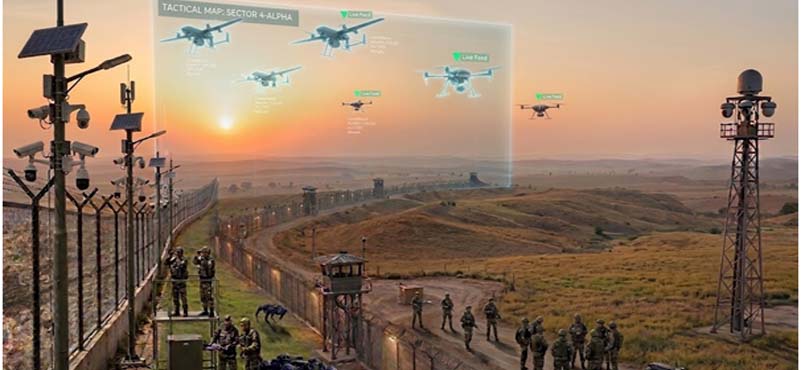
Drones now carry narcotics, weapons, and surveillance payloads across borders at negligible cost. Encrypted networks coordinate infiltration in real time. Underground tunnels bypass traditional fencing systems. Cyber disruption can blind surveillance grids before a physical intrusion even begins. In such an environment, border management can no longer depend on static defence and fragmented institutional structures. It demands continuous domain awareness, integrated command systems, and technological sovereignty.
India’s emerging smart border initiative recognises this shift. The move towards integrated surveillance architecture, artificial intelligence-enabled monitoring, optical fibre-linked communication systems, anti-drone capability, tunnel detection technologies, and real-time command interfaces marks one of the most consequential transformations in India’s internal security doctrine in decades. The strategic significance of this transition lies not in the equipment itself, but in the philosophy driving it: borders are now systems, not sectors. That distinction matters.
Traditional border management operated through layered but often disconnected mechanisms. Patrol units gathered information. Intelligence agencies processed separate streams. State police handled local networks. Central forces managed tactical responses. Coordination existed, but largely through institutional habit rather than digitally integrated architecture. In a slow-moving threat environment, such fragmentation was manageable. In today’s environment, it creates dangerous delays.
Modern border threats operate at machine speed. Response systems still function at bureaucratic speed. That gap is becoming India’s central vulnerability.
The value of a smart border, therefore, lies in compressing the decision cycle. Persistent surveillance, fused sensor grids, AI-assisted analytics, and secure communication backbones can convert isolated information into actionable intelligence almost instantly. An intrusion detected by a drone sensor, ground radar, fibre intrusion system, or subterranean monitoring grid must trigger an integrated operational response within minutes, not hours. Technology’s real purpose is not merely surveillance. It is decision dominance.
But there is also a temptation to mistake technological procurement for strategic transformation. Buying sensors does not create integration. Deploying drones does not automatically create deterrence. Installing digital systems without unified command structures risks building islands of technology inside oceans of institutional fragmentation.
This is where the debate around “One Border, One Force” becomes strategically important.
The concept is often viewed narrowly as an administrative reform. In reality, it is about creating a coherent operational architecture. India’s borders are currently managed through overlapping responsibilities spread across multiple agencies. While this evolved historically for practical reasons, the future battlespace increasingly punishes divided command structures. A technologically integrated border cannot function efficiently if organisational control remains fragmented.
A unified border management model would create clearer accountability, streamlined command chains, and faster operational coordination. It would also ensure that technology investments are integrated into a single security ecosystem rather than distributed unevenly across competing institutional silos. In military terms, unity of command is not simply desirable; it is operationally decisive.
Yet the larger strategic issue extends beyond command reform. India cannot build smart borders while remaining dependent on imported strategic technologies.
This is the uncomfortable reality often overlooked in discussions about modernisation. Surveillance systems, AI-enabled analytics, encrypted communications, drone detection software, and data management platforms are not politically neutral technologies. Nations that control the algorithms, software architecture, and data ecosystems ultimately control operational dependency.
A border protected by foreign-controlled systems carries embedded strategic risk. This is why technological sovereignty must become the core principle of India’s future border architecture. Indigenous development of unmanned systems, secure communication protocols, AI-assisted surveillance, and sensor fusion technologies is no longer a matter of industrial policy alone. It is a national security imperative. Strategic autonomy cannot coexist with technological dependency in critical security infrastructure.
Equally critical is data sovereignty. A truly smart border will generate enormous volumes of real-time geospatial, behavioural, and operational data. Whoever controls the storage, processing, and analytical architecture of that data possesses immense strategic leverage. Sensitive border intelligence cannot reside in vulnerable or externally dependent systems. Secure national data ecosystems must therefore become foundational infrastructure for future border management.
However, technology alone will still not decide outcomes. History repeatedly demonstrates that adversaries adapt faster than institutions expect. Every surveillance advantage eventually encounters a countermeasure. Drone detection systems will face swarms of drones. Sensors will confront electronic deception. AI-enabled monitoring will encounter AI-assisted evasion. Border security can never become a static technological construct. It must evolve continuously through adaptive upgrades, iterative learning, and institutional flexibility.
That requires a fundamental shift in procurement philosophy. India’s security establishment has traditionally focused on acquisition cycles. Future border systems must instead be built around innovation cycles. The distinction is profound. Acquisition assumes stable requirements. Innovation assumes continuous adaptation.
The human dimension is equally important. Smart borders do not diminish the importance of personnel; they raise the quality expected of them. Border forces of the future must operate comfortably in data-rich environments where sensor feeds, predictive alerts, drone imagery, and digital command systems shape tactical decisions in real time. This demands a new training culture combining traditional fieldcraft with technological literacy and systems thinking.
Ultimately, India’s border transformation is not merely about preventing infiltration. It reflects a deeper evolution in how national power itself is understood. Borders are no longer passive territorial edges. They are active interfaces of state capacity, technological depth, intelligence integration, and political resolve.
In the twenty-first century, sovereignty will not be defended only by the soldier standing at the fence. It will also be defended by the algorithm that detects anomalies, the secure data grid that transmits intelligence, the indigenous software that resists cyber intrusion, and the command architecture that responds before a threat fully materialises.
India’s smart border initiative, therefore, represents something larger than a security upgrade. It is an attempt to redefine border management for an era where wars increasingly begin long before the first shot is fired.
Whether that transformation succeeds will depend on three factors: institutional integration, technological self-reliance, and the ability to adapt faster than adversaries.
Without those, smart borders may become expensive infrastructure. With them, they could become the foundation of twenty-first-century Indian deterrence.
ABOUT THE AUTHOR
 Lieutenant General A B Shivane, is the former Strike Corps Commander and Director General of Mechanised Forces. As a scholar warrior, he has authored over 200 publications on national security and matters defence, besides four books and is an internationally renowned keynote speaker. The General was a Consultant to the Ministry of Defence (Ordnance Factory Board) post-superannuation. He was the Distinguished Fellow and held COAS Chair of Excellence at the Centre for Land Warfare Studies 2021 2022. He is also the Senior Advisor Board Member to several organisations and Think Tanks.