
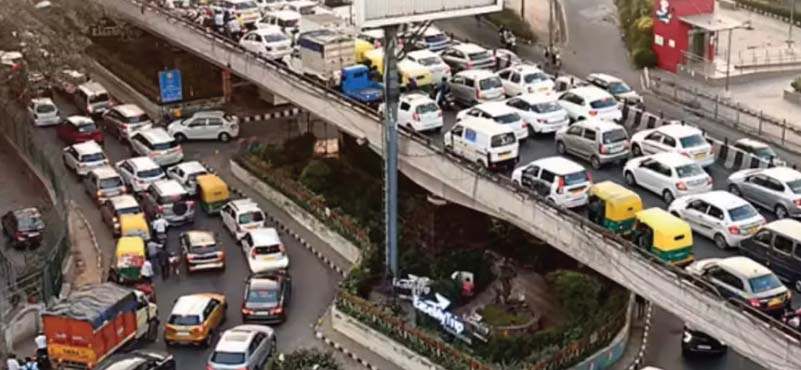
The proposed Modi Mill–IIT Gate signal-free corridor is a critical intervention structured to eliminate decades-old bottlenecks and restore flow to the Outer Ring Road
Choked turns and crossings, long agonising wait as one expertly manoeuvres through bumper to bumper amidst blasting, impatient horns – truly a quintessential Delhi experience. The Outer Ring road is particularly notorious because of the merging traffic from residential expanse lined up along the route, with interspersed commercial pockets. The specific intersection below the Chirag Delhi flyover has become a perpetual choke point. The signal turns green at least thrice before one can turn towards Nehru Place — only to be bottlenecked a few meters ahead. Heavy merging traffic with a right turn towards Savitri Cinema adds to the chaos.
That’s why the recent announcement by the PWD Minister Parvesh Sahib Singh for the Integrated Corridor Redevelopment Plan to decongest the Outer Ring Road is being hailed as a massive relief for South Delhi. The lifeline of Delhi connecting the national capital to its burgeoning satellite cities, the Outer Ring Road, is finally set for a massive structural transformation.
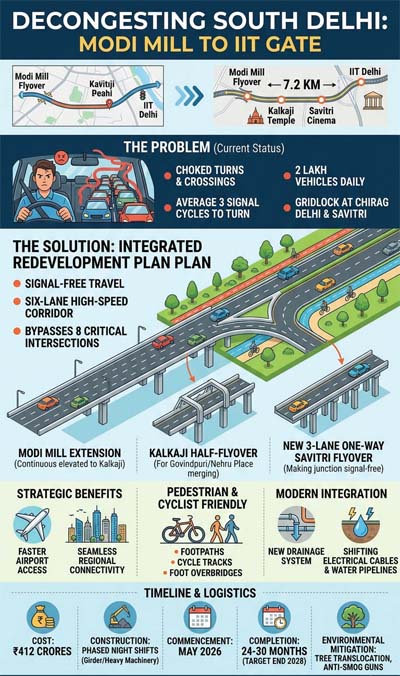
The target 7.2 km stretch between the Modi Mill flyover and the IIT Delhi sees a heavy load of two lakh vehicles every day, causing a nightmare to the commuters. The new blueprint that expands the Modi Mill flyover and constructs two “half flyovers” at Savitri Cinema and Kalkaji promises to usher in signal-free travel.
The primary objective of the project, as articulated by PWD Minister Parvesh Sahib Singh, is to achieve a completely free flow of traffic along the Outer Ring Road. The main focus areas will be Modi Mill, Kalkaji temple and Savitri Cinema. The existing Modi Mill flyover will be extended to the Kalkaji Temple flyover through a continuous elevated route. An additional half-flyover will be built along with the Kalkaji Temple flyover to streamline traffic merging from Govindpuri, Okhla and Nehru Place. Moving on, a new three-lane one-way flyover will be built parallel to the existing Savitri Cinema flyover, making the intersection signal-free. In short, the entire stretch from Modi Mill to IIT Delhi is set to transform into a six-lane high-speed corridor.
 For years, the commute from the southeast borders of Delhi to the heart of South Delhi has been slowed by eight major traffic signals. The single-carriageway Savitri flyover was built in 2001 to improve traffic flow from Delhi’s commercial and IT hub Nehru Place towards IIT Delhi but became a major congestion point. It serves as a critical junction for Greater Kailash II, Chittaranjan Park, Kalkaji and Nehru Place. Two and a half decades ago, there were fewer vehicles, less population and fewer housing units. However, over the years, official reports state at least a three-fold increase in vehicular traffic and population. Further, the flyover is marred with maintenance issues, with potholes and cracks reappearing shortly after repair. Similarly, the existing Modi Mill flyover was built around the same time in 2001. Both these flyovers are showing signs of wear and tear – seeking urgent repair and structural strengthening.
The South Delhi transit corridor is a strategic infrastructure response to severe traffic woes and urban gridlock. Engineering feasibility and investigations to decongest the Outer Ring Road and augment traffic capacity at Maa Anandmayee Marg, Captain Gaur Marg and Savitri Cinema intersections were conducted last year. The project is an integral part of PWD’s comprehensive development agenda for a smooth, signal-free corridor from Sarai Kale Khan to Malviya Nagar. Initially proposed in 2015 and sanctioned by the Unified Traffic and Transportation Infrastructure (Planning & Engineering) Centre (UTTIPEC) in 2016, the project was stalled for nearly a decade due to a revenue crunch, land acquisition challenges, and delays in tree-felling permissions, until it finally received all clearances last year. Recently, the PWD awarded the tender for the Integrated Corridor Redevelopment Plan to Gawar Construction Limited. The development project, estimated to cost ₹412 crores, of which ₹150 crores will be rolled out this financial year to mobilise the early-stage constructions. Commencement is scheduled in May 2026 with a target deadline for completion of approximately 24-30 months.
A significant challenge identified during the feasibility study was the impossibility of road-widening. Dense residential complexes and commercial establishments line both sides of the Outer Ring Road, leaving the PWD with no lateral space to expand. Consequently, the engineering solution was to “double-deck” or extend existing elevated structures.
The redevelopment is not just about local ease; it is a strategic regional link. Once completed, the corridor will provide seamless connectivity between three important satellite cities of Delhi – Gurgaon, Noida and Faridabad. The project will connect the corporate hub of Haryana with the industrial and residential sectors of Uttar Pradesh seamlessly. For those travelling to the Indira Gandhi International Airport, the Outer Ring Road will reduce the travel time considerably, bypassing eight critical traffic intersections. And not to overlook, residents of Greater Kailash (I & II), Chittaranjan Park, Kalkaji, Panchsheel and Hauz Khas stand to be the primary beneficiaries.
Being a complex nature of work in a highly urbanised environment, and that the Outer Ring is too critical to close down, the government agency proposes to carry out the building work in a phased manner. The intense construction, like girders and heavy machinery, will operate only during the night shift. Moreover, before the main flyover work begins, service roads will be optimised by widening and clearing encroachments to serve as relief tracks.
To minimise the environmental damage, trees affected by the ramps will be translocated as per Delhi’s revised green policy. Also, given the proximity to residential blocks in GK and CR Park, the contractor is mandated to keep dust levels in check with the use of anti-smog guns and constant sprinkling of water.
The plan is to integrate new schemes with the matrix of existing infrastructure – high-tension electrical cables, along with water pipelines will be shifted and developing a new drainage system to prevent chronic waterlogging that plagues during monsoons. Unlike the previous projects that overlooked the safety concerns of those on foot, the current plan will comprise footpaths, foot overbridges and cycle tracks. Bus stoppages will also be strategically relocated to prevent obstruction of merging traffic at the surface level.
So far, the Integrated Corridor Redevelopment Plan looks optimistic. The immediate effect will be the end of the Savitri stalemate. Surface-level chokes will disappear, and traffic will be lifted off the ground, literally. The corridor will navigate traffic at high speed, bypassing the three most congested crossings of Delhi. However, despite its advantages, the local residents are apprehensive about the noise and dust during the 30-month construction period. Commuting through barricaded streets will further add to the trouble. Also, will the merging points at the ground level, like Nehru Place, become the new bottleneck points? Only time will tell if the project is futuristic enough to respond to the burgeoning needs of a dynamic city like Delhi.
To summarise, the redevelopment of the Modi Mill-IIT Gate stretch is more than just a road project, it is an attempt to “re-engineer” a city that grew faster than its infrastructure. By the end of 2028, if the government and private agencies meet the deadline, the vision of a freeway Outer Ring Road could become a reality, saving millions of man-hours and litres of fuel every year. Time to shift gears to the cruise mode – a city that crawls to a city that flies.