In the early days of post-independence, in India commercial aviation was considered a rich man’s travel mode and did not need to be subsidised. However, over time, two schemes were introduced. The first attempt was in 198, when the two monopoly public sector airlines, Air-India and Indian Airlines joined together to set up a region airline, Yayudoot, using 19-seater Dornier 228 aircrafts. At its peak, Yayudoot connected over 100 regional airports but ran into financial losses; later, it was merged with Indian Airlines in April, 1993.
There was no government subsidy involved. The second was the Route Dispersal Guidelines, introduced by DGCA in 2024 for the North East, Jammu & Kashmir and island territories. This scheme was essentially a plan whereby airlines flying metro routes were mandated to fly a small percentage of their flights to designated remote areas without any external subsidy. This scheme still exists.
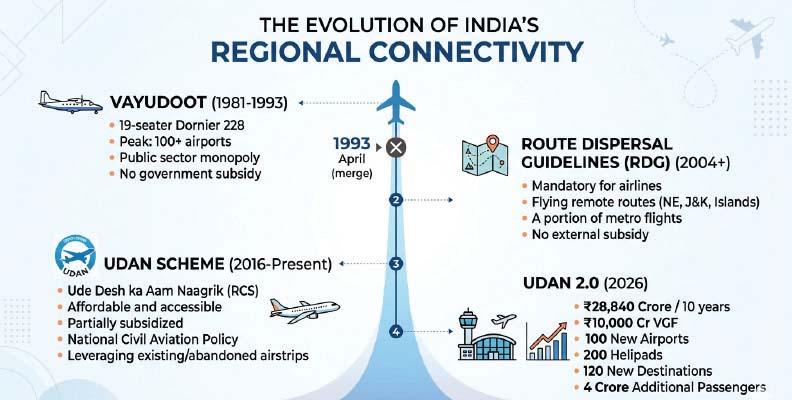
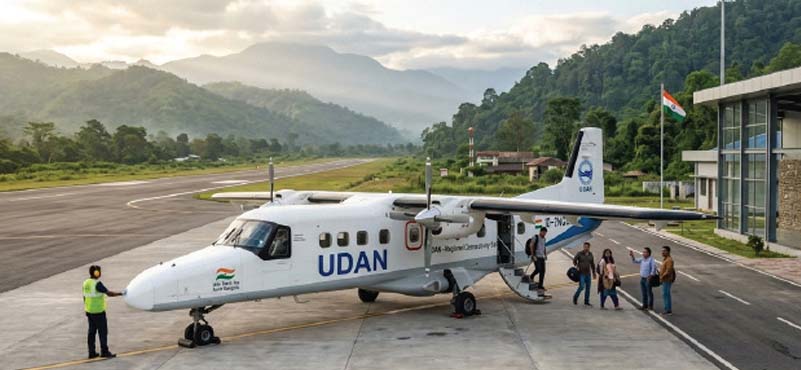
1. The present and third scheme UDAN (Ude Desh ka Aam Naagrik) scheme, was launched in October 2016 to expand the footprint of Indian aviation to smaller towns and regions. This is a partially subsidized scheme under the National Civil Aviation Policy of 2016, as a Regional Connectivity Scheme (RCS) promoted by India’s Ministry of Civil Aviation. It aims to make air travel (including helicopters and amphibious aircrafts) affordable and accessible to smaller cities, unserved/underserved regions through a combination of infrastructure support, route auctions, fare caps on a portion of seats on each flight. This was to enable India to deepen its aviation reach.
India is blessed with over 400 airstrips built mainly during Second World War. Many of these do exist in some form or the other, but the land upon which they were built, is secure with either the Airports Authority of India (AAI) or with the concerned state government. With a grant for their renovation from Central government, these strips are being brought into use under the UDAN scheme. The scheme is being run on a three-year route concession by the Ministry supported by central/state governments along with Viability Gap Funding (VGF) to bridge airline operating gaps, if any. Funding also comes from a levy on domestic flights flying metro routes, states government with direct or indirect subsidy, and lastly, funding of deficit, if any, by AAI. The scheme is also operated by AAI.
2. In the latest version of UDAN scheme called UDAN 2.0 approved in March 2026) the Union Cabinet approved budgetary allocation of ₹28,840 crore over 10 years (FY 2026-27 to 2035-36) with an announcement of introducing another 100 new airports and 200 helipads in the scheme and a VGF of Rs 10,000 crores for airlines, with the aim to connect 120 new destinations and benefit 4 crore additional passengers.
It is a Regional Connectivity Scheme with competitive route auctions of pre-selected city-pairs, explicit fare caps (e.g., ₹2,500 for short sectors on a portion of seats), Viability Gap Funding (VGF) to airlines, and concessions by airports mainly on airport charges, taxes. The consequences both from economic development of the region and tourism potential (if it exists) of connecting these regional areas with air connectivity can be measured in a longer term but are bound to be extremely positive.
3. The success of UDAN 2.0 will still hinge on demand generation, rigorous route promotion, airline participation, and post-subsidy viability. If past patterns hold, many new routes could face attrition without complementary measures (e.g., tourism promotion, better last-mile connectivity, or incentives for private investment).
4. Success so far in UDAN scheme far has been mixed. Many routes (up to 50%+ in early phases as per audits) never started or were discontinued post-VGF; low occupancy in thin-demand areas; implementation delays; high subsidy dependency as brought out in audit reports on feasibility and oversight.
5. However, it is to the credit of the government that they are continuing with the scheme and there is great optimism that it will be a great success. India is at a threshold of a high growth trajectory with a rising middle class, with greater affordability for air travel. India remains a price sensitive country, even more so in aviation. Therefore, keeping nearly 50% of the seats in every flight subsidised for 3 years gives a greater incentive to travel by air from smaller towns to do business or for tourism. It’s a great incentive for first time travellers from smaller towns.
6. Further, UDAN has opened up hundreds of routes, generated 1.6 crore cumulative passengers on RCS, first-time flyers in remote/tourist pockets, with accompanying socio-economic multipliers. Persistence despite mixed results shows policy commitment. At the same time, many of these routes have or will become commercially viable and then taken out of the scheme. Further, UDAN has leveraged the advantage of many existing/abandoned airstrips with targeted development and support in its new version.
7. Another advantage coming out of this scheme is the potential of manufacturing in India of smaller aircrafts to meet the demand for small aircrafts. Regional Jet Manufacturing (50–150 Seaters) companies like
- Embraer of Brazil have signed a Memorandum of Understanding (MoU) with Adani Defence to establish a Final Assembly Line in India for its regional jets (70-146 seats), with production potentially starting in 2030-31.
- Russia’s UAC (SJ-100) United Aircraft Corporation (UAC) of Russia has announced at WINGS India 2026 a partnership with HAL to jointly assembling Superjet (SJ-100)- a 87-108 seater regional jet in India within 3 years
- ATR: The European turboprop manufacturer Airbus is evaluating potential to set up final assembly in India, given the potentially high demand in India’s regional routes.
Do we have parallels of UDAN in other countries? Yes, similar but different schemes do exist in USA, European Union, Australia, Indonesia, Malaysia, China and some more countries.
Therefore, UDAN is a great endeavour to connect regions and smaller towns that could not be connected so far either because of non- availability of an airport or the route was not viable without some subsidy.
ABOUT THE AUTHOR
 Sanat Kaul is Chairman of International Foundation for Aviation, Aerospace and Drones.