A Book for a Moment of Flux
There are moments in history when events outpace frameworks, when the world changes faster than the ideas used to interpret it. We are living through such a moment. The global order is no longer unipolar, not yet multipolar, and increasingly unpredictable. In this fluid landscape, Navigating the Geopolitical Churning: India’s Defence and Security Challenge emerges as a timely and serious intellectual intervention.
This is not merely a collection of essays. It is a strategic compendium—twenty-five essays by sixteen distinguished practitioners—seeking to interpret a world in flux and situate India within it. The book’s strength lies not just in the eminence of its contributors, but in the coherence of its underlying message: India must think, prepare, and act as a civilisational power navigating a complex and contested century.
The Event and the Moment
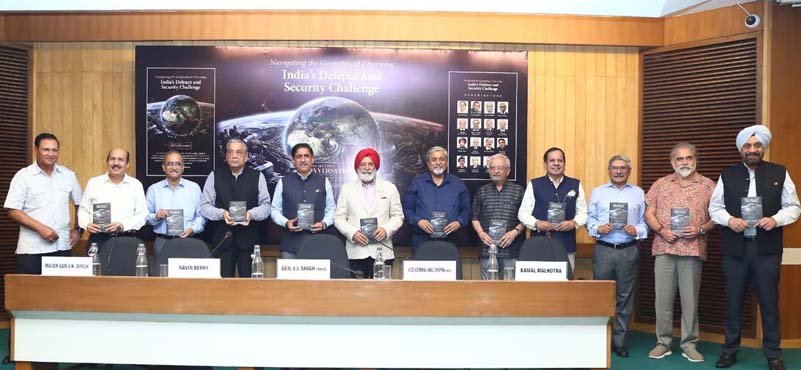
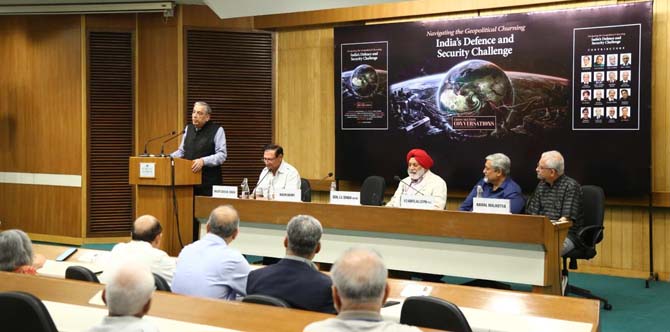
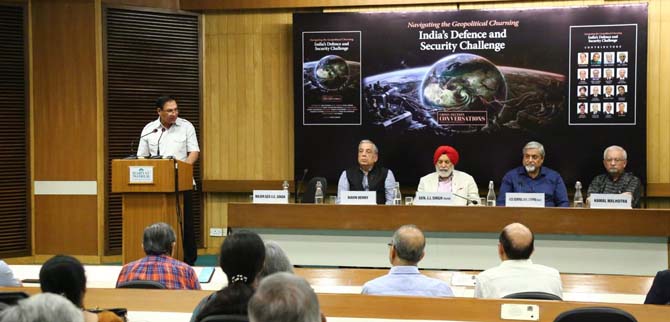
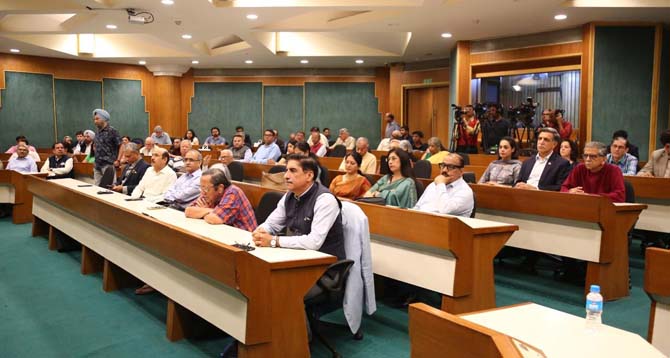
The book launch itself reflected the seriousness of the enterprise. The presence of General J.J. Singh, former Chief of Army Staff and Governor, lent institutional gravitas and continuity to the occasion. His association symbolised a bridge between India’s strategic past and its evolving future.
At the centre of this effort stands Navin Berry, the editor and driving force behind the volume. A seasoned editor with decades of experience, Berry has done more than compile essays—he has curated a strategic conversation. Bringing together voices from across the military, diplomatic, and policy spectrum, he has shaped a book that reads as a unified reflection rather than a fragmented anthology. The book is, in many ways, a product of dialogue—of practitioners thinking aloud together about India’s place in a rapidly changing world.
Section One: India and the Changing World Order
The opening set of essays situates India within the shifting global order, where power is diffused, alliances are fluid, and rules are contested.
- Ajay Bisaria — Brick by BRICS: Building an India-Friendly World Order. Bisaria frames the current global moment as an “interregnum” between orders. He argues that India’s strategy of multi-alignment—engaging BRICS, Quad, and other platforms—is a deliberate effort to shape outcomes rather than merely respond to them. India, in his formulation, is emerging as a “system-shaping” power.
- Ashok Sajjanhar — India–Central Asia Relations: On the Cusp of a Reinvigorated Partnership. Sajjanhar highlights Central Asia as a critical yet under-leveraged region for India. Rich in resources and strategically located, it offers opportunities for connectivity and energy security. However, he cautions that India must act with urgency to compete with China’s growing influence.
- Kamal Malhotra — Navigating Geo-political Storms: Fast Forward to Realizing India’s Full Economic Potential. Malhotra shifts the focus inward, arguing that India’s global standing will depend on domestic reform. Health, education, inequality, and R&D investment are presented as foundational pillars. Without strengthening these, geopolitical ambitions may remain unfulfilled.
- Iqbal Chand Malhotra — India’s Sub-Continental Threats. Malhotra provides a layered understanding of threats emerging from the subcontinent, emphasising the interplay of geography, history, and politics. His essay underscores that India’s neighbourhood remains a persistent source of strategic pressure.
Together, these essays establish a key theme: India’s rise will depend on how effectively it balances external engagement with internal transformation.
Section Two: Strategic Awareness, Internal Cohesion, and National Power
The second cluster of essays turns inward, examining India’s strategic mind-set, internal cohesion, and structural strengths.
- Lt Gen A B Shivane — Reclaiming India’s Strategic Mind for Viksit Bharat. Shivane argues that India must rediscover its strategic culture—one rooted in long-term thinking and adaptability. He calls for moving beyond reactive policymaking toward anticipatory strategy aligned with national aspirations.
- Maj Gen Suresh Mohanty — Cohesion, Stability and Development: The Essential Triad for India’s Future, Mohanty emphasises that internal cohesion is central to national strength. Stability and development, he argues, are mutually reinforcing, and together they form the foundation of enduring security.
- Lt Gen Syed Ata Hasnain — J&K: From Long War to Irreversible Integration. Hasnain offers a nuanced perspective on Jammu and Kashmir, describing its transition from prolonged conflict to a phase of integration. He highlights the shift from kinetic operations to political and societal consolidation.
- Lt Gen Rajeev Chaudhry — Bharat at Strategic Crossroads: Infrastructure, Security and National Power. Chaudhry convincingly argues that today power is projected through the flow of energy, data, capital and goods. This shift has given rise to Infrastructural Geopolitics which defines the national sovereignty and puts Strategic Infrastructure as the Fourth Arm of National Power.
This section reinforces a critical insight: national power is not built on military strength alone. It emerges from cohesion, infrastructure, governance, and strategic clarity.
Section Three: Innovation, Industry, and the Foundations of Future Power
The third segment of essays begins to explore how India can build capacity for the future.
- Lt Gen Tarun Chawla — Innovation as Power: Building India’s Future-Ready Defence and R&D Ecosystem. Chawla positions innovation at the heart of strategic strength. He argues that a robust defence R&D ecosystem is essential for technological self-reliance and operational superiority.
- Lt Gen Rajeev Chaudhry — Public-Private Partnership in Strategic Infrastructure Development. Chaudhry extends his earlier argument by advocating for greater private sector participation in infrastructure development. Efficiency, speed, and innovation, he suggests, require collaboration between state and industry.
- Lt Gen Tarun Chawla — The Spine of a Superpower: Atmanirbharta in Defence as Catalyst for Viksit Bharat @2047. In a powerful articulation of self-reliance, Chawla argues that indigenous defence capability is not optional—it is central to sovereignty. Atmanirbharta becomes both an economic and strategic imperative.
What emerges from this section of the book is a layered understanding of India’s strategic reality. The essays move seamlessly from global geopolitics to domestic resilience, from traditional security concerns to emerging domains of power If there is one unifying thread, it is this: India’s rise will not be accidental. It will require deliberate alignment of vision, capability, and execution.
Section Four: The New Battlefield — Doctrine, Technology, and the New Grammar of War
This segment explores how the character of war is evolving from visible confrontation to invisible contestation.
- Maj Gen Suresh Mohanty — The Narrative Post-Operation Sindoor: Concerns Remain. Mohanty highlights a crucial shift: success on the battlefield must now be sustained in the domain of narrative. He argues that even decisive operations can be diluted if perception is not managed effectively. Information warfare, therefore, becomes integral to strategy.
- Maj Gen Jagatbir Singh — Cognitive Warfare Can No Longer be Confined to the Periphery. Jagatbir Singh takes this further by placing cognitive warfare at the centre of modern conflict. He describes a battlefield where influencing minds—of populations, adversaries, and even decision-makers—becomes as critical as physical dominance.
- Maj Gen VK Singh — Need to Recalibrate the Nuclear Doctrine. VK Singh introduces a more traditional but equally pressing concern. He questions whether India’s existing nuclear doctrine remains adequate in a rapidly changing threat environment. His essay calls for a careful recalibration without compromising credibility.
- Air Marshal (Dr) Sanjeev Kapoor — Contours of India–China Power Dynamics in the Post-Sindoor Era. Kapoor examines the evolving balance between India and China, particularly in the aftermath of recent tensions. He presents a nuanced picture of competition, deterrence, and cautious engagement, where escalation is managed but rivalry persists.
- Air Marshal (Dr) Sanjeev Kapoor — Lessons from the United States–Israel–Iran Conflict and their Implications for the Indian Air Force. In his second contribution, Kapoor draws operational lessons from contemporary conflict. Precision strikes, integration of intelligence, and rapid decision-making emerge as defining features of modern air power—lessons directly relevant to India.
This section collectively signals a paradigm shift: war is no longer just about territory; it is about perception, credibility, and speed.
Section Five: Technology, AI, and Emerging Domains
Closely linked to doctrinal change is the technological transformation of warfare. The next set of essays explores how innovation is reshaping strategy.
- Lt Gen PJS Pannu — Mosaic Warfare: In the Era of AI. Pannu introduces the concept of mosaic warfare—distributed, networked operations enabled by artificial intelligence. He argues that future conflicts will rely on flexible, interconnected systems rather than centralised command structures.
- Lt Gen PJS Pannu — India’s Space Thresholds. In his second essay, Pannu shifts focus to space as a strategic domain. He underscores that space is no longer a benign frontier but a contested environment, essential for communication, surveillance, and deterrence.
- Vice Admiral Anil Chopra — Clear and Present Danger: India’s Intangible Vulnerabilities. Chopra’s essay is a sobering assessment of risks that are not immediately visible—cyber threats, informational fragility, institutional weaknesses. He argues that these vulnerabilities, if left unaddressed, can undermine even the strongest conventional capabilities.
These contributions highlight a critical transition: technology is no longer a support function—it is the core of strategic capability.
Section Six: Neighbourhood, Resources, and Strategic Convergence
No analysis of India’s security environment is complete without examining its principal adversaries.
- Lt Gen A B Shivane — Realigning the Neighbourhood First Policy. Shivane revisits India’s neighbourhood strategy, calling for recalibration in a region marked by shifting alignments and external influence. He emphasises sustained engagement, economic integration, and strategic patience.
- Maj Gen VK Singh — Water Management Lessons for India. VK Singh introduces a dimension often overlooked in strategic discourse—water. He argues that water security will increasingly intersect with national security, both domestically and regionally, making efficient management a strategic imperative.
- Maj Gen Jagatbir Singh — How Pakistan–China Collusivity Metamorphosed Into Fusion. Jagatbir Singh provides a stark assessment of the deepening relationship between China and Pakistan. What was once tactical cooperation, he argues, is now approaching strategic fusion, creating a more complex and coordinated challenge for India.
These insights reinforce the idea that contemporary conflicts are laboratories of future warfare. Observing them is not optional—it is essential.
Section Seven: Maritime Power, Shaping the Battle-space and Historical Lessons
India’s maritime domain—often under-emphasised in public discourse—receives sharp analytical attention.
- Commodore Anil Jai Singh — Submarines in the Indian Ocean – Of Friends and Foes. Anil Jai Singh explores the undersea dimension of power in the Indian Ocean. Submarines, he argues, represent both deterrence and denial, shaping strategic balance in ways that are largely invisible. The growing presence of external powers in these waters adds complexity to India’s maritime calculus.
- Air Vice Marshal Rajeev Hora — Anti-Access/Area Denial: A Case for Integration. Hora examines A2/AD strategies as a means of limiting adversary movement and shaping the battle-space. He emphasises integration—across services and technologies—as essential for these strategies to be effective in the Indian context.
- Maj Gen Jagatbir Singh — The Long Military Leash to Israel: Lessons from History for India. Jagatbir Singh examines Israel’s military evolution and strategic choices, extracting lessons for India. His focus is on adaptability, innovation, and the ability to align military capability with national objectives over time.
Together, these essays underline a key point: maritime power is not just about fleets, but about control, denial, and strategic depth beneath the surface. Also these serve as a bridge between past and future, suggesting that while contexts change, certain strategic principles endure.
Takeaways: A Collective Strategic Message
Across its twenty-five essays, the book converges on a set of powerful and consistent takeaways.
- First, India must think strategically, not reactively. Several contributors emphasise the need for long-term thinking—anticipating challenges rather than responding to them after the fact.
- Second, national power is multidimensional. Military strength alone is insufficient. Infrastructure, economy, technology, cohesion, and governance are equally critical components.
- Third, the nature of conflict is changing fundamentally. War now extends into cognitive, informational, cyber, and space domains. Preparing for this requires new doctrines, new capabilities, and new mind-sets.
- Fourth, self-reliance is not optional. From defence production to technology ecosystems, Atmanirbharta emerges as a recurring theme—central to both sovereignty and resilience.
- Fifth, integration is the key to effectiveness. Whether in strategy, operations, or policy, siloed approaches are increasingly inadequate. Success will depend on the ability to integrate across domains and institutions.
Taken together, these essays push the reader to rethink traditional assumptions about security. They suggest that preparedness in the coming decades will depend less on static strength and more on adaptability, innovation, and the ability to operate across multiple domains simultaneously.
Conclusion: A Book as Strategic Compass
As the book closes, it leaves the reader with a sense not of closure, but of direction. This is not a work that claims to have all the answers. Instead, it provides a framework—a way of thinking about India’s challenges and opportunities in a rapidly changing world.
The contribution of Navin Berry is central to this achievement. His ability to bring together sixteen voices and shape them into a coherent narrative is what gives the book its intellectual weight. It reflects both editorial experience and strategic sensibility. Similarly, the presence of General J.J. Singh at the launch is more than ceremonial. It represents continuity—an assurance that India’s strategic evolution is anchored in experience even as it adapts to new realities.
Ultimately, what makes Navigating the Geopolitical Churning significant is its collective voice. Each essay stands on its own, but together they form a mosaic—a comprehensive picture of India at a strategic crossroads. The book does not assume that India’s rise is inevitable. Instead, it presents it as a possibility—one that must be earned through preparation, clarity, and cohesion.
In an age defined by uncertainty, such clarity is invaluable. The world may be in churn, but within that churn lies opportunity. The challenge for India is not merely to navigate it, but to shape it. This book is a reminder that doing so will require not just power, but purpose.
ABOUT THE AUTHOR

Lt Gen Rajeev Chaudhry (Retd) is a social observer and writes on contemporary national and international issues, strategic implications of infrastructure development towards national power, geo-moral dimension of international relations and leadership nuances in changing social construct.