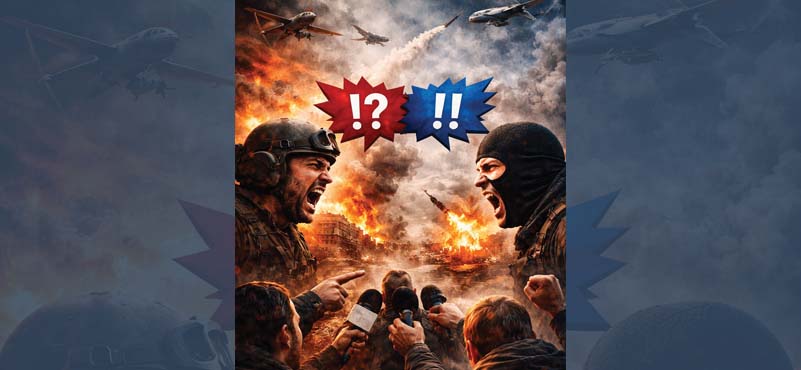
It’s my truth versus yours, a battle of narratives. While drones fly, and missiles hit targets, conversations become short and crisp, the more stirring the better, the louder the better, where ‘honesty’ of purpose is left undefined, to each his own.
The War of Narratives
Truth reaches its breaking point in war. The ongoing Israel–U.S.–Iran conflict is a laboratory of filtered narratives, contradicting claims, and digital illusions. When the first U.S. airstrikes struck Iranian soil in early 2026, the official story was that Tehran posed an imminent nuclear threat. Yet diplomatic cables revealed that Iran had just agreed to downgrade uranium enrichment under a new inspection regime. Far from the brink of doom, negotiations were inching toward stability.
Still, the missiles flew. The justification appeared not in a press briefing but, fittingly, on Truth Social: declarations of “credible intelligence,” “imminent danger,” “decisive leadership.” Within hours, independent analysts were asking where this intelligence came from. None of it was ever fully shown. The machinery of justification moved on without evidence—it was truth by assertion, my assertion and not yours, the two shall never meet!
Then the claims multiplied. President Trump alleged that Iran had “launched Tomahawk missiles at our regional allies”—even though Iran has never possessed U.S.-made Tomahawks. The statement raced through news cycles before experts could refute it. CNN’s fact-checkers later found no supporting intelligence. It didn’t matter. Once a lie is retweeted enough, it graduates into belief.
As historian Timothy Snyder observes, authoritarianism begins not with censorship but with flooding the zone with nonsense, until people stop believing anything at all. The new fog of war is not weather; it’s deliberate design.
 The Precedent of Iraq
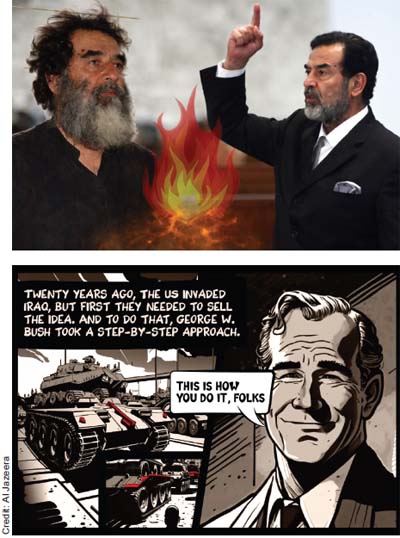
Was this the first time that such a discourse panned out in full public glare? We have seen this pattern before. The 2003 invasion of Iraq was justified by the phantom of “weapons of mass destruction.” Intelligence was partial and contested; inspectors asked for more time; no WMDs were ever found. Yet the phrase carried moral force. It condensed fear, righteousness, and vengeance into three potent letters. Once released, it could not be withdrawn without political collapse. Thus, an entire war was constructed on a linguistic infrastructure of half-truths.
The cost was immeasurable: hundreds and thousands’ dead, millions displaced, and the eventual confession that the central premise was false. The apology came, but history did not reset. Truth, once spent, is never fully recovered.
Manufactured Uncertainty
Today, digital technology elevates that old propaganda into fine art. During the Iran attacks, recycled footage from unrelated conflicts circulated under fresh labels—entirely AI-generated “breaking news” clips, complete with fictional reporters and blazing visuals. They appeared, trended, and vanished before fact-checkers could catch up. The deliberate overproduction of competing truths ensures one outcome: paralysis.
Who started the war? Who first decided the U.S. could strike? The origin dissolves in the noise. In an ocean of fragments, no single fact can float for long. It is my truth against yours, some change into beliefs while some started in hopes and aspirations.
 Power and Amnesia
When truth becomes inconvenient, it quietly recedes behind “security classifications” or “ongoing investigations.” Leaders move on; journalists chase the next spectacle. Accountability fades until the falsehood seems almost innocent—a product of “the moment.” What happened last is just gone, faded past memory. There is not even an inkling of remorse. Sadly, it is now accepted, that truth will become the first casualty in wars, and do not rely on anything you hear or see. What is worse, even when war is done with, you will then, too, never know.
The pattern follows a similar ritual: an outrage, a lie, an exposure, then amnesia. Each cycle wears down the moral muscle that once distinguished a democracy from its deceivers. Truth, meanwhile, becomes time-bound, valid only until the next claim overwrites it.
The Corporate and Cultural Versions
Governments aren’t alone in editing reality. Corporations brand their own moral universes. Oil giants talk of “clean energy futures” while expanding drilling. Tech companies insist they “connect the world” while monetizing division. Fashion houses proclaim “ethical sourcing” while subcontracting to sweatshops.
These are not outright lies; they are narratives of selective truth—crafted fictions that make conscience compatible with consumption. In personal life, we do the same: Instagram smiles that conceal despair, curated feeds that replace reflection with performance. We live in a marketplace of moral cosmetics.
Language becomes the Camouflage
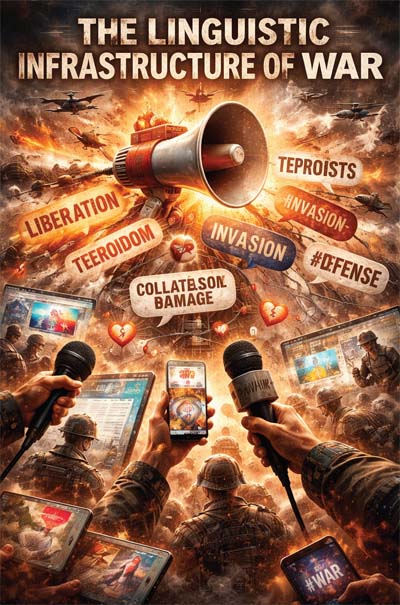
Even the language of governance has become euphemistic armour. Civilian deaths are “collateral damage.” Torture is “enhanced interrogation.” Domestic spying is “data collection.” Each phrase wraps violence in vocabulary designed to sound responsible. George Orwell anticipated this when he wrote that political language exists “to make lies sound truthful and murder respectable.” We no longer invent new truths; we rebrand old lies.
Diplomacy and the Shared Fiction
International diplomacy often maintains peace through managed illusion. Allies overlook abuses to preserve “stability.” Ceasefires are declared around fictions everyone agrees to pretend are facts. Pakistan, for instance, now casts itself as a potential mediator between Iran and the West—a remarkable claim for a nation teetering on economic collapse. Yet even this performance gains traction, because credibility itself has become performative. Appear moral long enough, and morality will be inferred. A recent report said that at a Board of Peace meeting, a deal was struck on the sidelines: the two governments, that of the US and Pakistan, will jointly run a Pakistan owned hotel in central New York, a property that till recently had been flagged by the Trump administration, as home to terror.
The Moral Irony
Every party in this global theatre insists on its righteousness. Western governments claim to defend democracy; religious regimes claim divine justice. Each side swears that truth and morality march together—that their cause is the truthful one, often the only one, because it is the moral one. But morality without truth becomes absurd, and truth without morality becomes hard to digest. Modern politics manages to mix both, a blend that narrows any possible divide.
The tragedy is not only that truth dies in war; it dies in peace as well, quietly, through spin, convenience, and exhaustion. The more loudly each faction proclaims its sincerity, the more we should suspect the editing behind it. Is this also the face of money power, or orchestrated muscular power of governments that can cobble support easier? Is then the truth also favouring the rich, the ‘haves’ instead of the more needy? Then, is it a given that truth will favour those in power, the rich and the powerful.
Toward a Modest Truth
Perhaps truth has not vanished but retreated into smaller, humbler forms. It survives in verified reporting, in citizens who double-check before sharing, in scholars who publish evidence rather than slogans. It exists wherever someone risks being unpopular for saying what is plainly so.
Truth today demands courage rather than certainty. It is no longer a universal monument; it is a daily practice of resistance against noise. If there was a Statue of Liberty, was it that virtue that exists, one that we extol, or one that is long gone and we salute an era behind us. Should there be a Statue of Truth?
We live in an age that worships information yet distrusts facts, an era when every click can rewrite the world. But one principle remains: every war, every cover-up, every manipulation begins not with missiles or money, but with a story. The battle for truth, then, is not academic—it is political, moral, and existential.
For the present, it is my truth versus yours! And nobody knows the truth, even when voiced over Truth Social, because that too can either be the truth or just social chatter. Once truth has become just another narrative, nothing that matters can matter for long. Like life, truth is that fleeting moment, and nothing more!
ABOUT THE AUTHOR
 Navin Berry, Editor, CS Conversations, over five decades has edited publications like CityScan, India Debates and Travel Trends Today. He is the founder of SATTE, India’s first inbound tourism mart, biggest in Asia.
Blogs at: https://www.csconversations.in/nb-blogs