
If Iran does emerge as the dominant power in West Asia, India will not find itself in an easy position of advantage. The temptation is to interpret the shift as an opportunity—another pole, another counterweight, another route westward, finally opening up. But that is too simple a conclusion for a region that rarely behaves in straightforward ways.
Power here does not simplify; it complicates. A stronger Iran will act accordingly. It will push, test, and expand its influence. That much is predictable. What is not predictable is how far it chooses to go and how others react when it does. For India, that uncertainty matters more than the rise itself.
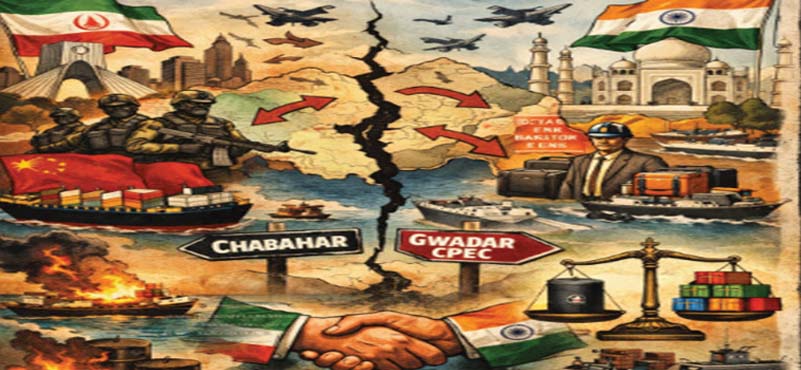
 There is an obvious starting point: geography. Iran is located exactly where India has long needed access. For decades, Pakistan has blocked India’s land route to Afghanistan and Central Asia. Iran provides a way around this. Chabahar was never just about a port; it was about overcoming a barrier that had constrained India’s options for years.
New Delhi has maintained that stance despite sanctions, slow progress, and shifting alignments. That persistence is deliberate. It shows a clear understanding that once access is gained, it generates its own influence over time. If Iran becomes more powerful and stays open to trade and transit, that access could start to produce benefits that have so far been out of reach.
But geography is just the beginning. It opens doors but doesn’t determine who walks through them or what happens next. A more powerful Iran will not only enable connectivity but will also look outward. It already does, and with greater capacity, that drive will only increase. Influence in West Asia is rarely quiet or contained. It invites pushback, attracts rivals, and creates pressure points that extend far beyond immediate borders.
This is where the comfort ends. India’s interests in the region are not abstract; they are connected to stability, steady energy supplies, secure sea lanes, and a conducive environment for millions of Indians living in the Gulf. These are non-negotiable interests; they are fundamental.
A more assertive Iran, especially one engaged in a prolonged rivalry with its neighbours, complicates all of them. Take the Strait of Hormuz. It does not need a full-blown crisis to be disrupted. Even a hint of tension can increase freight costs and raise insurance rates. Oil markets react swiftly. For India, those movements are not distant signals; they directly translate into economic pressure.
That is the immediate risk. The longer-term concern is more structural. Iran is no longer acting solely on its own terms. China has advanced steadily, both economically and politically, now with a clearer strategic purpose. This is not a loose or temporary alliance; it is becoming an integral part of the system.
That alters the nature of Iran’s rise. If Tehran’s growing influence is linked, even partly, to Beijing’s support, then it will not act as an independent balancing power. Instead, it will operate within a broader framework that India neither controls nor can easily influence. That is a completely different situation.
Chabahar illustrates the dilemma. It was established as an alternative to bypass routes linked to Pakistan and China. However, if Iranian infrastructure gradually aligns with Chinese interests, that distinction becomes less clear. India might find itself invested in a corridor it uses but cannot influence, leaving it vulnerable to uncontrolled access. India has experienced this situation before. It is a concern for any nation that values strategic independence.
There is also a tendency to underestimate the human and economic risks. The Gulf is not just an arena of competition; it is a lifeline for millions of Indian workers. Their earnings support families back home. Their presence relies on a stable regional order.
Any sustained escalation involving Iran, direct or indirect, puts that stability at risk. Evacuations, job losses, and falling remittances are not hypothetical scenarios. India has dealt with them before. It will again if the region tips into prolonged tension.
Energy markets would respond just as swiftly. India’s reliance on imported oil provides little cushion. Even moderate disruptions tend to ripple through the economy. So the question is not whether India gains from Iran’s rise. The real question is whether India can accept the kind of region this rise creates.
A weak Iran is not the solution. That leads to its own issues, such as external interference, internal instability, and the risk of sudden collapses that affect neighbouring regions. However, an overly dominant Iran, especially one that overextends or relies too much on external alliances, presents a different set of challenges.
India neither needs extremes. It requires balance—an Iran strong enough to act independently yet restrained enough to avoid overreach. Though narrow, this approach is the most practical. Such an Iran could help prevent the region from tilting too far in any direction. It would preserve space for trade, diplomacy, and flexibility, which India has relied upon.
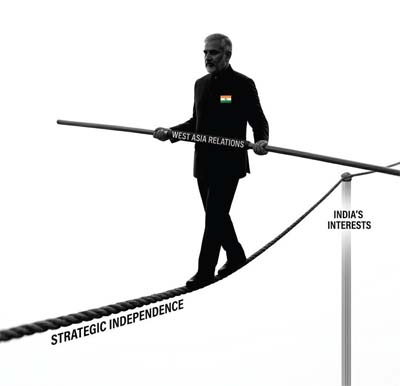
For years, India has successfully engaged across divides in West Asia, maintaining relations with countries that do not easily cooperate. It has avoided becoming fully involved in rival camps. Although this has not always been simple, it has been effective.
A more influential Iran could complicate that balancing act. As power centralises, expectations increase. Maintaining neutrality becomes more challenging. The pressure to adopt clear and public positions grows over time.
India has so far resisted that pull. It may not be able to do so indefinitely. There is also a need for caution in how India approaches its own investments. Chabahar is important, but it cannot become the focus of a single-track strategy. Overcommitment in a region as fluid as West Asia carries risks that are easy to underestimate.
India’s approach has to remain spread, across routes, partners, and options. That is not hesitation, it is prudence.
Ultimately, Iran’s rise is something India cannot prevent, nor is it something to accept uncritically. It is a development that must be managed carefully and without illusions. Not every shift in the balance of power creates opportunities; some bring new constraints that are less obvious at first but more difficult to handle over time.
India’s priorities remain clear enough: stability in the region, reliable access, and the ability to work with multiple partners without being boxed into someone else’s contest.
If Iran’s rise supports those objectives, it can be accommodated. If it begins to work against them, India will have to adjust, quietly, without overreaction, but with intent.
West Asia rarely offers clean outcomes. It offers trade-offs. Power here always comes with consequences. The challenge for India is to ensure that it is not left carrying the wrong ones.
ABOUT THE AUTHOR
 Lieutenant General A B Shivane, is the former Strike Corps Commander and Director General of Mechanised Forces. As a scholar warrior, he has authored over 200 publications on national security and matters defence, besides four books and is an internationally renowned keynote speaker. The General was a Consultant to the Ministry of Defence (Ordnance Factory Board) post-superannuation. He was the Distinguished Fellow and held COAS Chair of Excellence at the Centre for Land Warfare Studies 2021 2022. He is also the Senior Advisor Board Member to several organisations and Think Tanks.