Air Strikes
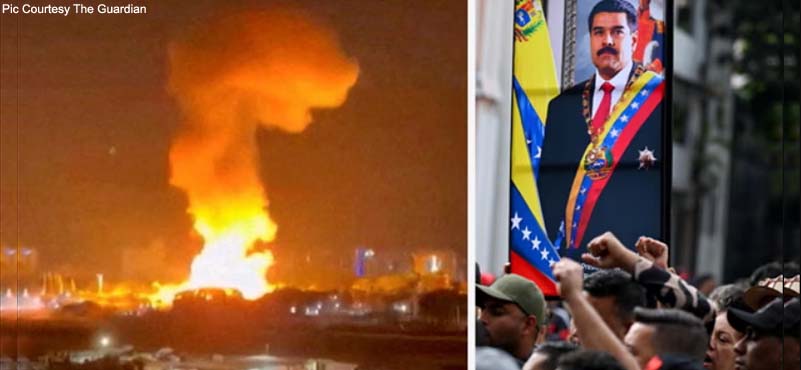
The night of 16 March 2026, saw a sharp escalation in tensions between Afghanistan and Pakistan, as a result of a Pakistani air strike on the Omid Drug Rehabilitation Centre, in Kabul. The incident comes amidst a global crisis, with the war involving Iran, USA, and Israel, thus adding pressure to an already volatile neighbourhood.
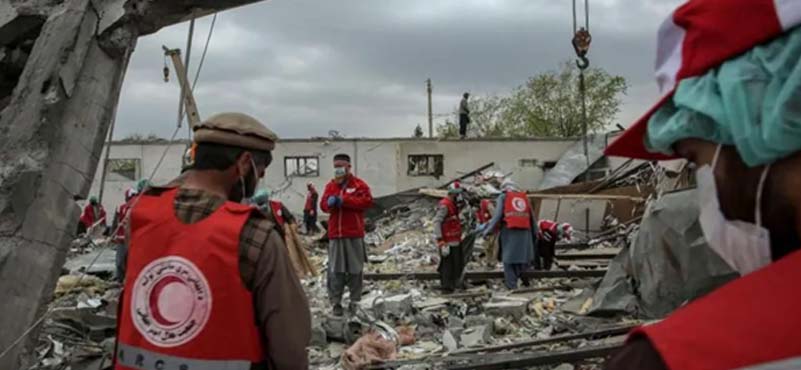
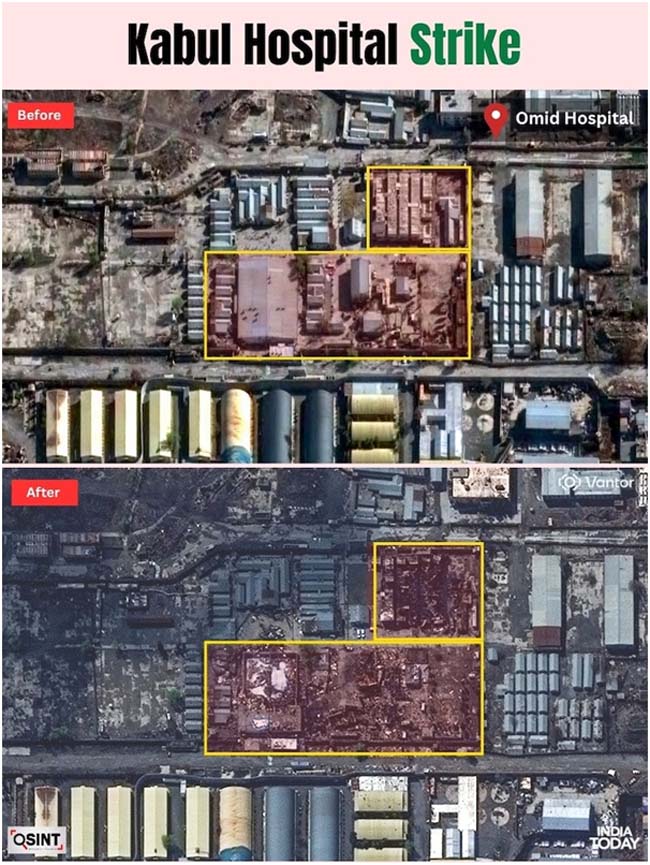
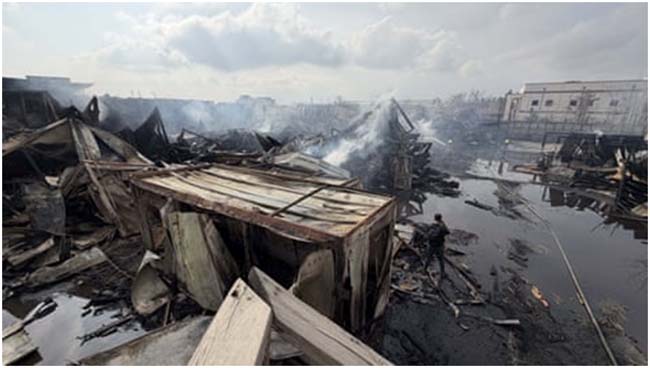
In a post on X, Afghanistan’s Deputy Government spokesperson Hamdullah Fitrat said the airstrike had hit the hospital in Kabul at about 9 pm local time, destroying large sections of the 2,000-bed facility. He said the death toll had “so far” reached 400 people, with around 250 reportedly injured.
Sharafat Zaman, the Taliban’s Health Ministry Spokesperson, said there were about 3,000 patients in the state-run Omid Drug Rehabilitation Centre at the time of the strike. He also said that there were no military facilities near the rehabilitation centre. Local television stations posted footage of firefighters struggling to extinguish flames among the ruins of a building.
While Pakistan rejected the accusation, insisting its strikes targeted militant infrastructure and not civilians. In a post on X, Pakistan’s Ministry of Information said, Monday night’s strikes were “precisely targeted military installations and terrorist support infrastructure including technical equipment storage and ammunition storage of Afghan Taliban, as well as Afghanistan-based Pakistani militants in Kabul.”
India has “unequivocally” condemned the strikes calling it a “cowardly and unconscionable act of violence.” The statement states the strike “can by no means be justified as a military target,” adding that Pakistan is “now trying to dress up a massacre as a military operation.”
Open War
Pakistan has been the Afghan Taliban’s closest friend for decades. It was Islamabad that helped give birth to the Taliban in the early 1990s, to give Pakistan “strategic depth”. But Pakistan and Afghanistan have had a strained relationship since the Taliban returned to power in 2021. Today ties have snapped.
The strike is an escalation of a conflict that began between the two countries in the last week of February and has witnessed a series of cross-border clashes in addition to airstrikes inside Afghanistan. The fighting began after Afghanistan launched cross-border attacks in response to Pakistani airstrikes inside the country, which Kabul claimed had killed many civilians. Pakistan’s Defence Minister said last month the escalating tensions between the two Islamic neighbours amounted to an “open war”.
Later in February, Pakistan carried out multiple air strikes on Afghanistan’s major cities. Air and ground strikes which hit Taliban military posts, headquarters, and ammunition depots in multiple sectors along the border. At least 75 people have been killed and 193 injured in Afghanistan, as a result of continuing cross-border fighting between the countries since 26 February, according to the United Nations Assistance Mission in Afghanistan (UNAMA).
Earlier, border clashes between the two countries killed dozens of soldiers in October last year, until negotiations facilitated by Turkey, Qatar, and Saudi Arabia ended the hostilities and a fragile ceasefire was put in place.
The latest violence comes after a brief period of de-escalation driven in part by diplomatic efforts by China, who urged both sides to return to the negotiation table. According to reports the Chinese Foreign Minister Wang Yi, spoke to his Afghan and Pakistani counterparts over the phone in the past week; Calling for a ceasefire “at the earliest opportunity”, he urged the two countries to “remain calm and exercise restraint [and to] engage face to face ASAP.”
Responding to the escalating tensions, Chinese Foreign Ministry spokesperson Lin Jian said, Beijing hopes that both sides will avoid further conflict and pursue dialogue. He said; “Dialogue and negotiation are the only viable ways to resolve issues between the two countries.”
That momentum now appears to have collapsed. The renewed fighting, just days before the Eid al-Fitr, underscores how fragile the ceasefire environment was and how quickly tensions can resurface.
The Fault Lines
Few borders in the world carry as much history and tension as the one between Pakistan and Afghanistan. Stretching roughly 2,600 kilometers, the Durand Line was drawn in 1893 during British colonial rule has always remained a point of contest. While Pakistan recognizes it as the official international border, successive Afghan governments have historically disputed it, arguing that it divided Pashtun tribal regions that had long been connected culturally and geographically.
The relationship between Afghanistan and Pakistan has always been difficult since the time of the founding of Pakistan, when Afghanistan at first had voted against admitting Pakistan as a member of the United Nations. The Soviet invasion changed the relationship as Pakistan supported the Taliban.
Relations between the two countries remain complex and are shaped by security concerns, cross-border militancy, refugee movements, and economic ties. At the same time the border region itself remains deeply interconnected. Communities on both sides share languages, tribal affiliations, and centuries of cultural ties that predate modern state boundaries. While political borders can divide territory, they rarely erase the historical bonds between the people who live there.
But the present conflict with its unprecedented intensity is the worst to break out between the former allies. Relations began to fray over the Afghan Taliban’s alleged role in giving a safe haven and sponsorship to radical militants, particularly the Pakistan Taliban, that have been responsible for a surge in deadly terrorist attacks in Pakistan. Afghanistan’s Taliban government have denied any involvement in cross-border terrorism in Pakistan.
At the core of the present dispute lies a long-standing disagreement over militancy. Pakistan accuses Afghanistan of providing safe haven to armed groups that carry out cross border attacks. Afghan authorities deny this, arguing that militancy within Pakistan is a domestic issue.
The Pakistan Taliban or TTP emerged in 2007. Increasingly positioning itself as the protector of the ‘Pashtun tribal nation’ against ‘Punjabi imperialism,’ it has blended jihadist rhetoric with ethno-nationalist appeals to boost recruitment.
This unresolved tension has repeatedly triggered military responses. Pakistan’s air strikes are framed as counterterrorism operations, while Afghanistan views them as violations of sovereignty and attacks on civilians.
The absence of a shared framework for addressing these concerns means each incident risks spiraling into broader confrontation, as seen in the current escalation.
China has attempted to play a mediating role in the conflict. Last week, they dispatched a special envoy to the region to try to ease tensions and bring the two parties back to the negotiating table, but without success.
A Tale of Narratives
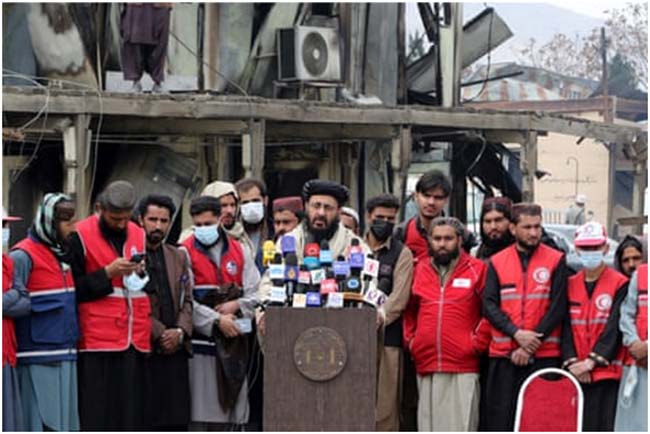
At the centre of the crisis there are also two sharply opposing versions of events. Afghan authorities say the strike hit a large civilian medical facility, causing mass casualties and widespread destruction. Eyewitness accounts describe scenes of devastation, with fires engulfing buildings and victims trapped under rubble. The accounts from survivors point to a worsening humanitarian situation, with rescue efforts ongoing and fears that the death toll could rise further.
Pakistan, by contrast, maintains that the operation was precise and aimed at militant targets. Officials point to secondary explosions as evidence that the site housed ammunition or militant infrastructure rather than purely civilian functions. But Pakistan’s narrative is expected as it has a tryst with falsifying facts.
For Afghanistan, highlighting civilian casualties serves both a domestic and international purpose, drawing attention to sovereignty violations and seeking external pressure on Islamabad.
There is no doubt that the strike on the hospital represents a serious escalation with significant legal and humanitarian implications. Hospitals occupy a protected status under international law and the strike on such a facility will intensify scrutiny on Pakistan’s conduct.
Divergence is not unusual in modern conflict, but the scale of the alleged casualties and the nature of the target make this episode particularly sensitive. The reported scale of casualties has drawn concern from international observers. Richard Bennett the UN Special Rapporteur on the human rights situation in Afghanistan, called for restraint and emphasised the need to protect civilians and civilian infrastructure.
For Pakistan, the challenge lies in balancing its security objectives in the face of international backlash.
Pakistan had a free hand to meddle in the domestic politics of Afghanistan for years during the American occupation, with Pakistani intelligence (the Inter-Services Intelligence, ISI) playing all sides to its own advantage. However, today, relations with its former proxy have deteriorated to a degree where Pakistan’s declaration of “open war” suggests more significant military action could be on the table.
Another issue for Pakistan, is India’s relations with the Taliban after its return to power. India has adopted a more pragmatic approach, seeking to exploit the opportunities now offered by deteriorating Afghan-Pakistan relations, including reopening its embassy in Kabul in October 2025 and strengthening economic ties. Pakistan feels that Afghanistan is its backyard and resents India’s outreach. As per Christophe Jaffrelot, “Pakistan fears being caught in a pincer movement between Afghanistan and India. This fear remains a factor in Islamabad’s attitude towards Kabul and largely explains the strikes in Afghanistan in recent months.”
For Afghanistan it is the worst time ever. Afghanistan’s economic position is at its weakest in years, hemmed in from two directions simultaneously. The trade corridor through Iran is losing steam because of the ongoing war, while on the other side the border with Pakistan is closed. Kabul is caught in an economic quagmire.
Almost half of Afghan imports come through Iran, including Indian goods through Chabahar. On the Pakistani side, border closures at Torkham and other crossings have halted an estimated 35 to 40 percent of Afghanistan’s total trade. If the situation does not improve millions of Afghans will face acute food insecurity in 2026.
Afghanistan must work on opening northern trade corridors through Central Asia to reduce dependence on Iran and Pakistan.
Where are we Headed?
Not too long ago, one can vividly recall crossing military hospitals, in any cantonment, displaying their characteristic green paint, with slanting roofs, that flashed a white circle with a red cross in the centre of it. That was the protocol. An accepted norm across the world, that leave these buildings alone. Under international humanitarian law, attacks on hospitals and medical facilities are prohibited regardless of circumstance. So, even in a war that is centred around death and destruction, there was a silver lining, a lining of humanity. Where has that humanity gone? When the strategy was aimed at neutralizing militants, how does the bombing of a rehabilitation hospital get justified?
In this year alone, there have been four distinct incidents, that have shaken up the very ethics of war.
Firstly, on 26 February 2026, Iranian and American negotiators concluded what Iran’s Foreign Minister, Abbas Araghchi, described as the most intense rounds of talks, and agreed to reconvene in Vienna, the following week. Both sides said progress had been made. The bombs fell two days later, decapitating Iran.
Secondly, on 28 February 2026, a missile struck the Shajareh Tayyebeh Girls’ Elementary School in Minab, Iran. As per reports, between 165 and 180 people were killed. The majority were girls aged seven to twelve.
Thirdly, in the early hours of 04 March 2026, a torpedo hit and sank the Iranian Naval Ship IRIS Dena, killing close to 100 sailors. The ship was in international waters about 20 nautical miles South West of Galle, Sri Lanka. She was on her return voyage to Iran after participating in MILAN 2026, a multinational naval exercise hosted by the Indian Navy, at Visakhapatnam.
Fourthly, in night of 16 March 2026, Pakistan, carried out an air strike on the Omid Drug Rehabilitation Centre, in Kabul, killing over 400 patients.
The US Secretary of Defence, Pete Hegseth said, the war is not an effort to build democracy in Iran. “No stupid rules of engagement, no nation-building quagmire, no democracy-building exercise, no politically correct wars. We fight to win and we don’t waste time or lives.”
The above episodes and the statement of Pete Hegseth reflect that the very nature of war has changed. We are headed back to barbaric times.
Conclusion
Today, as the US and Israel are rearranging the international system to a design that suits their interests, Pakistan has sensed this as an opportunity to settle scores with their protégé as the world’s attention was fixed elsewhere.
Pakistan now appears intent to keep hitting targets in Afghanistan and the Taliban determined to retaliate with operations on Pakistani border posts and potentially with asymmetric tactics from launching drones to sponsoring militant attacks in Pakistan. Pakistan is being tested by the very jihad it initiated and the jihadis it nurtured.
While on paper, there is a wide mismatch between the military capabilities of both sides, but history has shown that Afghanistan has been a graveyard of the countries that invaded or occupied it, be it the British Empire, the Soviet Union, or more recently the US. Hence despite its overmatching military power Pakistan cannot assume victory over Afghanistan.
The broader concern is that this bilateral conflict is unfolding within a region already under strain. With overlapping crises and limited diplomatic bandwidth, the risk is not just continued fighting but deeper instability across the region to include India and West Asia.
What happens next will depend on whether external actors can revive mediation efforts and whether both sides see value in restraint. For now, the trajectory points in the opposite direction, toward further escalation and entrenched mistrust. Greater destabilisation in an already volatile region does not bode well.
Where is this world heading? Why so much hatred? There is a message for each one of us. Is this a time to keep quiet and look the other way? Do we not have any obligation towards humanity?