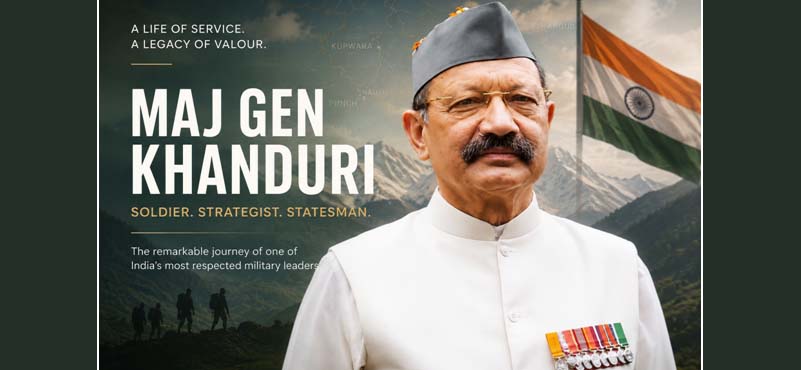
There are some men whose achievements can be measured in offices held, ranks attained, or projects completed. And then there are rarer men whose true legacy lies in the trust they inspire. Major General Bhuwan Chandra Khanduri belonged unmistakably to the latter category.
Soldier, Engineer, Parliamentarian, Chief Minister, Union Minister — these were merely the appointments of his long public life. The deeper essence of the man lay elsewhere: in discipline without arrogance, authority without spectacle, and integrity without compromise.
He came from the mountains of Garhwal, and perhaps he carried something of the Himalayas within him — austere, unshakeable, and quietly commanding. In both the Army and public life, he represented a generation that believed duty was sacred and public office was a responsibility, not an entitlement.
Before India came to know him as the architect of highways and governance reforms, the Army knew him as a professional soldier-engineer of exceptional standing. Those who served under him or alongside him remember not merely his rank, but his standards. He belonged to that tradition of military leadership where personal example mattered more than rhetoric.
He expected competence, clarity, and honesty — first from himself, then from others.
As a young officer, I experienced that quality in a deeply personal way. Immediately after Operation Trident, I was detailed for a month-long course at CME, Pune. I worked hard and eventually topped the course. Once we returned to Meerut, I received a demi-official letter from Major General B C Khanduri, who was then Chief Engineer, Central Command. For a young officer, that letter was no routine communication. It felt like a decoration.
Senior officers often issue commendations through formal channels, but a personal note carries something more enduring — encouragement. That gesture revealed an important aspect of Gen Khanduri’s leadership: he noticed merit. He understood that institutions are strengthened not only through systems and structures, but also through timely recognition of young officers striving to excel.
I preserved that letter carefully for decades.
Years later, in 2015, our paths crossed briefly for the first and only time. By then, he had already become a national figure — former Union Minister, former Chief Minister of Uttarakhand, and among the most respected public personalities to emerge from the Armed Forces. He visited CME as Chairman of the Parliamentary Standing Committee on Defence along with other committee members. At that time, I was serving as Brigadier and Commander Faculty of Combat. The Commandant detailed me to conduct the delegation through the training areas and facilities, including the Army Rowing Channel — among the largest man-made rowing channels in Asia.
During the interaction, I mentioned that long-forgotten DO letter written to me in 1987. What followed remains etched in memory. Gen Khanduri broke into warm laughter — genuine, joyous, almost boyish. For a brief moment, the layers of rank, office, and public stature disappeared, revealing instead the deeply human core of the man. He was delighted not because he had written the letter, but because a small act of encouragement had remained meaningful to someone across nearly three decades.
That moment explained him better than any political biography ever could.
Public life, unfortunately, often corrodes simplicity. Yet Gen Khanduri managed something exceedingly rare in India’s political landscape — he carried the discipline of the Army into democratic governance without losing humility. Even his critics acknowledged his personal honesty.
India has seen soldiers enter politics before. But very few carried military integrity into public life as convincingly as Maj Gen B C Khanduri. The journey from commanding troops to guiding democratic institutions is not easy. Yet he moved from the Army to the Union Cabinet and the Chief Minister’s office without ever appearing transformed by power itself.
As Union Minister for Road Transport and Highways under Prime Minister Atal Bihari Vajpayee, he emerged as one of the principal drivers of India’s highway transformation. The Golden Quadrilateral and the ambitious expansion of national highways altered India’s economic geography permanently. Roads ceased to be merely engineering projects; they became instruments of national integration, mobility, commerce, and confidence.
Millions travel daily on highways whose origins trace back to that vision, often unaware of the man behind them. But perhaps infrastructure alone does not fully define his contribution. Many build roads. Far fewer build credibility.
As Chief Minister of Uttarakhand, Gen Khanduri acquired a reputation for probity that stood out sharply in an era increasingly cynical about politics. He reduced extravagance in governance, insisted on administrative accountability, and attempted to restore seriousness to public office. There was little theatrical populism about him.
He governed more like a commanding officer entrusted with responsibility than a politician chasing applause.
That approach sometimes made him appear stern, even uncompromising. But nations ultimately depend upon such individuals — people who place standards above convenience. In retrospect, Gen Khanduri represented a bridge between two Indias: the India of sacrifice and the India of aspiration. He understood both border roads and national highways; both military discipline and democratic complexity. Perhaps that synthesis explains why he commanded respect across institutions.
Today, India moves rapidly toward modernity, ambition, and global stature. Yet amid this acceleration, figures like Major General B. C. Khanduri remind us of something essential: development without character is fragile. Asphalt and concrete can connect cities, but only integrity can connect citizens to institutions.
He belonged to a generation that spoke less and served more. A generation that believed leadership was not performance, but responsibility. And perhaps that is why his memory endures with such quiet dignity.
Not merely as a General.
Not merely as a Chief Minister or Union Minister.
But as a rare public servant whom people instinctively trusted.
India still builds highways. But it rarely produces public men of his character anymore.
ABOUT THE AUTHOR
Lt Gen Rajeev Chaudhry (Retd) is a social observer and writes on contemporary national and international issues, strategic implications of infrastructure development towards national power, geo-moral dimension of international relations and leadership nuances in changing social construct.