

When Books Ruled the Mind
There was a time when books occupied a place of quiet authority in human life. They rested beside pillows, travelled in cloth bags during long railway journeys, and stood proudly on wooden shelves in homes where knowledge was respected more than display. A child entering a library felt a strange reverence. A gifted book carried emotional weight. A second-hand bookstore could become an entire universe for a curious mind. Earlier generations possessed fewer books, but often deeper relationships with them.
Books were not merely sources of information; they were companions. In lonely hostels, remote government quarters and military barracks, a good book often became a conversation partner. One remembers elderly teachers underlining passages with fountain pens, readers folding page corners carefully, and fathers rereading the same treasured novel every few years as though meeting an old friend again.
Across civilizations, books preserved humanity’s intellectual inheritance. In India, wisdom travelled through oral traditions before finding permanence in scriptures, epics, poetry and philosophy. Long before the internet connected the world digitally, books connected generations spiritually and intellectually.
Reading also shaped temperament. It taught patience before society became addicted to speed. It cultivated concentration before human attention fragmented into endless notifications. A serious book demanded participation. Unlike modern visual media that delivers ready-made imagery instantly, books required imagination. The reader had to construct worlds internally.
Silence did not feel empty then. It felt fertile. Today, however, that silence struggles to survive.
The Publisher’s Paradox
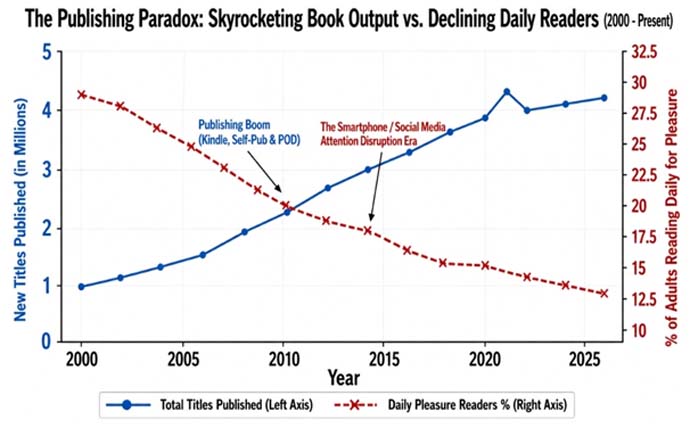
Never in history have so many books been written, published and sold. Yet never has sustained reading faced such a crisis of attention. This is the Publisher’s Paradox.
Every year millions of new titles enter the global market. Self-publishing platforms have democratized authorship. Digital printing has reduced costs dramatically. Artificial intelligence assists drafting, editing and summarizing. Publishing barriers that once seemed insurmountable have collapsed almost entirely. And yet, deep readers appear to be declining.
The paradox is striking: the supply of books is rising while the supply of attention is collapsing.
Modern publishers no longer suffer from shortage of manuscripts. They suffer from shortage of uninterrupted minds. Books today are not competing merely against other books. They are competing against social media feeds, streaming platforms, gaming ecosystems, algorithmic entertainment and an endless flood of digital stimulation. A nineteenth-century novel once competed for a reader’s evening. Today even a brilliant book competes against thousands of distractions arriving every hour through screens.
The consequences are visible everywhere. Many people buy books enthusiastically but struggle to finish them. Bookshelves expand while attention spans shrink. Reading increasingly becomes aspirational rather than habitual. This does not mean intelligence has declined. It means attention has become fragmented.
The modern citizen consumes enormous quantities of text daily—messages, captions, headlines, emails, comments and posts. Yet much of this reading is rapid, shallow and disposable. The mind moves continuously but rarely settles deeply.
Civilizations do not decline because people stop consuming information. They decline when they lose the ability to contemplate meaning patiently. That perhaps is the hidden anxiety beneath the Publisher’s Paradox.
From Typewriters to AI: Industrialization of Writing
The journey from typewriters to artificial intelligence tells the story of writing becoming progressively faster.
The typewriter mechanized writing. Computers simplified editing. Laptops liberated work from desks. Smartphones transformed every individual into a potential publisher. And now AI systems such as OpenAI can generate outlines, summaries, essays and even books within astonishingly short periods.
This transformation carries extraordinary possibilities. Voices once ignored can now reach audiences directly. Regional writers, independent thinkers and niche experts no longer depend entirely on traditional publishing gatekeepers. Knowledge has become decentralized. Yet every technological revolution carries unintended consequences.
The acceleration of writing risks outpacing the maturation of thought itself. Earlier, a manuscript demanded patience—drafts, revisions, reflection and time. Today the pressure of digital culture rewards immediacy. Books are often launched rapidly to capture trends before public attention shifts elsewhere. The result is an overwhelming abundance of content.
Thousands of books now appear every week. Some are profound, many are repetitive, and countless others are produced primarily to satisfy algorithms rather than readers. The challenge of the future may therefore not be access to knowledge, but discernment.
Earlier generations searched desperately for books. Future generations may search desperately for authenticity.
Artificial Intelligence will undoubtedly shape the future of reading and writing. Readers may increasingly use AI to discover books, summarize difficult passages and organize ideas. Writers may use it as a creative assistant. But wisdom itself still resists automation. For meaningful literature is not assembled mechanically. It emerges from lived experience, suffering, memory, contradiction and reflection.
Technology may accelerate expression. It cannot replace depth.
Do People Still Read? Yes — But Differently
Despite frequent complaints, humanity has not stopped reading. It has simply changed the way it reads.
Young generations consume blogs, newsletters, fan fiction, online essays, digital articles and discussion forums daily. Professionals increasingly read PDFs instead of printed reports. Students annotate online textbooks. Platforms like Kindle have turned entire libraries into portable devices. Meanwhile, audiobooks through platforms such as Audible allow people to listen while driving, walking or travelling. Humanity has not stopped reading; it has stopped lingering.
There remains a profound difference between reading for stimulation and reading for transformation. Short-form digital content trains the brain to expect novelty every few seconds. Deep reading trains endurance. A serious book asks the reader to remain inside complexity without immediate gratification.
That is why printed books continue retaining emotional power. A physical book creates intimacy impossible to fully replicate on screens. Margins carry notes, pages preserve memory, and shelves become biographies of the reader.
I once met a retired army officer carrying a heavily worn novel during travel. Its pages were filled with annotations accumulated over decades. When asked why he repeatedly returned to the same book, he smiled and replied, “Because every time I read it, I discover a different version of myself.” Good books do not merely provide information. They deepen self-understanding. And perhaps that explains why books continue surviving every prediction of extinction.
“Book Brigade” and the Revival of Reading Culture
Interestingly, just as attention spans appear to weaken globally, a quiet counter-movement is emerging across societies to revive the culture of reading.
Libraries are reinventing themselves as community spaces rather than silent archives. Literary festivals attract enormous crowds. Independent bookstores and book cafés are making unexpected comebacks. Schools are reintroducing dedicated reading hours. Parents increasingly worry about screen addiction and consciously encourage children toward books.

Across cities worldwide, silent reading clubs invite strangers to gather simply to read quietly together for an hour. Community libraries are emerging in villages and small towns. Even digital platforms now host passionate reading communities discussing literature with remarkable seriousness. This reveals something deeply human.
Despite endless entertainment, people continue searching for reflection, depth and intellectual companionship. Screens may dominate attention, but they do not fully satisfy the deeper hunger for meaning. Perhaps the strongest resistance to distraction today comes not from technology, but from communities consciously protecting the culture of reading.
I have personally experienced this through Book Brigade, a book club initiative started in September 2024, dedicated to reviving meaningful reading habits and conversations around books. What begins as a discussion around literature often evolves into something far more significant—a rediscovery of patience, listening and thoughtful dialogue. By now collectively we have read 35 best sellers, which has enriched our minds with distilled wisdom.
Book clubs therefore perform a role far larger than they appear to. They preserve attention in an age of distraction. They create spaces where ideas are explored rather than merely reacted to. They encourage listening without shouting and reflection without urgency. In an era dominated by speed, reading itself becomes an act of resistance. That is why such initiatives matter profoundly—not merely for literature, but for civilisation itself.
For when societies stop reading deeply, they often stop thinking deeply as well.
The Battle for Human Attention
The real crisis of the modern age is not the absence of books. It is the fragmentation of attention.

The Publisher’s Paradox reveals a civilisation producing more written material than ever before while simultaneously struggling to sustain deep reading. Technology has democratised both writing and publishing, but it has also created unprecedented competition for the human mind.
The future of reading will likely be hybrid. Printed books will survive because they offer permanence and intimacy. E-books will thrive because they provide convenience. Audiobooks will expand because modern life increasingly moves in transit. Artificial intelligence will assist discovery and comprehension.
Yet none of these technologies can replace the essential encounter at the heart of reading—one mind meeting another across time through words. Books ultimately survive because human beings continue searching for meaning beyond noise.
And perhaps the future crisis will not be the absence of books, but the absence of minds patient enough to truly read them.
ABOUT THE AUTHOR

Lt Gen Rajeev Chaudhry (Retd) is a social observer and writes on contemporary national and international issues, strategic implications of infrastructure development towards national power, geo-moral dimension of international relations and leadership nuances in changing social construct.