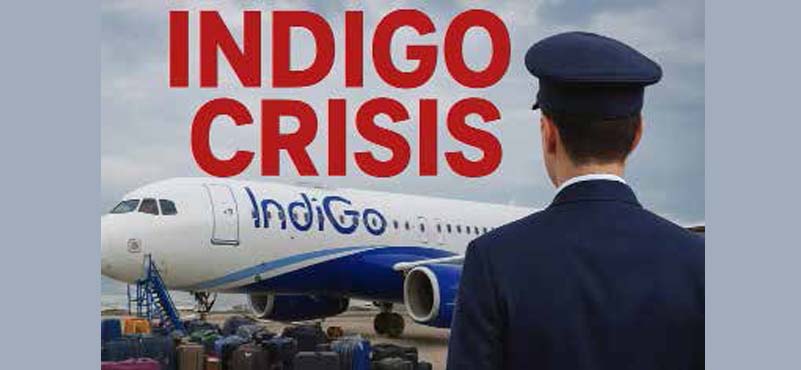
What now for Indigo and for Indian aviation? A reprieve has been granted with a 10% cut in flights schedule, till February, 2026. Meaning, the airline would have to fall in line, conforming with the FDTL rules that have been formulated, though not implemented by Indigo, yet.
India’s precious home-grown airline, an esteemed organization winning accolades across global awards platforms, hailed as one of the fastest growing LCCs in the world, one of corporate India’s leading success stories! Where the owners kept a low profile, in fact none at all, seldom seen on public forums, preferring to let their work speak for them. Institutionally driven, it served as a benchmark for profitability in an industry marred by repeated failures – it has been the only success story in our aviation world where a host of issues only served to make business difficult. Staying on course has never been easy.
India’s aviation industry remains the most taxed, globally. With high ATF charges between the centre and the states, it has always been looked upon as luxury, as the elite way to travel. That stigma has not yet gone away. Even though, it should have, long ago, as civil aviation increasingly began to be seen as simply given, air transport, just as much as road, rail and auto. All these other modes of transport have been given stimulus, in one form or the other. Not air transport, which it truly deserves.
Even as Indigo raced to a record and enviable 65% share of air traffic among Indian carriers, there were cries of dangers of the airline being a monopoly. But who creates this monopoly? The airline industry has not once attracted the big boys, not being seen as investment friendly industry, full of problems and challenged profitability. In recent years, airports have attracted money, though that has come about largely from the off-side retail and hospitality attractions, even as airport charges remain high, and unfriendly to the airlines.
Wake-up call on FDTL rules!
How much are they suited to Indian conditions? India is high-frequency, short-sector flying, Indian LCCs routinely operate 4–6 sectors per day. Do the current FDTL limits sufficiently differentiate high-cycle duty days from fewer long sectors. Infrastructure and delay environment with chronic ATC congestion, airport saturation, weather volatility, and ground delays that are structurally higher in India, which “legal” duty days into fatigue-heavy ones without formally breaching limits.
Limited operational flexibility compared to FAA/EASA systems, India’s framework offers less mature FRMS-based flexibility for high-utilisation networks. A better model would keep the stricter fatigue protections but explicitly account for sector count, delay-prone environments, and structured FRMS approvals for high-frequency networks.
Should India rethink FDTL for a highcycle aviation economy, more in keeping with realities of India’s flying patterns?
Do new FDTL rules challenge the low-cost model?
What follows for the air transport industry when its market leader with a 65% market share has to battle new flying conditions? What about Viksit Bharat, wherein air connectivity is a common thread for all industry and commerce? It is possibly the mother of all industry, in that sense, providing that vital connectivity across the length and breadth of the country?
A 5–8 (or thereabouts) per cent drop in aircraft or crew productivity can wipe out already thin margins, push breakeven load factors beyond realistic levels and force airlines to cancel frequencies rather than marginal routes. Legacy or longhaul carriers can absorb such shocks. Highcycle LCCs cannot — not because they are unsafe, but because they are optimised for efficiency in a priceelastic market.
We need intelligent regulation. Neither the United States nor Europe explicitly writes “LCCspecific” rules. But both recognise operational diversity. With considerations like bringing limits with Fatigue Risk Management Systems (FRMS), allowing flexibility under strict oversight. Europe permits sector-weighted duty calculations, earlystart and latefinish fatigue modelling, and nationally approved variations. Highfrequency airlines such as Ryanair, EasyJet and Southwest operate within these systems without recurring systemic collapse. India has adopted the restrictions, but not yet the flexibility layer. Is the answer in not exemptions or rollbacks, but differentiation.
Wake-Up Call for Indigo?
Has the airline stretched itself far too much? This little tinkering was enough to bring about the network crash? Like we have noticed in recent times, just about every compartment looked like they had little time, listening to passengers was often seen as luxury they could not afford. So much so, often they came out as rude, uncaring and arrogant. So, that part also needed to be addressed, which was going unnoticed. It is not just the pilots – salaries, one gathers, have been stagnant, with no increment since covid, if that be true? Surely, it is a moment of that inner search for the airline, to identify where their systems need that extra human touch, which we saw as the hallmark in its earlier days. Indeed, it is that rare moment for 6E to introspect, and come out the better for it.
There is no going back, their story is only beginning, as India’s air transport industry remains on course to connect both internally and globally, keeping in mind her aspirations for becoming a Viksit Bharat, whether in 2047, earlier or later?
Arrogance? Was it going down up, or up down? Was there a sense of bravado? Will some heads roll? Indeed, they should, if evidence comes to that effect, that this meltdown was avoidable?
Wake-Up call for the Regulator?
Another ‘first’ step is to establish an independent regulator, it cannot be just another government department, as it is at present. It also needs its full-strength staff, which at present is said to be roughly half its sanctioned number. We must induct talent, if necessary, bring back some of the retired staff that has worked for decades in the past. It must get armed with latest technology, in keeping with the expanding industry ahead of us. The health of the industry depends upon it, just as much as the other verticals. After all, how was the airline given fresh approvals for a ten percent increase in its winter schedule? Considering that it was not ready to implement the new FDTL rules, around the same time?
Wake-Up call for the air transport industry, its eco-system?
The government must first emphasise how this is not luxury, tax it only so much that the industry can grow, on a sustainable basis. Not for the sake of Indigo; on the contrary, for the sake of ensuring more airlines can take to the Indian skies? It must do a reality check on sustainability, taking solace in having given a few motley new licenses is not going to solve this problem. Feedback from corporate houses on what they think of air transport industry, is important. Only in the survival of all the verticals, can we ensure a healthy growth for the industry. And grow we must, we have no other alternative.
The government cannot go back to running airlines or airports. They found themselves stuck with Air India, as they tried to finally privatise. It was a somewhat reluctant, though passionate about it, that the Tata group bought into the package offered to them to buy into Air India. Only a deep pocket like theirs could get afford it.
Except in China and in the Middle East, airlines are privately owned, traded on stock exchange. In the USA, they are run for business. Not for prestige. The market is 100% driven by the market, it is routine for airlines to fall.
How much is LCC really low cost? What is Low Cost in India?
The question that is often asked is how LCCs differ from those elsewhere, say in Europe? The average price per ticket is normally the same on Air India, a legacy carrier, with Indigo charging the same. This is for the economy class travel on the legacy carrier, but it has to spend equally so as that against the average fare and offering on the LCC. Just the cost of food alone can make that vital difference. While Indigo would charge, Air India will give a bouquet of free food, as an added attraction. So, while you are charging about the same, the legacy carrier cost of operations has gone up, and that makes it a losing proposition. India is a price driven, sensitive to offers, market, where some 70% traffic is low cost?
Typically, in the Indian Low-cost module there are no 20-pound tickets? It flies the same aircraft as the legacy carriers, pays the same salaries, pays the same landing charges, the same ATF. So where is the difference. In tightening their belt, except that possibly Indigo tightened it too much, to remain flying. Till these FDTL rules were brought in, with what happening in between, only the Heavens know what and why?
ABOUT THE AUTHOR
 Navin Berry, Editor, CS Conversations, over five decades has edited publications like CityScan, India Debates and Travel Trends Today. He is the founder of SATTE, India’s first inbound tourism mart, biggest in Asia.
Blogs at: https://www.csconversations.in/nb-blogs