

At this exclusive conversation, we bring keen and most perceptive minds to debate on some of the most obvious and pressing subjects that India will be debating in the new year. Joining the conversation are Lt Gen Ashok Shivane (retd), Lt Gen Rajeev Chaudhary (retd), Lt Gen Tarun Chawla (retd), Major Gen. V K Singh (retd), and Major Gen. Jagatbir Singh (retd). Anchoring the conversation is Navin Berry, editor, Cross Section Conversations.
Viksit Bharat, a reality check. A quick SWOT analysis, it’s our common goal that Viksit Bharat must be achieved in 2047. It’s not an easy task, though, there are challenges on the way?
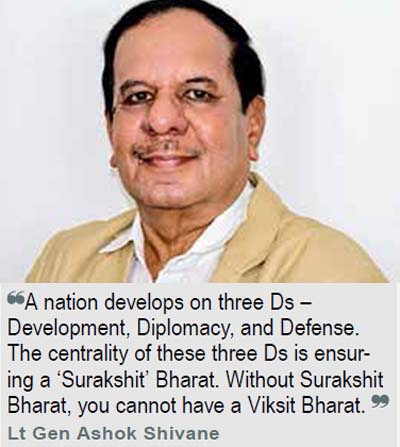 ASHOK Shivane: The first thing, at the strategic level, when you talk of Viksit Bharat, we talk of a developed nation. A nation develops on three Ds – Development, Diplomacy, and Defense. Unless the defense is strong enough, in today’s world, diplomacy will not have that sort of a voice, and development resources will be sidelined to other avenues of defense or security. And therefore, the centrality of these three Ds is ensuring a ‘Surakshit’ Bharat.
Without Surakshit Bharat, you cannot have a Viksit Bharat. And Surakshit Bharat, unfortunately, has the lowest vote banks. You know, it’s a silent thing of internal threats, tackling them and being preemptive and proactive.
I think the strength of our system, we have to grant it, we have macro stability with scale. We’re among the fastest growing economies. Digital India has taken off. Even if it is not inclusive as we want it to be, at the same time, you can’t deny that the economic growth and the digitization and the digital UPI are emerging at a global level.
Second, I think the strength that we have is our demographic depth, particularly the youth bulge. And the youth bulge being, looked at IT and services which are expanding.
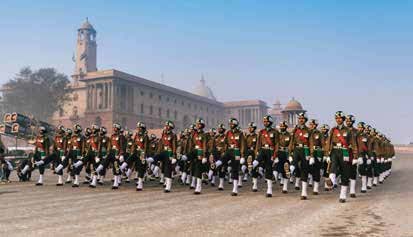 The third thing I think is a proof of infrastructure in terms of national level infrastructure, in terms of airports, highways, ports, railways that have expanded. We spoke of the lack of infrastructure at the city level, but at the national level, these have taken off.
And the fourth strength that we today is a sense of national strategic autonomy, where we are looking at what is good in the national interest and playing the game accordingly. So, these are our strengths today, but there are a whole lot of weaknesses that we have.
We’ve got a patchy state capacity, and we spoke of that. World class metros falling aside, urban drainage. We’ve got a job gap. Unemployment is on the rise.
The skilling programs today are growing faster than the actual employment outcomes. You may have a policy, but between the policy and the outcome, why it’s not taking place is the bureaucratic drags which still work on a legacy system. And the opportunities that really come to us are today, globally, the world is looking at China plus one. And that plus one is where India actually fits into the system.
So electronic manufacturing, like it’s happening in Tamil Nadu and happening in Uttar Pradesh, your green defogging, digital state, defense indigenization, your exports are rising. There’s no doubt about that and the private sector is playing an important role. So, these are the opportunities, but there are threats.
 There’s geopolitical volatility, there’s climate stress, there’s populism versus reforms, and there’s an urban implosion. So, Viksit Bharat is a good thing, but the key issue is that we are not looking at our internal fault lines and our internal weaknesses which we tend to gloss over, because if we come out openly on them, it would be exploited for petty politics in a democracy where alternatives really do not exist.
But to my mind, there are tremendous opportunities that India today has, and particularly in the present times. And I think we can make this a reality.
We should not be stuck at 2047, but certainly the trajectory at which we are moving, is a forward -looking trajectory and going at a reasonably good pace as long as we know our fault lines and as long as we know our weaknesses and don’t adopt an ostrich approach towards them.
VK Singh: Now, in this kind of long -term planning, one of the countries that was most successful in setting targets, setting dates, and achieving them is China. China started in 1949, and they set dates, and they made plans which almost seemed to be unachievable at one point in time. But what they did, which is different from what we are talking about, is that in those, let’s say, even 50 -year plans, they had single one -year plans too, which they made sure they achieved and achieved before time. Of course, their system of governance is different. This 2047 to me, seems that everybody who is in the chair today, is unlikely to be around in 2047. So, if we have 2047, and if I take all the good ideas which General Shivani put across, I would like to break it down to a six -monthly or a yearly plan, that this is what we achieve. And if we don’t, then we are at fault. And those that let down targets should be called out.
 Navin Berry: Very good, VK. That was a forceful answer from you. I do believe that you do need targets. You do need a vision. You do need something to scale up yourself, call it a slogan or an aspiration. Now, I think you have a very good idea about suggesting that such a road map should have an annual or a six-monthly target.
Jagatbir Singh: Now, the other day there was a very interesting article by Atta Hasnain where he said, you don’t look into politics of all things, but you look at a system. And unfortunately, you see the army or the defense forces are always there with courage, resolve, everything else. But you can’t win battles just with your courage, with your resolve. You have to be equipped. You have to have the latest cutting-edge technology. You have to have a defense industrial base that is strong enough.
You have to have rare earths which we do not possess. To build your technology. So, all this matters. And if you have to get things from outside, if you have to develop it in-house, you have to have systems in place. Unfortunately, there are very few people who are willing to bite the bullet and see things during their tenure.
So, unless we change our systems, unless we re-examine our systems, unless we become more proactive, it’s very easy to say I have allotted so many thousand crores to defence to procure ABC, but have you seen that procurement through, the answer in most cases is no. So, it just gets delayed. So, I feel that there has to be a major revamp and how we are structured now has to change.
 ASHOK Shivane: I have had a few meetings in the ministry. So, everything in terms of physical infrastructure, timelines, resource allocation, responsibility, the weak points, all that in a greater time frame is there, at least on paper, it does exist. But my point to them is that where we are missing out strategically and culturally is the citizen -centric Viksit Bharat. Because you do not have a national citizen security culture. You do not have a national citizen civic culture. You do not have a national citizen-centric, developed nation culture.
So, unless you start investing at this, at the school level, at the college level, and education is the base of all this. Empower your societies towards them. Orient your society towards them. Unless it is driven by the people, this thing is not going to be coming up in a holistic manner.
Navin Berry: That’s an excellent point. As VK put it, he said people who are talking about Viksit Bharat at the moment, most likely they are not going to be around in 2047. But I think the school children are going to be around and they would be the guardians of your Viksit Bharat program. Any specific ideas on how to take it forward with them?
ASHOK Shivane: If you are looking at, say, Surakshal Bharat, if you don’t have a national citizen security culture, you don’t empower them, you don’t have an integrated security grid in which the society, the RWAs, the citizens are part of it. You will have people, what is happening today when you see subversion taking place in the institution, seeing, you know, hearing, but not speaking, not coming up with anything. A lack of citizen -centric focus in both the development and in the security of the nation. And the police cannot be everywhere. You’ve got 140 policemen for one lakh citizens and the UN norm is 222 per lakh. Each intelligence and security mechanism is functioning in their own silos. So, this is a major void.
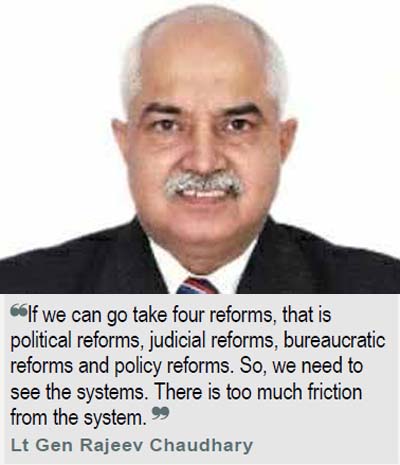
 Rajeev Chaudhary: But also, on the real side, I am with Teddy, that what he said, that things on the ground are different. But what I’m saying is, if we can go take four reforms, that is political reforms, judicial reforms, bureaucratic reforms and policy reforms. So, we need to see the systems. There is too much friction from the system. Despite all this friction, India is progressing.
We are among the fastest growing in the world today. But if we can make things simpler, we could be among the miracles. In fact, it will be more than 30 trillion. So, this is the point that I want to make, that political class has to be totally reformed. There has to be some criteria to become a politician.
You can’t just be there. You can’t even read the oath. You don’t have that kind of literacy that you can read an oath. So, how can you be having leaders who are not even minimum, let’s say metric or 12th class pass. So, there has to be some kind of benchmark to select our leaders, and there are criminals there, there are all kinds of people who are elected by us.
 Technology, that’s a big challenge. It’s a new race that is taking place globally, AI. In many other industries, we have over a period of time been latecomers. Then we had to play the catch -up game. In AI and technology, in many of those IT services, we are already a leader. Where is the challenge today as we move towards 2026? General Chawla, would you like to just break it up for us in technology terms, which are the various aspects where we can develop, and wherein lies the challenge, or where are we positioned as of now?
Tarun Chawla: At the very outset, I would like to say that my pitch is on a very optimistic note. I mean, a lot has been happening in the country on the technology front. Maybe a little slow, maybe there are hurdles which I will list out, but somewhere I find the government of the day is sensitive to it and is taking adequate actions to circumvent that. For decades, India was being celebrated as the world’s back office. We were the back-office boys.
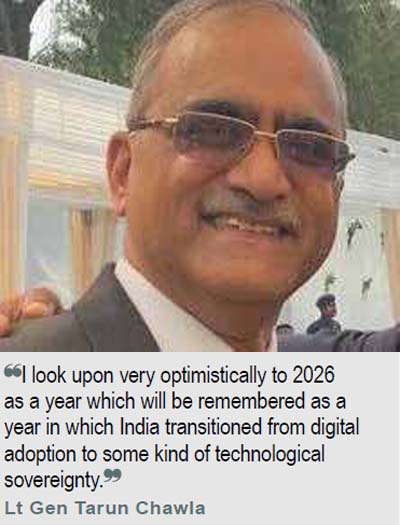
We were a hub for software services. Also, for business processing. But as we look towards 2026, I think, the year will prove it, this narrative is fundamentally shifting. Today, we are making endeavours not to consume the technology that is there in the world, but in our own way, architecting that technology. So, I look upon very optimistically to 2026 as a year which will be remembered as a year in which India transitioned from digital adoption to some kind of technological sovereignty. From the silicon chips which power our devices to some green molecules which will fuel our heavy industries, we find a new Bharat is emerging.
 For the first time, the Make in India phrase will be etched onto the most complex product ever created, the semiconductor chip. By 2026, this is the roadmap. The semiconductor market will be somewhere around $64 billion. Now the physical landscape of India if you look at, you look at Dholera, Sanand in Gujarat, hubs in Karnataka, in Tamil Nadu and as far as Assam, massive fabrication units and testing, marking and packaging units are mushrooming and these are converting what till now was only a blueprint into a production line. But there is a challenge associated with it.
Building a single fabrication unit for semiconductors costs billions and it also requires an ultra-pure ecosystem. Now, how do we tackle it? The government has launched a mission called the India Semiconductor Mission and has pumped in Rs 76 ,000 odd crores into that mission and is going to support 50 % of the cost.
When you and I decide to set up a unit, 50% of the cost will be borne by the government. The government is promoting semiconductor cities with the design-linked incentive schemes to nurture, as of now, 100 plus startups into this industry so that the intellectual property stays with us, what we manufacture in India the ownership rights stay with us. So, this is the mitigation for the challenge that we have.
Now, the second thing that I will touch upon is Agentic AI. AI is the new buzzword in the town these days. But the way we are moving ahead, I find that we will soon be graduating from chatbots to some kind of digital colleagues. The days of simple generative text are gone. We are transitioning into an era of agentic AI. What is an agentic AI?
It is a system that can plan, that can execute multi -step workflows. I’ll give you a small example. Chatbot, you told ChatGPT, design an email for me, for my customer, and it did it, but you go to an agentic AI you just have to tell that fix up a meeting with so -and -so client so it will draw out your previous conversations, it will draft an email, it will send that email it, will look at your calendar, it will schedule that meeting with that particular client, so that is where we are moving towards. Now, these agents will penetrate various sectors. They will manage our supply chains, crop diseases, and even go on to the extent of legal audits.
 But there must be some challenges. Why haven’t we done it so far? There is a problem of some kind of trust gap that exists. You and I want our data to stay very close to us, and rightfully so. So, some kind of a government policy on this data privacy has to come, as to how much of my data can be used by these companies for their benefit. And secondly, to do all this, we need a tremendous number. Today, the figures stand as 800,000 skilled workers to run these agentic AI machines.
But the government has thought of it and is building an India AI mission which has got a large amount of funds allocated to it for establishment of some kind of processing units all over the country. Then we just talked of education. The government, I think, is sensitive to it and there is SOAR, Skilling for AI Readiness program that the government has launched, in which the curriculum of schools is being changed from a child who goes to class 5 to class 10. This child is being trained into familiarization with artificial intelligence and then there are separate programs for grown-ups as also for professionals. So, the target is a huge 8 lakhs or 800,000 that I was saying is humongous as it seems. But I think slowly and steadily, there are steps being taken to reach there. Third thing is data centres. There’s going to be a proliferation of data centres across this country.
What is a data centre? Basically, if I put it very simplistically, if AI is the engine of our growth, a data centre is the fuel that runs that engine. Now, what lies ahead? India’s data center capacity, people who are staying in Gurgaon or who are in Bombay or Bangalore, they will agree with me, our data center capacity today is minimal. But there is a target to actually double that in the year 2026. Now, data center setting up itself is again a challenge which costs money, extremely resource heavy.
 And also, they consume a lot of electricity and cooling and all those problems that come. And these are coming up in places like Mumbai and Chennai which are already water-stressed cities. So, there is a challenge out there. But what the government has done is possibly given data centres an infrastructure status.
Navin Berry: Where could be the shortcoming? Where could we fail? Where could we falter?
Tarun Chawla: Where could we falter is, first of all, the resources that are promised initially have to be allocated. And secondly, the resources that are allocated have to be systematically and transparently utilised.
I think if we can take care of these two things, I think we are on the path even if we will not reach the destination in 2026, certainly not. But we would have taken maybe a little more than baby steps as they would.
Navin Berry: We constantly hear this fear of losing jobs. If the AI machinery can draft a letter and organize your appointment, then you don’t need a secretary. So how many more such jobs will go and therefore what will come in its place?
Tarun Chawla: Yeah, this is a very, very serious concern which is affecting our service industry today as too many jobs will be shed. But somewhere down the line, you have to see the people who are batting for artificial intelligence and while some are saying it is a bubble that will burst sooner than later. But people who are batting for artificial intelligence, they say that the quality of the work and the multiplicity of the work that will happen with artificial intelligence coming in will take care of the shortfall that will happen because of some jobs which have to be shed. Let us accept it in government organizations today that there is a man for every function that is there.
 Navin Berry: Technology for ease of living, any comments?
Rajeev Choudhary: I want to talk about technology for ease of living first. That is very important. After all, we are humans. We are not robots. General Chawla spoke about children being taught in class 5 about AI and all. That’s good. But Australia very recently passed a law that till 10th class, they will not even take the mobiles or computers and all in the classes. Today, I just finished reading a book, Anxious Generation by Jonathan Hedgett. It says that Gen Z is facing a lot of anxiety, depression, because of technology and their lifestyle has changed. Now you want to push the new children now coming into this AI thing. AI is very lucrative, it is very attractive, very fashionable, and it is doing a lot good also. But then you have to also see that we are living creatures. We can’t forget what is happiness, what is free time. Today you just chat GPT, do this, do that, send my email and all.
That’s very good. But then where is the human existing? You have got an agentic colleague who is doing everything for you. What are you doing then? So, we have to see today we are trying to push children to go out for play. On the contrary, we are also bringing in AI in everything. Yes, it will come. It will push itself as the mobile in the 1990s. It will do that. You can’t stop it. But we have to guard against all these things. Ease of living is a very important thing for humans because either we’ll have to retire at the age of 30, 46 or so instead of 60s or give place to more people.
Jagatbir Singh: You asked a question about failure. We have a glaring example of failure in front of us. The first semiconductor plant or industry in India was established in 1976 in Mohali, Semiconductors India Limited. And the first time it produced something was in 1985. In 1989 a fire broke out. After that, it almost went into limbo. Today, it’s been given money. And see how it’s changed. And it was first under PSU. Then it came under the Department of Space. And now it shifted under the IT Ministry. So, look at that. So we had a start. Now, nobody can tell you the exact reasons for the fire. Also, there’s speculation was it deliberate? We had a lead start and we never capitalized on it.
 Navin Berry: I can only echo my personal remark or personal thought that in all areas, whether it’s aviation, when you see what happened recently, with the IndiGo fiasco, and people are asking me, what is the future of India’s aviation industry? And if we don’t achieve what we are setting ourselves to achieve, we will have only ourselves to blame. And that goes for every endeavor. We can be our own best enemies. We don’t need an outsider to spoil our show.
ASHOK Shivane: I won’t elaborate, but I think we need to pay greater emphasis in terms of resources and prioritization of deep technology R&D. As far as defence is concerned, I think globally we are facing the problem of ethics in AI because once autonomy systems are launched it may not differentiate between a passenger plane and a military transport plane. And who is to be blamed?
And the third thing is today, algorithms are being created within algorithms by itself, which are beyond even the manifestation or understanding of humans. So, the caution here is that technology is a force multiplier. It multiplies force and therefore, whether it’s AI or any other advanced technology we talk of, we have to ensure that the human in that loop remains relevant.
Tarun Chawla: You mentioned UPI has been a success and where are we going from here? In our country there is a program to launch an open network for digital commerce. What UPI did for the payments, UPI is only related to payments, this will spread commerce across the length and breadth of the country and even the smallest shop next to your house will come on the network like it is being monopolized by Amazon and such like companies today or Walmart or something. But the visibility to the local guy if it is given, you can imagine the multiple effect on the growth and ultimately contributing towards the cross -domestic produce of this country.
Navin Berry: Yes. So, the big advantage of this, as I see it, is that a lot of these petty cash transactions, which used to happen earlier, have all come into the organized sector of the economy by virtue of an interface like UPI.
Tarun Chawla: You are right, but he uses it only to take money from you. I am talking of a system where his cart will be on the net. And you will be able to place orders on that ‘sabjiwala’ on the net.
 In India because of our numbers, because we are still in the catch-up game. We are in the process of sanitizing public areas across the streets of India, Delhi, Bombay, Calcutta, small cities, urban, rural. The pressure of numbers. Are we in a porous society where we become more vulnerable to such attacks? How do we secure ourselves as much as we need to, as fast as we need to, at the lowest cost possible.
Jagatbir Singh: When you see Ops Sindoor, it is something that India said yes, that we will tackle terror. How many countries actually stood by us when we tackled this terror? And how many countries then elevated Pakistan to a position which was unimaginable before Operation Sindoor? That’s something you need to see.
Relations between US and Pakistan changed dramatically post Operation Sindoor. Pakistan’s standing which was first being relegated to the back pages. Suddenly there’s a pact with Saudi Arabia, Trump is leaning in, IMF loans are being given, so… What happened? We have very categorically stated in the manner in which we executed operations during Ops Sindoor, in the manner in which we targeted the terror camps, in the manner in which we were restrained, in the manner in which we closed, raised, went up the escalation ladder and yet we closed operations when we were on top. Yet, where we faltered, which I feel, is the narrative and how that narrative has been spun.
So today, it’s not nearly enough, fighting a conventional war and winning it. So how exactly are we ready to fight these ambiguous conflicts in the years ahead? And how do you fight it psychologically? How do you influence your own population? It has also become a battle of narratives, how each tells his own story.
 How do you influence the rest of the world that what you’re doing is right? Why do you need to target terrorism? The same way in Australia, Bondi Beach, how did they come about? And every time what is happening is we are targeting the terrorists who carry out the strikes. But more important than that and what I’ve said is, that what about the people who are influencing these terrorists to carry out the strikes?
You carry out a strike, eliminate a terrorist, yet somebody else comes in his place because the people who are influencing them, be it literature on the net, be it people preaching in a particular manner, be it people supporting them with money, those people, those organizations also need to be targeted.
Next thing is that we are saying we’re a porous society. A man was roaming around on the streets of, you know, Delhi, Gurgaon, Faridabad with explosives. There are thousands and thousands of cars. Is it physically practical, possible to stop each car to check what you’re carrying? Look at the traffic jams that take place even with their cars being checked to enter Delhi at times of GRAP 4. So, I mean, every day a man doesn’t carry a weapon inside Delhi. So, that’s something that needs to be seen. What is the way out?
Are you going to have a state where you’re monitoring each citizen? Your intelligence has to be strengthened. As General Shivani said earlier, what is applicable for urbanization is also applicable for combating terrorism, you cannot operate in silos. The police cannot be acting in one manner. The state police cannot be acting in another manner. The armed forces cannot be acting in another manner.
Your border security force and all cannot be acting in another manner. You have to have a whole government approach towards this. And you have to have greater consolidation of these resources under one person. There’s no point creating more and more organizations with all operating in a silo. You have to get them together. And you have to concentrate more on a national security, awareness, and national intelligence grid.
VK Singh: To me, the answer is a one-word answer, which is accountability. This accountability is what we lack as a nation. You take just a few incidents as an example. You take Kargil first. Kargil, the responsibility of external intelligence is that of the R&AW. Internal intelligence is that of the IB, battlefield or tactical intelligence is that of the army. In the army, yes, some heads did roll or may have rolled. But did we hear of any head ruling anywhere else? You take the second example of Galwan. Then there is Pahalgam. And the same as for Red Fort. Too many agencies and not adequate integration between them. Well, which head did you see roll? It is not possible that we don’t have intelligence. After all, what are we paying taxpayers money to so many people who’ve got jobs in those agencies?
I am also talking about intelligence sans borders. I talked about that if we really want to think about the future, then we can’t have these compartments, of course, within our country, forget within our country, even across countries. Okay, so it has to be real-time intelligence sharing. We have to get out of our silos. But please, let a head roll. And you will find a head, or heads, you will find the entire attitude will change. And people will be answerable. The moment they are accountable, they’ll be answerable.
 Question of leadership, question of heroes, question of mentors in public life. Where are they? And I think when you’re talking about the youth of the nation, I’m sure they’re looking up to some people, iconic figures, who can provide them guidance, to whom they look up to and they want to achieve like they have. A few figures have surfaced in sports, in cricket or some other games, where there are mentors, whom they would like to emulate. In our public life, however, do we have these heroes? We need to see them in public life, we need a certain moral force emerging, of success, where they can become some kind of esteemed iconic figures.
Rajeev Chaudhary: Today, as we have moved to present times, the leadership is not confined to any domain, it is confined to results, and most of it in the economic domain. It is the achievement which is creating leaders and it is not confined to any age or some particular set. We see these heroes like the younger generation is primarily getting inspired by their achievements, not by a particular class.
 The brave children who are given awards on 26th January, a 10-year-old Sikh boy saved the life of another boy, so he is being given this award. And today in the fast connectivity in social media, such figures pop up very fast and this becomes viral and definitely the younger generation is into social media, more than what we are.
So, these figures inspire wherever, even in the moral domain, where they are doing something good which normal people don’t do. So, the normal honesty or respect for others is also inspiring the younger generation.
ASHOK Shivane: I feel despite the abundant talent and the youth bulge and the potential that the nation has, the visible moral and the visionary leadership remains scarce, particularly across the public spheres and I attribute it to two or three things.
Firstly, is a legacy mindset of being defensive and reactive rather than being pro-activist. And this I think is something, a legacy we carried forward even before our independence. That inhibited our initiative, our risk-taking ability, which is a very important aspect of leadership. The second thing is the environment in which we move. Anything, which is due to, by and large, with brilliance and constructive criticism, is shunned.
And particularly at the hierarchical public national level. You can’t be an awkward guy who’s giving a different viewpoint. It’s not taken. It’s not taken. So that plays a second cultural deficit of accepting constructive criticism or a different viewpoint which must start right from schooling. Today, if a child in a school is going to give you a different viewpoint, may be totally wrong, but he is discouraged. So that grooming has to start at the institutional level as such.
 The third thing I wanted to bring out is that in some way we have to break the Macaulay’s chain in our strategic leadership. We must reclaim our civilized mind, rebuild our institutions and indigenous knowledge and bring in that pride in the sort of leadership that we have, imbibe those qualities at a young school level.
I know NEP 2020 is looking at all these things, but not adequately. So, when we started in school, we had moral science. Why can’t we have such leadership lessons and leadership training at the school level?
Navin Berry: You hit the nail on the head. One of the minimum criteria and uppermost criteria is the moral fabric of our society. That is causing the biggest erosion in creating heroes. Today, thanks to social media, so much of what you call instant gratification news, you can put a slur on just about anyone and let him spend the rest of their life defending that slur, which you created without any proof, but with a lot of motivation?
So how do we marry these contradictions in our society? The lack of moral fiber, the fabric, intensity of social media which can mar reputations overnight. Where are the heroes? We don’t have them. And even some of our leaders, big leaders, I mean, there are people who don’t stop at putting them down. It’s like a 24×7 machinery at work to put down people, to put down their achievements. So, what are we going to do?
Jagatbir Singh: But you’ve seen during various times, various other people have emerged as heroes. So when you talk of wars, say World War II, who emerged as the heroes? People were writing about Patton, people were talking about Eisenhower. Those were the figures that came up at that time. In our own case, we talked about our freedom fighters, like we talked about Mahatma Gandhi. And we talked about other people also, like Nehru. But today, people are questioning Nehru as a prime minister. So that’s also happening today. You talked about Indira Gandhi in 1971. You talked about Sam Manekshaw in 1971, how he led the troops forward. So, they were all our heroes.
Today, people are saying that their heroes come from an economic background. Yes, we looked at people with high morals, people looked up to JRD Tata and Ratan Tata more than they looked up to others, and today, people are looking up to success stories like that of Adani, who make good money. But the values, the moral aspect was more earlier, as far as JRD Tata and Ratan Tata were concerned.
Navin Berry: Jagat, are you also saying that there will not be those perfect figures today as were there, perhaps 30 years ago or 50 years ago. And we will have to accept them in their imperfection.
Jagatbir Singh: There won’t be perfect figures. I am also saying certain circumstances created certain types of leaders who were looked up at that time. So, during the independence efforts, you looked up to freedom fighters, when you had a war, you looked up to the people who led you to success in the war. Crises also create heroes.
I would also like to share a recent project that MOD initiated, promoted by USI for them, called Veergatha, which is a gallantry awards portal. So those are the three – Paramveer, Mahavir, Vir Chakra and Ashoka, Keerthi and the Shaurya Chakra. So, we have about 4 ,500 plus such people who have received these. And this is what I want to talk about, about leadership or how we are training. We started running a program for schools in which we asked school children to write a short essay, say 10 lines on these people, or draw a painting, or make some video message, or write a short poem. And you’ll be surprised. The first time we started this project, we had 8 lakh entries. And this is across India, North, South, East, West, right from Kashmir to Andaman and 8 lakh entries.
 This year, when we just finished the program on 10th of November and the prizes will be given away on 23rd January by the R.M. and the Minister of Education. You will be surprised to learn the number of entries was a staggering 192 lakhs. So, you can just see. And so now, 192 lakh children are writing and identifying with military courage and military gallantry award winners across the armed forces.
Navin Berry: Are we also becoming a more materialistic society and therefore our new heroes are also those who are successful and have made money and become billionaires? If there is a school teacher who has done very well, are we more dismissive of that because that’s more value driven rather than materialistic successes.
Rajeev Chaudhary: It is a cyclic process and it will change with time.
Tarun Chawla: As we transition to a more materialistic society, the leaders of tomorrow will be people from different walks; there might be a business leader. Today a lot of people are doing well in their respective fields but those fields were not necessarily the military field or the political field. Like I will give you one small example, that of Shubhanshu Shukla. Isn’t he an iconic figure? Aren’t there many young boys and girls who have been motivated, inspired by this gentleman? Absolutely, absolutely.
And the women’s cricket team. Those 11 girls that were there who played and inspired others!
Ashok Shivane: Two tricky issues, but I will tackle them head on. First thing, I think we need to get over the psyche of political patronage. If we have to have leaders truly coming up, who may not toe the line, but otherwise have a brilliant career. And the second point, I think we have to, I don’t have the answer, but I do feel that, if we have any system which has alternatives is a vibrant system. So, a nation which has a lack of alternatives, you really can’t call it a vibrant democracy. You can call it a managed democracy, even if it is doing very well, even if that particular system is far better than the previous.
But then, over a period of time, when you know that there are no alternatives, then that leadership does not come up. Because then you do not allow them to come up, because you’re the supreme.
VK Singh: As far as quality leadership is concerned, you find plenty of it. When you think about Bollywood, when you think about sports, when you think about arts and science, there’s no dearth of it. Do you really equate the same leadership in our political arena today? Do you have the faith and trust in each and every political leader who is there across the spectrum? You will answer it yourself and very naturally. Now, that is where we need real leadership. If it is there, then you will find that there will be a complete change.
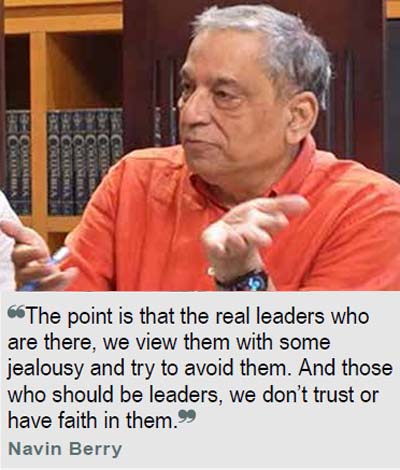
I think in our time, one of the greatest military leaders has been Sam Manekshaw. General Sam Manekshaw was not even given his due pension for years till the President of India went and met him in hospital, two decades after the war was over, or more than that. And who was there when he passed away? Was there any national figure at his funeral? No, sir. So, the point is that the real leaders who are there, we view them with some jealousy and try to avoid them. And those who should be leaders, we don’t trust or have faith in them.
NAVIN BERRY: That is plenty of food for thought, gentlemen. Thanks for being with us in this most engaging conversation.