
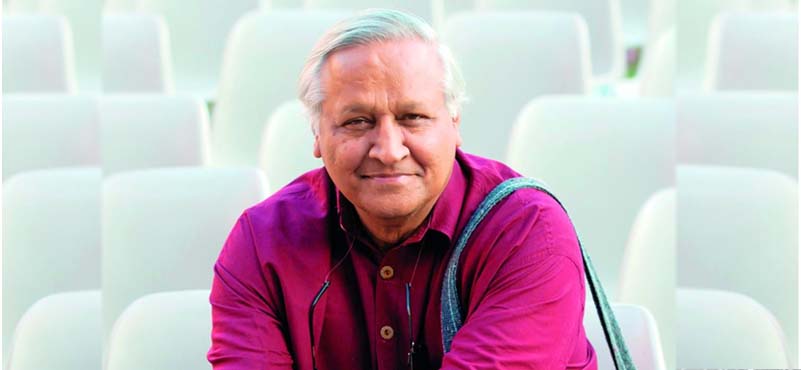
He did not merely take development to a village. He challenged the belief that the poor needed outsiders to tell them how to develop. From a small Rajasthan village, he created a movement that travelled across continents.
India has produced many remarkable men and women who gave up the comforts of urban life to work among the poor and underprivileged. Some devoted their lives to education, others to healthcare, sanitation, water conservation, livelihoods or the emancipation of women. They went into remote villages, often with little money but enormous conviction, and built institutions that changed lives. Their work seldom receives the attention accorded to achievements in business, politics or public administration, somehow it has always lagged behind!
Bunker Roy belonged to this tradition, but he took a somewhat different road. For him, rural India was not waiting to be rescued by educated people from the cities. He questioned the very assumption that those without formal education were necessarily without knowledge, skill or the ability to solve their own problems. His life was not merely to provide services to the poor, but to demonstrate that they could become their own engineers, teachers, technicians, healthcare workers and agents of change.
His laboratory was Tilonia, a relatively obscure village in Rajasthan’s Ajmer district. His institution was the Barefoot College, founded in 1972. And his greatest achievement was perhaps not any single project, but the confidence he helped create among people whom society had long treated as incapable of managing their own affairs.
To understand the significance of his work, one must first understand the man and the journey that brought him to Tilonia.
Born Sanjit Roy in 1945 into a privileged Bengali family, Bunker enjoyed an upbringing that could scarcely have been more different from the life he eventually chose. He studied at the Doon School and St Stephen’s College, Delhi, institutions that opened doors to the highest levels of professional and public life. He was also an accomplished sportsman, becoming India’s national squash champion three times. A successful career in business, administration or almost any profession he chose was within his reach.
Then came an experience that changed his understanding of India and, ultimately, the direction of his life. In 1966, he travelled to famine-affected Palamu, then in Bihar and now part of Jharkhand. He went to help, but discovered how little his privileged education had prepared him for the realities of rural poverty. The absence of water, the hardships of everyday survival and the resourcefulness of people living with almost nothing made a lasting impression.
Years later, he would speak candidly about the arrogance that had accompanied his formal education. He had been taught that qualifications and knowledge could solve problems. In the village, he discovered that he did not even understand many of the problems, much less possess ready-made solutions.
He spent the next eighteen months travelling through India, studying voluntary organisations and exploring how rural development might be approached differently. Eventually, he arrived in Tilonia. It was here that he decided to stay, not for a few months or a particular project, but for what became the rest of his life.
His early work was rooted in the most basic of rural needs: water. Rajasthan’s arid countryside suffered from recurring shortages, and access to reliable drinking water shaped much of village life. Working with Meghraj, a local farmer, Roy began exploring wells, groundwater and ways to improve water availability. The early organisation brought together trained professionals and villagers, including geologists and other specialists. Its first task was as much about listening and understanding as about constructing anything.
In 1972, the Social Work and Research Centre was established at Tilonia, later becoming internationally known as Barefoot College. The name was itself a declaration of intent. Here was to be a college unlike any other, where degrees were not the measure of competence and where practical knowledge, experience and community trust counted for more than academic qualifications.
The institution did not begin with a fully formed philosophy. Its methods evolved through experience, including the discovery that formally qualified professionals brought from cities were not always willing to remain in villages. The skills they brought were valuable, but the dependence they created could become a weakness. If a technician installed a water pump and subsequently left, who would repair it? If a doctor visited periodically, what happened between visits? If a schoolteacher had little understanding of the village, how relevant would the education be?
Roy’s answer was to train local people to undertake many of these responsibilities themselves.
This was the essential departure from conventional development work. India had no shortage of organisations seeking to improve rural conditions. Baba Amte built Anandwan around the dignity and rehabilitation of people affected by leprosy. Ela Bhatt organised self-employed women and helped create a powerful movement for economic security. Rajendra Singh mobilised communities around water conservation. Aruna Roy, Bunker’s wife and an exceptional activist in her own right, would become a leading figure in the movement for transparency and the Right to Information.
Each pursued a different route to social change. Bunker’s particular contribution was to challenge the monopoly that formal education appeared to hold over technical knowledge. He wanted to show that a village woman who had never attended school could become a competent engineer, that a farmer could understand and manage water systems, and that people without certificates could acquire specialised skills and teach them to others.
Accent on Solar Energy:
The most celebrated demonstration of this philosophy came through solar energy.
In villages without electricity, darkness was more than an inconvenience. It restricted children’s study hours, complicated household work and reinforced isolation. Conventional electrification depended on infrastructure that could be expensive and slow to reach remote settlements. Solar technology offered an alternative, but it, too, appeared to require trained engineers and technicians.
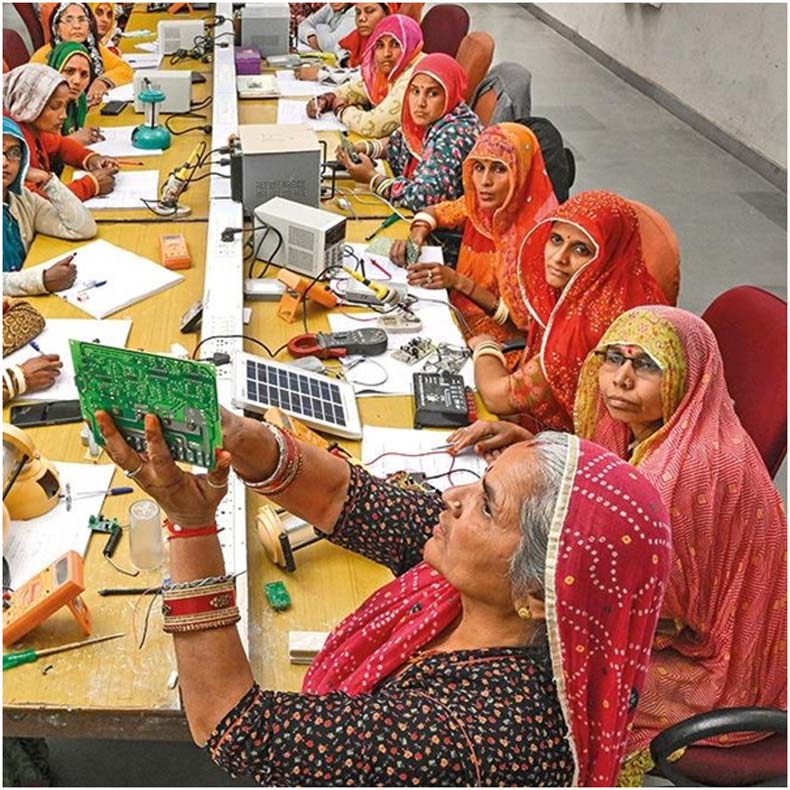
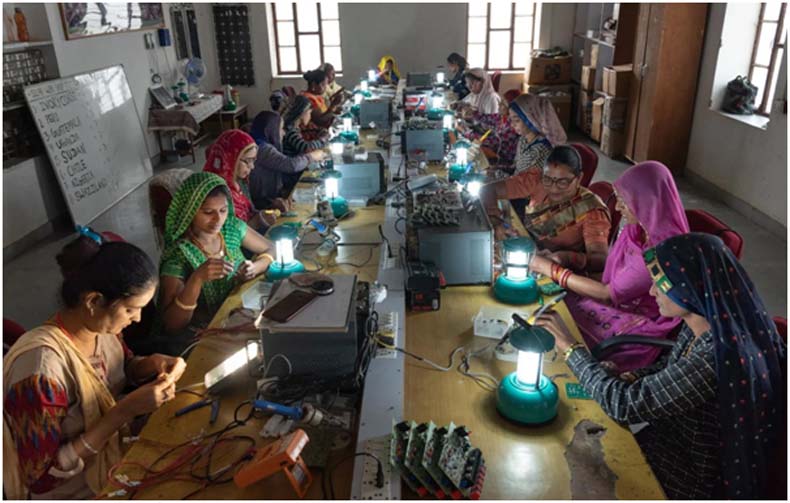
Barefoot College developed a programme to teach rural women to assemble, install, maintain and repair solar lighting systems. Many of the women were middle-aged or elderly, and some had little or no formal schooling. Training relied heavily on practical demonstration, repetition, colour-coded components and learning by doing rather than written examinations.
These women became known internationally as the Solar Mamas, or Solar Grandmothers.
The choice of older women was deliberate. Younger people trained in technical skills might leave their villages in search of better-paid employment. Older women, particularly those with established families and community ties, were more likely to remain and make their knowledge available locally. What appeared to be an unlikely choice for technical training became one of the programme’s strengths.
Imagine the transformation in the life of a woman who had been regarded as uneducated and dependent, and who returned from Tilonia capable of installing and repairing solar systems. She was no longer merely a beneficiary of development. She had become a skilled technician, someone whose knowledge was needed by the entire community.
The programme expanded beyond Rajasthan and India. Women from remote communities in Africa, Asia and Latin America travelled to Tilonia for training, frequently overcoming language barriers through practical instruction. They returned home with the skills to electrify households and maintain the systems themselves.
There was something extraordinary about the reversal. A small Rajasthan village, once regarded as needing assistance from the outside world, had become a centre from which technical knowledge travelled to other countries. The teachers were frequently rural women who themselves had never passed through a conventional classroom.
Beyond solar energy, more innovation!
Yet solar energy was only one part of the work.
Water conservation remained fundamental. Barefoot College promoted rainwater harvesting, groundwater management, the repair and maintenance of hand pumps, and the construction of systems suited to local conditions. Rather than simply installing equipment, the emphasis was on training villagers to operate and maintain it.
Education took another unconventional direction. In many poor households, children were required to work during the day, tending animals, helping in the fields or undertaking domestic responsibilities. Conventional school hours could make attendance difficult. Barefoot College established night schools, allowing children to study after their daily work was finished.
These schools were not a substitute for the wider obligation to provide full-time education to every child. They were a practical response to children who might otherwise receive none. They also sought to connect learning with the circumstances of rural life.
Healthcare, sanitation, handicrafts and livelihood development formed other parts of the institution’s work. Women learned skills that could provide income. Local workers received training in basic healthcare and community services. The objective was not to create an endless dependence on charity, but to increase the capacity of villages to meet their own needs.
By 2015, reporting from Tilonia described more than 6,500 people trained in a variety of practical occupations, including solar engineering, hand-pump maintenance and community services. Such figures reflect the institution’s cumulative training activities rather than a verified count of permanent jobs or independently transformed households. Even with that qualification, the range of skills being taught was remarkable.
The Outcome? Did Tilonia, too, prosper?
But what happened to Tilonia itself? Did fifty years of work transform the village into a model of prosperity? Did every household acquire better income, education, healthcare and opportunities?
These are important questions, particularly when assessing the legacy of a man whose reputation travelled so widely.
Tilonia undoubtedly acquired an institutional identity that few comparable villages possess. It became a destination for social workers, researchers, development practitioners and rural women from different parts of the world. The Barefoot College created training opportunities, employment and a network of activity extending well beyond the village itself.
But it would be misleading to claim that Tilonia became a universally prosperous village or that all its social and economic problems disappeared. The available evidence documents the institution’s programmes and achievements more clearly than it establishes the long-term improvement in income, health or education of every household in Tilonia. A proper assessment would require independent comparisons over time, including the experiences of villagers who were never directly associated with Barefoot College.
This distinction does not diminish Roy’s contribution. It helps define it more accurately. His achievement was not the creation of a perfect village. It was the development of a working model through which disadvantaged rural communities could acquire knowledge, organise themselves and assume responsibility for services traditionally controlled by outside experts.
The institution itself also deserves to be understood as a collective achievement. Roy was its founder and guiding force, but Barefoot College depended on hundreds of village workers, women trainees, teachers, technicians, organisers and volunteers. Meghraj’s contribution in the early years was significant. So were those of the professionals and social workers who helped establish the organisation. Many local people developed and sustained its programmes over decades.
Roy’s partnership with Aruna Roy was another important part of his life. Aruna had joined the Indian Administrative Service but resigned in 1975 and came to Tilonia. Their work subsequently followed different paths, with Aruna becoming a leading figure in the movement for the Right to Information. Yet both shared a commitment to giving ordinary people greater control over decisions affecting their lives. In different ways, they questioned institutions that placed authority beyond the reach of those most directly affected by it.
National and Global recognition:
Recognition came steadily. Roy received the Jamnalal Bajaj Award in 1985 and the Padma Shri in 1986. International honours followed, including the Tyler Prize for Environmental Achievement, the Skoll Award for Social Entrepreneurship and the Clinton Global Citizen Award. In 2010, TIME included him among its 100 most influential people.
Visitors from across the world came to Tilonia. Prince Charles visited in 1975 and returned in 1992 with Princess Diana. Decades later, as King Charles III, he continued to acknowledge Roy’s work. The Barefoot model became a subject of international discussion, particularly in relation to women’s empowerment, decentralised technology and sustainable development.
Yet Roy continued to live in Tilonia. The village remained the centre of his work, even as his ideas reached across continents.
The passing of an Era, a Legend in his lifetime!
He died there on 10 November 2026, aged 81. According to the statement issued by his family and colleagues, he passed away peacefully at home at 6.15 in the morning, with Aruna Roy and people close to him by his side. His funeral was held in Tilonia that evening.
There was an appropriate completeness to the journey. A young man who had left privilege behind to understand rural India had spent more than fifty years in the village he chose as his home. His last journey, too, remained within that community.
His passing raises a question that applies to many exceptional institution builders. Can the institution retain its vitality when the founder is no longer there? Can the ideas remain relevant as rural India changes, as young people migrate, as technology advances and as expectations rise? Can the original emphasis on local participation survive the administrative and financial demands of an international organisation?
These questions now belong to the people who carry Barefoot College forward.
There is also the question of national recognition. Roy received the Padma Shri four decades ago, but his contribution continued to grow in scale and international significance. A case can reasonably be made for considering him for a higher national honour, not simply because he spent his life working among the poor, but because he created and sustained an approach to rural development that travelled far beyond India.
Such recognition would also acknowledge the larger tradition of grassroots service in which he worked. India has produced many men and women who have devoted their lives to communities largely invisible in the national conversation. Their achievements may not command the attention of major industrial investments or government projects, but their work often reaches people who remain outside the benefits of conventional development.
Bunker Roy’s legacy deserves to be considered within that larger history.
He did not invent rural self-reliance. Gandhian thought had long placed the village at the centre of India’s social and economic imagination. Nor was he alone in recognising the importance of traditional knowledge or community participation.
What he did was give these ideas an unusually practical and visible expression. He demonstrated that sophisticated technology need not remain the preserve of formally educated professionals. He helped create circumstances in which women excluded from conventional education could become skilled engineers. He showed that a small village could become a place where the world came to learn.
Perhaps his greatest contribution was to challenge a deeply rooted hierarchy in Indian society: the assumption that those who possess degrees necessarily know more than those who possess experience, and that those who are poor must always remain recipients rather than providers of knowledge.
There is a difference between helping people and enabling them to help themselves. The first can bring immediate relief. The second can change their standing within society.
Bunker Roy devoted his life to pursuing that second possibility.
He began by discovering how little he knew about rural India. He ended by helping the world recognise how much rural India already knew.
That, more than the awards, the international recognition or even the solar installations, may be the most enduring measure of the man and his contribution.