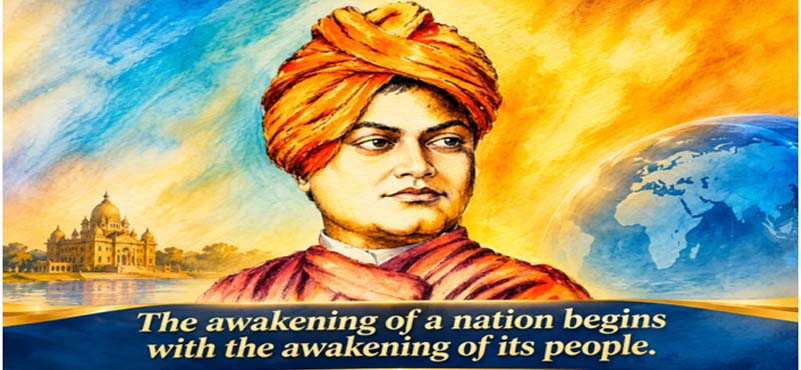
There are moments in history when a single voice does more than address an audience; it opens a passage between worlds. On 11 September 1893, at the World’s Parliament of Religions in Chicago, a young Indian monk rose before an assembly largely unfamiliar with him and began, “Sisters and Brothers of America.” The response was extraordinary, but the significance of that greeting went beyond applause. Swami Vivekananda had not arrived as a representative of a civilisation seeking acceptance. He stood before the West as an equal, carrying the wisdom of an ancient civilisation into a world undergoing profound change. In that moment, he became a bridge between worlds.
A bridge is an unusual creation. It belongs to neither bank yet makes both accessible to each other. It does not erase the river or demand that the shores become alike; it enables passage while allowing each side to retain its character. This is the distinction that gives Vivekananda’s example enduring relevance. He did not travel to the West to persuade it to abandon its inheritance, nor did he suggest that India should imitate Western civilisation to become modern. He believed that civilisations could learn from one another without surrendering their identities. His was not a call for uniformity, but for mutual enrichment through understanding.
Vivekananda presented Vedanta not as an exotic curiosity or a relic of the past, but as a living philosophy capable of addressing universal questions about human existence, spirituality and the unity of life. He challenged the assumption that any one faith could claim a monopoly over truth. At the Parliament’s final session, he rejected the expectation that harmony would emerge through the triumph of one religion and the destruction of others. His appeal was for “Help and not Fight; Assimilation and not Destruction; Harmony and Peace and not Dissension.” These were not merely words advocating religious tolerance. They expressed a philosophy in which differences could become sources of collective enrichment.
The bridge he imagined was reciprocal. India, he believed, had much to learn from the West in science, technology, organisation and practical enterprise. The West, in turn, could encounter in India a profound exploration of inner life, spiritual discipline and the unity underlying apparent diversity. Neither side needed to be diminished for the other to grow. This was an exchange between confident civilisations, each bringing something valuable to the meeting. Vivekananda’s confidence was not insularity; it was the confidence to engage without fear.
That message speaks directly to our unsettled present. The world is connected by trade, technology, travel and communication on a scale earlier generations could scarcely imagine, yet its political and cultural conversations are increasingly fractured. East and West are often described as opposing camps, while the relationship between the developed world and the Global South remains burdened by historical grievances, unequal power and competing expectations. Strategic rivalries, wars, economic uncertainty and identity politics have narrowed the space for patient listening. Countries may sit across the same negotiating table yet arrive carrying assumptions about one another that leave little room for understanding. Connectivity has multiplied, but genuine connection remains fragile.
In such a climate, the temptation is to build higher walls: to defend identity by dismissing others, to treat difference as danger and to mistake dialogue for weakness. Vivekananda offers a more demanding alternative. A bridgebuilder must possess roots as well as reach. Without roots, openness becomes imitation; without reach, identity hardens into isolation. He drew strength from India’s philosophical traditions while communicating in a language that audiences beyond India could understand. He did not ask his listeners to become someone else. He invited them to recognise the dignity and possibilities in traditions other than their own. His example demonstrates that confidence and curiosity are not opposites; they are partners.
There is a lesson here for India’s place in the contemporary world. As its economic weight, technological capacity and diplomatic profile expand, India’s contribution need not be measured only by the power it accumulates or the interests it advances. It can also be measured by the conversations it enables and the divides it helps narrow. The Global South is not a uniform constituency, just as the West is not a monolith. Both contain different histories, ambitions and disagreements. To act as a bridge is not to claim that all differences can be reconciled, or to stand vaguely between competing positions. It is to understand those differences, create space for honest exchange and seek common ground wherever possible.
The same principle applies beyond nations and civilisations. Generations struggle to understand one another; communities retreat into familiar circles and institutions become distant from the people they serve. Individuals, too, can become bridges by listening carefully, understanding unfamiliar experiences and refusing to reduce others to convenient labels. Such work demands patience, humility and the courage to remain in conversation when disagreement makes withdrawal easier. Yet it is through these everyday acts of connection that trust is rebuilt.
Vivekananda’s life reminds us that a bridge does not have to choose between the shores it connects. It must remain firmly grounded, strong enough to bear the weight of passage and open to those who seek to cross. The world does not need cultures to dissolve into one another, nor nations to surrender their legitimate interests. It needs the wisdom to engage without contempt, compete without losing sight of shared humanity and disagree without closing the door to understanding. More than a century after Chicago, Vivekananda’s message remains an unfinished task. Perhaps the true measure of a civilisation lies not merely in how high it builds its walls or how far it extends its power, but in how many bridges it has the wisdom and courage to build.
The world does not need more walls to protect its identities; it needs more bridges to understand them.
ABOUT THE AUTHOR
Lt Gen Rajeev Chaudhry (Retd) is a social observer and writes on contemporary national and international issues, strategic implications of infrastructure development towards national power, geo-moral dimension of international relations and leadership nuances in changing social construct.