
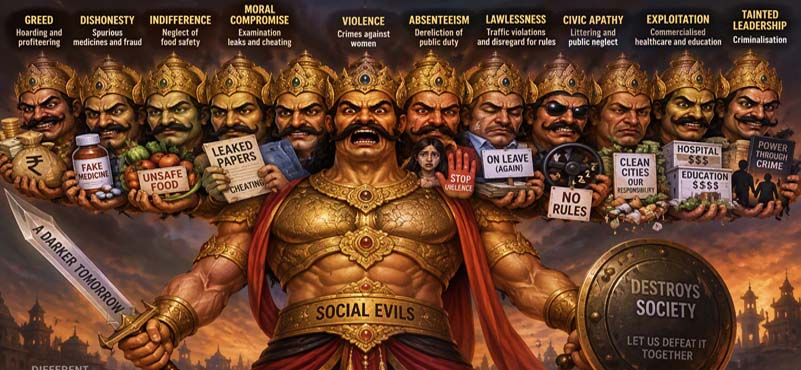
Every Dussehra we cheer as the towering effigy of Ravana are set ablaze across India. The spectacle is magnificent, fireworks light up the sky, crowds cheer, and we celebrate triumph of good over evil. We invoke the virtues of Lord Rama and remind ourselves that arrogance, greed, dishonesty and injustice must ultimately perish.
But when the celebrations are over and the ashes settle, an uncomfortable question remains: Have we destroyed any of the Ravanas within ourselves? We condemn evil in mythology, applaud goodness in our speeches and celebrate righteousness in our festivals. Yet, in our daily lives, many of us practise precisely those behaviours we claim to abhor. We preach honesty but look for opportunities to cheat. We demand accountability from the government but evade our own responsibility. We condemn corruption but are willing to pay a bribe when it suits us. Perhaps the most dangerous form of evil is not the evil we recognise and condemn. It is the evil we have learnt to rationalise, excuse and normalise. Ravana is not merely a figure from the Ramayana. He is a metaphor for the darker instincts within each of us. And those instincts do not disappear in the flames of an effigy. They disappear only when we confront them in our consciousness, our conduct, our institutions and our concern for fellow human beings. Let’s identify these ten social evils, representing the ten heads of Ravana.
Head 1: The Ravana of Greed: Exploiting Scarcity and Profiteering from Another’s Distress
Consider what happens when supplies of essential commodities become scarce. Whenever restrictions are announced, supplies are disrupted, or prices begin to rise, some traders see an opportunity not to serve society but to exploit its vulnerability.
When the West Asia conflict disrupted supply chains in March 2026, rumours preceded restrictions. The Central government in conjunction with the states conducted over 12000 raids recovering over 15000 cylinders with 642 FIRs and 155 arrests nationwidei. In Delhi’s Rohini, the man caught hoarding and illegally refilling cylinders was himself a registered delivery person of an authorised gas agency. Gas cylinders were hidden in graveyardsii.
Tomatoes and onions are often withheld from the market due to seasonal fluctuations, crop failures or supply chain disruptions to manipulate prices. The government itself often acknowledged artificial shortages caused by hoarding and black marketing to contribute to price increases. In April and May 2021, as people died gasping for breath, an oxygen cylinder worth ₹40,000 was sold for ₹1.45 lakh in Delhi, and a ₹31,000 concentrator for ₹1.65 lakh. Remdesivir, officially priced between ₹899 and ₹3,490 a vial, fetched ₹25,000 to ₹50,000iii. What kind of conscience permits a trader to deny an essential commodity to a family today merely because it may fetch a higher price tomorrow? The same moral failure appears when sellers exploit emergencies, conceal stocks, adulterate commodities or collude to raise prices.
Head 2: The Ravana of Dishonesty
In 2022 the WHO linked contaminated Indian-made cough syrups to the deaths of 66 children in The Gambiaiv. In September-October 2025 at least 20 children, mostly under five, died in Madhya Pradesh’s Chhindwara district after taking Coldrif syrup made by Sresan Pharma in Kanchipuram. In 2024-25 out of 1,16,323 drug samples tested, 3,104 (2.67 per cent) were Not of Standard Quality (NSQ) and 245 were spurious or adulteratedv. The central question is simple. How can a society claim to value human life if some of its commercial practices place that life at risk for a higher margin? A pharmaceutical company, a distributor, a pharmacist or a regulator who knowingly allows unsafe practices to continue cannot hide behind paperwork or procedure. The consequences may be borne by people who trusted the system with their lives.
Head 3: The Ravana of Indifference
Walk into a restaurant, hotel, roadside eatery or food outlet. We expect that the food we are served is prepared in a hygienic environment, stored at safe temperatures and handled by people who follow basic sanitary practices. In 2023-24 FSSAI and the states analysed 1,70,513 food samples. Of these, 33,808 (about one in five) did not conform to standards. Yet only 1,161 convictions came in criminal cases, against 6,377 criminal cases launched. Where inspections are sporadic, penalties are small and prosecutions rarely end in conviction, hygiene becomes optional for the owner who wants to cut costs. The numbers raise a question without answering it: why does enforcement so rarely bite? Tukaram Mundhe, the commissioner of Maharashtra FDA conducted 12083 inspections and over 3000 targeted raids in the first 100 days of assuming post, resulting in suspension of more than 600 licences and sealing over 322 establishments. He has now become a national icon. But do we need a Tukaram Mundhe in every city and village to enforce food safety standards? Food safety laws cannot protect citizens if inspections are predictable, penalties are avoidable and repeat offenders continue operating due to lack of conviction. Enforcement will not succeed if consumers knowingly patronise establishments that repeatedly disregard hygiene because the food is cheap or convenient.
Head 4: The Ravana of Moral Compromise/Contradiction
The anger of Gen Z over examination paper leaks in NEET-UG 2026 (22.8 lakh candidates) is understandable. Competitive examinations determine access to education, employment and social mobility. A leak destroys the faith of honest candidates who have studied for years and sacrificed time, money and opportunity. A 2024 India Today analysis, drawing on public records and media reports, identified at least 65 major examination-paper leak incidents across 19 states since 2019. An Indian Express investigation found 41 recruitment exams cancelled across 15 states in five years because of paper leaks. The Centre responded with the Public Examinations (Prevention of Unfair Means) Act, 2024. Supreme Court found that at least 155 candidates benefited from irregularities in NEET-UG 2024 leaks. But the sharper moral point is on the demand side: a paper sold for lakhs is sold because there are buyers, among aspirants, parents and coaching operators. Paper leaks are not merely administrative failures. They are betrayals of trust. Do we condemn a leaked paper only because it disadvantages us? Would we accept an advance copy if it were offered to our own child? Would we pay an agent who promises access to confidential questions? Would we remain silent if our child secured a seat through dishonest means? That is the Ravana within.
Head 5: The Ravana of Violence and Crime against Women
The Nirbhaya case of December 2012 shook the conscience of the nation. India witnessed unprecedented public outrage. Candlelight marches, demonstrations, public debates and demands for harsher punishment reflected a collective determination that such brutality must never be tolerated. The Nirbhaya Act (Criminal Law (Amendment) Act 2013) was promulgated. But what has changed since then? Have sexual assaults and molestation disappeared? Have women become substantially safer in public spaces, workplaces and homes? Or have we learnt to express outrage for a few days before returning to business as usual? NCRB’s Crime in India 2024, released in May 2026, recorded 4,41,534 crimes against women, one every 71 seconds, including 29,536 rapes (roughly 80 a day), 784 murders after rape or gang rape, 5,737 dowry deaths and 9,865 stalking cases. At the end of 2024, 26.4 lakh crimes against women were pending trial. It is even bizarre that some political leaders have openly trivialised such heinous crimes as “boys will be boys” with no attendant consequencesvi.
Head 6: Ravana of Absenteeism, Public Service without Public Accountability Absenteeism of teachers in schools, doctors in hospitals and government servants from the place of work is rampant. In February 2026 Telangana’s Director of Medical Education served show-cause notices on 115 government doctors absent without authorisation between 2013 and 2024. An earlier notice to 32 doctors cited absence of over a year while working at other institutions. Reports indicated that in July 2026 services of 94 were to be terminated. A subsequent Times of India report described the department’s decision to offer another opportunity to some of the doctors amid faculty shortages and concerns about recruitment and retention. Successive studies by the World Bank and Harvard researchers confirm that on any given day, roughly 25% of government primary school teachers are absentvii. Worse, only about half of the
teachers present are actively teaching. A government hospital without its appointed doctor, or a college without its teacher, is not merely an administrative inconvenience. It represents a service denied to people who may have no affordable alternative. It is hard to say that the district administration is either unaware or complicit in this malaise.
Head 7: The Ravana of Irresponsibility and Violation of Rule of Law
India’s roads provide a daily demonstration of our adherence (or non-adherence) to rules. A driver sees a red light but crosses it because the road appears empty or there are no traffic police in sight. A motorcyclist rides on the wrong side to save a few minutes. A motorist uses a mobile phone while driving, ignores lane discipline or treats a zebra crossing as a decorative marking. Someone parks in a way that obstructs an ambulance or more brazenly on the pavement, while another responds to a minor collision with threats and violence. India recorded about 4.87 lakh road accidents and
1.77 lakh deaths in 2024, about 20 deaths every hour. Approximately 1336 accidents and 485 deaths take place every dayviii. CARS24’s first Challan Report estimated more than 8 crore challans and ₹12,000 crore in fines in 2024, of which ₹9,000 crore (75 per cent) remained unpaidix. Delhi and Hyderabad had only 14 and 23 percent of Challans paid respectively. In October 2026, The Supreme Court observed that out of ₹49,194.05 crore in nationwide e-challans, only about ₹26,175.05 crore was recovered, leaving roughly ₹23,019 crore pending. The Court directed vehicle impounding, black listing on the Parivahan Portal, blocking renewal of RC, driving licences and other linked facilitiesx. High-profile luxury car incidents—such as the Pune Porsche case, Mumbai BMW/Land Cruiser cases, and Kanpur Lamborghini crashes (five big crashes in three years), have spotlighted recurring investigative bottlenecks and deterrencexi. Honking is a passion even if the driver in front has nowhere to goxii. We cannot demand that the police enforce traffic rules while treating those same rules as optional whenever they inconvenience us. Road discipline is not simply a matter of avoiding a fine. It is a recognition that our freedom to drive ends where another person’s safety begins.
Head 8: The Ravana of Civic Apathy
Garbage lies beside roads, outside residential colonies, around public buildings, parks and in vacant plots. Plastic bags choke drains and lakes. Waste is thrown from vehicles. Whose responsibility is it to keep our surroundings clean? The State of Indian Environment 2026 released by the Centre for Science and Environment warns that multiple planetary boundaries are being breached due to human activities. These include Biosphere integrity, freshwater depletion, and ocean acidificationxiii. Lighting of Diwali crackers continues to be a cultural necessity despite pollution levels affecting health. In a recent judgement, the Supreme Court opined that total prohibition would hurt public and cultural sentiments, while unrestricted 24 hour use would severely harm the environment and vulnerable groupsxiv. This is the Ravana of civic irresponsibility: the belief that public spaces belong to nobody, and therefore their upkeep is somebody else’s problem. The same mentality appears in vandalising public toilets, damaging buses, trains and railway stations, spitting in lifts and scribbling on walls.
Head 9: The Ravana of Commercialised Healthcare and Education
Healthcare is an area in which the imbalance of power between provider and patient is enormous. A seriously ill patient and an anxious family often have little choice but to depend on the treating doctor. The problem arises when commercial incentives displace professional ethics. Unnecessary investigations, avoidable admissions, inappropriate procedures, opaque billing, excessive consumables and poor communication can impose enormous financial and emotional burdens on families.
Where there is deliberate misconduct, the consequences can be devastating. Decisions about withdrawing life-sustaining treatment are medically and ethically complex. The most serious allegations is patients allegedly kept on ventilators or in intensive care after meaningful treatment is no longer medically justified, or families being encouraged to continue expensive treatment without a transparent explanation of prognosis and likely benefit. Clinical decisions must be guided by the patient’s welfare, not by the desire to exhaust an insurance limit. Similar is the situation in the education sector. Private schools and collages charge exorbitantly on fees and infrastructure in the face of poor government school and college infrastructure.
Head 10: Ravana in Our Elected Leadership
The Association for Democratic Reforms found that 251 of 543 MPs elected in 2024 (46 per cent) had declared criminal cases, and 170 (31 per cent) had declared serious ones, including rape, murder, attempt to murder and kidnapping. A candidate with criminal cases had a 15.3 per cent chance of winning, against 4.4 per cent for a clean onexv.
Elected members are often hurdled into resorts to prevent horse-trading/ poaching as if they are up for salexvi. The saying that “we get the leaders we deserve” stands to reason.
Who is responsible for these state of affairs? Not one person, and that is the trouble. Look at the chain: the producer who cuts a corner, the inspector who rarely inspects, the court that takes years, the leader who excuses, and the citizen who buys, pays or looks away. All of us who elect tainted leaders over and over again. It is a failure of conscience and moral compass. It is tempting to place the entire blame on government, politicians, schools, businesses or the police. Each has responsibilities, but none can solve the problem alone.
Beyond Dussehra: A Personal Audit of Conscience
Perhaps the most effective starting point is a simple exercise that we all citizens can undertake, before lighting the next effigy of Ravana. Ask ourselves
- Have I been honest in my dealings with others?
- Have I obeyed the law even when nobody was watching?
- Have I used my position or influence to obtain an unfair advantage?
- Have I treated people with less power or privilege with dignity?
- Have I remained silent when witnessing wrongdoing because speaking up would be inconvenient?
- Have I taught my children the values I claim to uphold?
- Have I contributed to the public good, or merely demanded that others do so?
Both institutional reform and individual transformation are necessary.
We should not confuse moral seriousness with cynicism. India has millions of honest teachers, conscientious doctors, responsible traders, principled officials, compassionate citizens and young people who stand up against injustice. Their example demonstrates that integrity is possible even in imperfect systems.
The task is to make their conduct the norm rather than the exception. Dussehra celebrates the triumph of good over evil. But its contemporary significance must extend beyond mythology and ritual. The Ravana of today may be the trader who creates artificial scarcity, the manufacturer who compromises medicine quality, the restaurant owner who ignores hygiene, the candidate who purchases a leaked paper, the official who neglects public duty, the driver who endangers others, the citizen who litters, the hospital that exploits vulnerability or the politician who treats power as immunity. He may also be the ordinary individual who recognises wrongdoing but remains silent because it is convenient. We need effective laws, competent institutions, ethical leadership, professional standards and consistent enforcement. But none of these can fully compensate for a society that has ceased to regard dishonesty as shameful.
The real danger begins when wrongdoing becomes normal, when exploitation is admired as cleverness, when indifference is mistaken for pragmatism and when integrity is dismissed as impractical idealism.
The ultimate victory of good over evil will not be measured by the height of Ravana’s effigy or the brilliance of the fireworks. It will be measured by how much dishonesty we refuse to practise, how much injustice we refuse to tolerate and how much responsibility we are willing to accept. Next Dussehra, let’s find the Ravana within ourselves and set it on fire; one at a time.
Endnotes
i Inter-Ministerial Briefing on Recent Developments in West Asia, Ministry of Petroleum and Natural Gas, Government of India, PIB, 17 March 2026; “Govt Reviews Fuel Supply, Evacuation Efforts Amid West Asia Crisis; Urge Vigilance against Hoarding”, News, 23 October 2026.
ii Grave turned LPG hub: Hyderabad police seize 414 cylinders worth Rs 21L in Banjara Hill, arrest 10; gas sold at 3X price” The Times of India, 31 March 2026.
iii Shemin Joy, “Covid-19 crisis | 144 held for black-marketing, hoarding: Pandemic turns into money-minting opportunity in Delhi”, Deccan Herald, 08 March 2021.
iv Bindu Shajan Perappadan, “Indian firm’s cough syrup may be tied to 66 deaths in Gambia: WHO”, The Hindu, 29 October 2022
v 3,104 drugs found to be ‘not of standard quality’ between April ’24 and March ’25: Govt, The Print, 22 July 2025.
vi Mulayam’s shocker: Boys will be boys, they make mistakes… Will you hang them for rape?, The Indian Express, 11 April 2014.
F. Halsey Rogers Emiliana Vegas, “No More Cutting Class? Reducing Teacher Absence and Providing Incentives for Performance”, Development Research Group, Human Development and Public Services
Team, February 2009. How to Manage Teacher Attendance in Schools India: A Complete Guide, edumerge,13 April 2026
viii Road Accidents in India 2024, Ministry of Road Transport and Highways (Transport Research Wing), Government of India,
ix CARS24 Releases First-Ever Challan Report”, Deccan Cronicle, 19 May 2025.
x Unpaid traffic fines of ₹49,194.05 crore can fund Ganga Expressway, The Hindu, 02 October 2026.
xi High-Profile Hit-And-Run Cases in India,B&B Associates LLP, 04 November 2024.
xii Sound and Fury: Bangaluru’s Honking Menace”, The Times of India, 29 september 2025.
xiii State of India’s Environment 2026, Centre for Science and Environment, 25 February 2026.
xiv Supreme Court rules out blanket cracker ban ahead of Diwali: ‘It will hurt sentiments’, Hindustan Times, 01 October 2026.
xv 25 years of strengthening Indian democracy, Association for Democratic reforms, 06 June 2024. https://adrindia.org/content/record-46-of-newly-elected-lok-sabha-mps-facing-criminal-cases; Mukesh Ranjan, “Record 46% of newly-elected Lok Sabha MPs facing criminal cases: Study”, The New Indian Express,06 June 2024.
xvi The many instances of ‘resort politics’ in India, The Hindu, 18 May 2018; “Luxury resorts -a key stopover- on road to topple governments”, The Times of India, 26 June 2022.
ABOUT THE AUTHOR
 Major General SC Mohanty, AVSM (Retd), was commissioned in June 1983. The officer commanded a Mechanised Infantry Battalion, a Mechanised Brigade and an Infantry Division (RAPID Strike) in the Western Sector. As a Brigade Major, he took active part in the Kargil Operations while located at Drass. As part of Military Operations Directorate, he headed the Information Warfare, Cyber and Electronic Warfare branches. Post retirement, he was the Security Advisor to Government of Arunachal Pradesh from July 2020 to May 2023.