
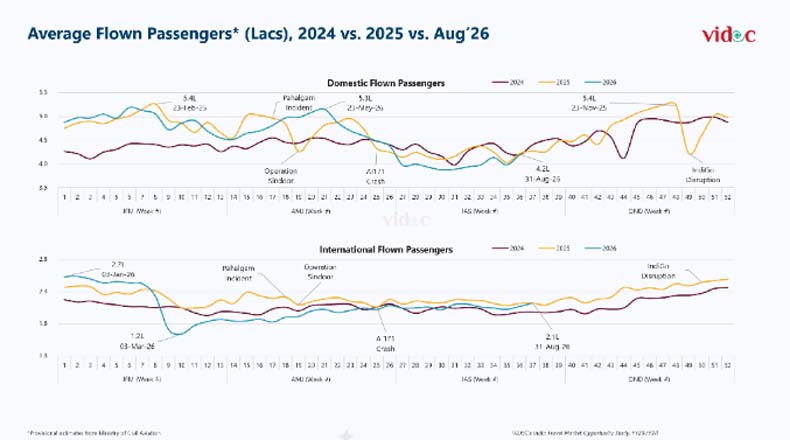
The year 2026 began at a record high on both domestic and international air fronts, hitting peaks of 5.3 lakh domestic and 2.7 lakh international daily flown passengers.
Even in 2025, the Indian air market held its own, despite accidents, war, and supplier issues such as FDTL. Domestic passenger traffic fluctuated, but international traffic remained sacrosanct as it continued to operate above its 2024 trendline throughout the year.
IndiGo carries two in three domestic air passengers (64%), while Tata Group accounts for another quarter (27%) in FY26, making India an airline duopoly.
However, on the international front, Tata Group still commands a slightly higher share (21.1%), while IndiGo has been hard on its heels, almost at par with a 21% share of Indian international passengers. For the uninitiated, IndiGo’s share was at 11.5%, and Tata Group (AI and IX) was 19.4% in FY20, highlighting the growth of the India-based carriers.
A tougher operating environment for air
India travels within its vicinity. Half of Indian outbound departures are to the GCC region, which is within three to five hours by air. The UAE and Saudi Arabia combined accounted for 37% of Indian outbound in 2025, making India one of the major source markets for both of them.
The share of foreign carriers in Indian international airlift is still close to 55%, with Middle Eastern carriers such as Emirates, Etihad, Air Arabia and Qatar Airways, and Southeast Asian carriers like Singapore Airlines and Malaysia Airlines leading India’s international airlift.
Ergo, the geopolitical tensions in West Asia had direct ramifications for Indian aviation. International departures declined drastically to 1.2 lakh in March 2026 and continue to hover below their 2025 trendline. Besides creating major capacity constraints, the disruption also contributed to the oil shock and broader inflationary pressures. Add to this the rupee depreciation.
With around two-thirds of airline costs dollar-denominated, this created a perfect storm resulting in high airline operating costs and untenable airfares. Domestic air passenger numbers are still trailing below 2025; this not only affects airlines’ performance but also online distribution and the Indian OTA market.
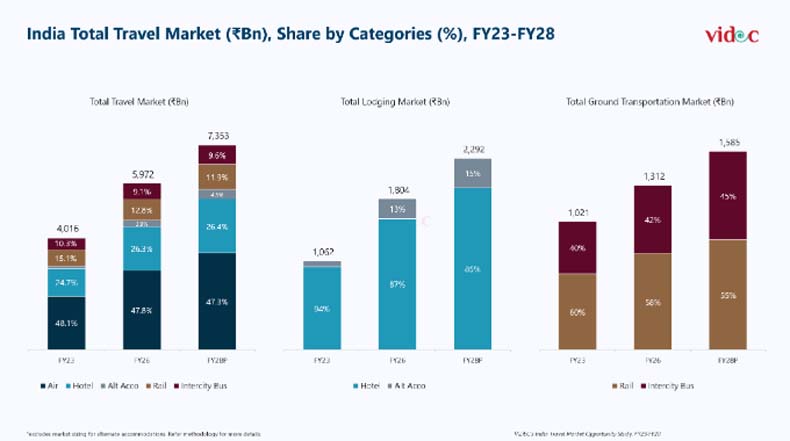
As per VIDEC estimates, the air market makes up almost half of the Indian total travel market valued at ₹6 lakh crore in FY26. Lodging, including hotels and alternative accommodation, accounted for another 30%, while the two ground categories, rail and intercity bus, contributed the remaining 20%.
E-commerce in India began with travel (circa 2004, IRCTC) and broader retail followed much later. OTAs began by servicing online air at their inception.
Accordingly, air continues to remain a substantial topline contributor, accounting for upwards of half of gross booking value (GBV) for India-based OTAs, and as high as 90% for some.
How Indian OTAs are adapting
The Indian OTA market is resilient and variegated, with each OTA having its own consumer cohort and product-market fit. Air is a low-margin, high-volume business. In times of distress, it behoves airlines to work hand in glove with intermediaries to drive demand and recovery, particularly in the outbound air market.
MakeMyTrip Group, the Indian OTA market leader, managed to nominally grow its air GBV amid this backdrop. The next two OTAs, ixigo Group and Cleartrip, made sizeable gains in the air category.
MakeMyTrip is the only true full-service OTA, with product offerings across air and ground transportation, transfers, lodging including hotel and alternative accommodation, holidays, visa, activities and experiences. It has performed particularly well in non-air, with lodging and ground transportation categories growing strongly.
Cleartrip has grown its air business phenomenally in recent years. It has been on a warpath to grow its top line on the back of aggressive discounting, cashback and other forms of customer inducement. Its hotel business has also grown substantially. A dual strategy including B2C and trade distribution, along with the auspices of being part of the larger Flipkart ecosystem (read BBD & nation on vacation sale, supercoins), has allowed it to drive this growth.
ixigo has had its roots in the two ground transportation categories and has been eyeing the next billion Indian users. Its distinct customer base includes a large proportion of newer and first-time air travellers. Its growth is coming particularly from non-metro India, supported by its traveller base, brand and pricing advantage.
Yatra has a different mix, with roughly two-thirds of its GBV coming from business travel, led by an enterprise clientele. Corporate travellers face the same inflationary headwinds, and current geopolitical uncertainty and profitability concerns are making business travel increasingly need-based.
EaseMyTrip had been an air-heavy OTA with air contributing upwards of 90% of its GBV in the past. It reported a decline in its air GBV in FY26 but has managed to increase its non-air contribution, led by hotels.
Paytm is one of India’s largest fintech players and continues to receive substantial traffic, with Paytm Karo still etched in the Indian e-commerce user base. Currently, rail and intercity bus are the two prominent categories for them, but it is a matter of focus for Paytm if and when it decides to double down on broader air and hotels too. Some of the other fintech platforms operate on an affiliate model, unlike Paytm, which has its own content sourcing and fulfilment.
Recovery hinges on cost and capacity
The October-December (OND) quarter in the Indian travel market is singularly significant. The festive and holiday demand, buoyed by discounts, creates massive periodic spikes across travel product categories. The green shoots are already visible, with domestic traffic crossing 4 lakh passengers per day in Aug’26, and the uptick continuing into Sep’26.
A major factor that can dampen the recovery is inflation. Oil is currently trading above $100, and geopolitical uncertainties show no sign of subsiding anytime soon. The inflationary pressures in 2026 have caused airfares to reach an inflection point, beyond which demand begins to palpably soften.
Subsequently, travel becomes necessity-based instead of discretionary, and passengers begin considering alternative modes of transportation.
If these cost and uncertainty pressures persist, the airlines and intermediaries will continue to grapple with the ongoing headwinds. While the current and historical trends indicate a solid OND quarter, the recovery will still be a function of airfare normalisation and capacity resumption, which is further dependent on a variety of macro factors such as oil pricing, forex, and the broader geopolitical environment.
ABOUT THE AUTHOR
 Virendra Jain is the Co-founder and CEO of VIDEC Consultants. He is a serial entrepreneur with 15 years of experience across emerging markets, particularly India, the UAE, Saudi Arabia, China and Southeast Asia.
He specialises in tech-enabled, high-growth businesses and advises companies across leisure and corporate travel on research, commercial due diligence, and buy-side and sell-side M&A.