
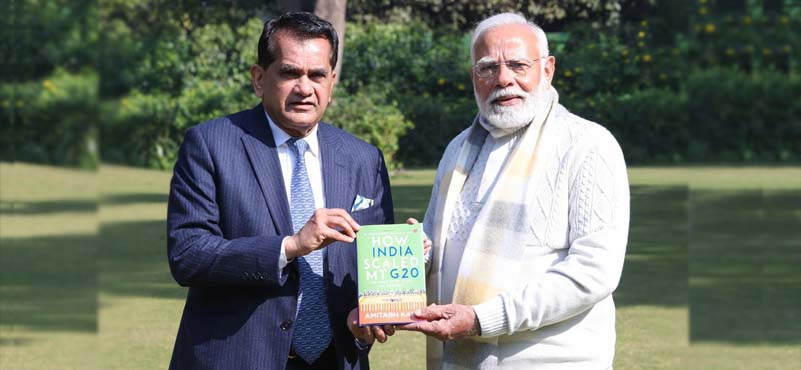
I was beginning to lose hope that India’s ambition to develop its first green-field city would ever become a reality. I was CEO of the Delhi Mumbai Industrial Corridor Development Corporation (DMIDC) at the time and tasked with driving the next phase of India’s industrial urbanisation. Every chief minister had rejected our proposal, saying that earmarking 150 square kilometers for such a project was far too risky and complex. Then I walked into the Gujarat Chief Minister’s office. Mr. Narendra Modi heard me out, took five minutes to think, and said “150 square kilometers is too small.”
“If you’re going to dream, then dream big,” he told me.
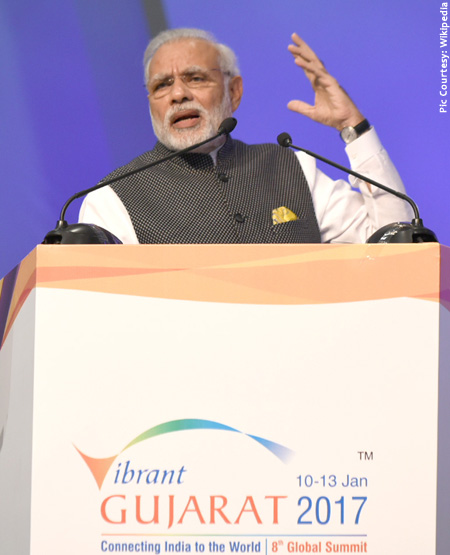
CM Modi offered 750 square kilometers, and by 2009, the Gujarat government enacted the Special Investment Region (SIR) Act and officially declared Dholera SIR alongside its master plan.
That first conversation showed me the scale of his thinking. His canvas was large. He did not see land as a constraint or a project as an isolated intervention. He saw the possibility of building a new engine of growth for Gujarat and, in time, for India. He was, and continues to be, one of the most forward-thinking and visionary leaders I have met over the course of my career.
Shortly afterward, I attended two Vibrant Gujarat Summits and saw his enduring passion for building a developed, dynamic, and world-class state. He wanted Gujarat to be India’s most advanced state, and he pursued that goal with remarkable clarity and energy.
By 2014, the new government had come to power at the centre, and Mr. Modi went from CM to the Prime Minister of India. As the then-Secretary of the Department of Industrial Policy and Promotion (DIPP), I was among the first officials to make a presentation to him. He looked disappointed when he saw that India ranked 142nd in the World Bank’s Ease of Doing Business rankings and asked us to focus on a singular mission – to make India easier, simpler, and more efficient for its citizens and businesses.
That is how the hard work began across ministries and departments. We worked on the Insolvency and Bankruptcy Code, the Goods and Services Tax, and the elimination of outdated rules, regulations, procedures and Acts. Changing the mindset of departments was difficult, but we persisted, and eventually succeeded, because the Prime Minister drove the effort from the very top. India eventually rose 79 places in the rankings.
Soon after, we made several presentations to the Prime Minister on Make in India. He was certain that if India had to become a manufacturing nation, it had to create jobs, drive prosperity and sustain high growth. Make in India was launched from that belief. Today, that vision has expanded into large-scale manufacturing capacity across sectors, from mobile phones—India is 2nd globally—and electronics to automobiles and EVs, pharmaceuticals, defence equipment, solar modules, telecommunications and engineering goods.
He was equally determined to make young Indians entrepreneurs. When the Startup India movement was launched, India had only 356 recognised startups. Today, that number has crossed three lakhs. At the launch, the PM spent an entire day interacting with young entrepreneurs, listening to their ideas, understanding their anxieties, and encouraging them to think beyond the limitations imposed by convention. He has continued to engage with startups ever since, because he understands that entrepreneurship is equally about giving young Indians the confidence to solve problems, take risks, and build a future on their own terms.
For PM Modi, even the sky is not a limit in terms of what is possible. He is one of the most technologically astute leaders, with a remarkable ability to absorb and engage with cutting-edge technologies. His belief in frontier technologies has consistently been accompanied by a willingness to create the policy and institutional conditions that allow Indian entrepreneurs to build in these new areas of growth. Under him, India has created immense opportunities in AI, quantum computing, geospatial technology, drones, defence and space exploration. The success of India’s space missions, including Chandrayaan-3 and Aditya-L1, has been accompanied by the emergence of a vibrant private space ecosystem. In tandem, India’s IndiaAI Mission and National Quantum Mission are building indigenous capabilities in AI and quantum technologies, creating the infrastructure, research ecosystem and talent needed for India to compete at the frontier of technology. And yet, while the PM believes in a tech-forward future, he also respects that which has been inherited. India’s leadership in sustainability, through initiatives like the National Green Hydrogen Mission, ensures that India’s development and industrial growth does not come at the cost of the planet.
This entrepreneurial vision, for many Indians, was made possible by India’s unprecedented push into the world of digital payments. A decade ago, everyday transactions were still dominated by cash and clunky cards; digital transfers were slow, expensive, and out of reach for most small merchants and first‑time smartphone users. What changed was a deliberate, whole‑of‑system effort. The Prime Minister pushed for a less‑cash economy; the Reserve Bank of India strengthened the regulatory framework; NPCI designed and rolled out UPI; and banks, fintechs, telecom companies and merchants together built an open, interoperable payments stack. He challenged our team to organise 100 digital melas in 100 days. That mammoth effort helped create the momentum behind the phenomenal growth of UPI. From just 1.78 crore UPI transactions in FY 2016–17, the system now handles over 24,000 crore transactions a year—more than a 13,000‑fold surge in volume and a 4,000‑fold rise in value. India achieved in seven years what would have otherwise taken 50.
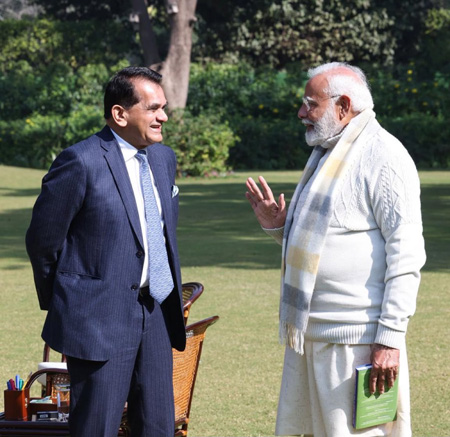 I found myself at the head of India’s apex policy think tank, NITI Aayog, by 2016. During one of our cabinet meetings, PM Modi called me aside and asked me to begin work on India’s most backward districts. He wanted to solve the hardest problems first and ensure that development reached the last person in the line. That conversation led to the Aspirational Districts Programme, through which I saw the PM’s deep belief in real-time data, measurable outcomes and the power of young officers. He was convinced that transforming these districts would transform India. He was also the one to suggest the word “aspirational” because he wanted these districts to be defined by what they could be, and not what they lacked.
The results confirmed his instinct. Districts began improving their performance across health, education, agriculture, financial inclusion and basic infrastructure. In several indicators, they moved ahead of the best-performing districts in the country. The Prime Minister followed the programme closely and insisted that the focus remain on real results on the ground.
One of my greatest lessons from working with him came from the reviews he conducted across India’s infrastructure sectors. NITI Aayog was expected to always do its homework, examine the performance of different ministries, and make detailed presentations. The PM always listened carefully, absorbed information, and then thought several steps ahead. His questions cut to the heart of the matter. He wanted to know what was holding up a project, who was responsible, what could be done immediately, and how the same problem could be prevented elsewhere and in the future.
As a result of his virtual reviews with chief secretaries on the PRAGATI platform, as well as through integrated, data-driven infrastructure through PM Gati Shakti, projects received faster approvals, land acquisition issues were resolved, and risks were identified before they became actual crises. Coupled with the Production-Linked Incentive (PLI) scheme, India has turned this momentum into the active expansion of its infrastructure and manufacturing capabilities.
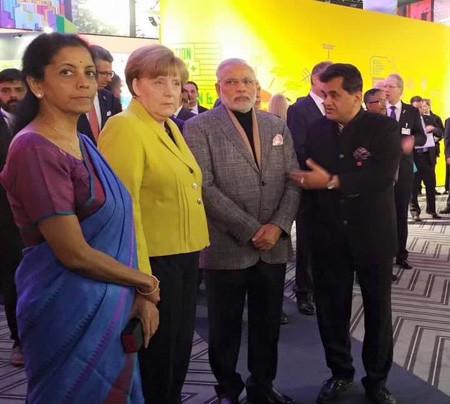 Through the years, I have been privileged to make more presentations to him than perhaps any other official. In each interaction, I saw the same combination of intellectual intensity, discipline, and curiosity. I also saw something that is less often discussed. The PM is an extraordinary listener. He can command a room without silencing it. In meetings, he absorbs perspectives before offering his own. During my time as India’s G20 Sherpa, I tried to follow the practice I had observed in him, listening for most of the meeting before intervening.
As I was leaving NITI Aayog, I called on the PM to offer my gratitude. Instead, he asked me to take on the responsibility of India’s G20 Sherpa, propelling me into the most challenging responsibility of my career. The world was deeply divided, geopolitical tensions were high, and consensus seemed almost impossible. et he was determined that India could bring countries together.
It was in the grip of this conviction that The New Delhi Leaders’ Declaration was crafted and unanimously passed. The negotiations were intense and often exhausting, but despite all our late nights, we continued to emulate the patience and composure set as an example from the top. I have never seen the Prime Minister raise his voice or lose his calm, even under intense pressure. His strength lies in restraint, and his optimism gives those working with him the courage to stand firm in our principles.
Working with Prime Minister Modi has fundamentally shaped my understanding of leadership. From him, I have learned to think at scale, listen deeply, remain calm under pressure, and hold on to the possibility of progress even when circumstances appear discouraging. I have learned that a leader must be willing to imagine what does not yet exist and then bring the full force of the state, the administration, and the nation behind that imagination.
My association with him began with a conversation about 150 square kilometres. It has continued through some of the most consequential transformations in modern India; and while the projects and missions matter greatly, what I carry with me most closely is the experience of working alongside a leader whose core ambition is to transform India into a fully developed economy and, above all, to improve the lives of every Indian.
*Amitabh Kant is former G20 Sherpa of India and CEO, NITI Aayog, and former Secretary, Department of Industrial Policy and Promotion (DIPP).