Introduction
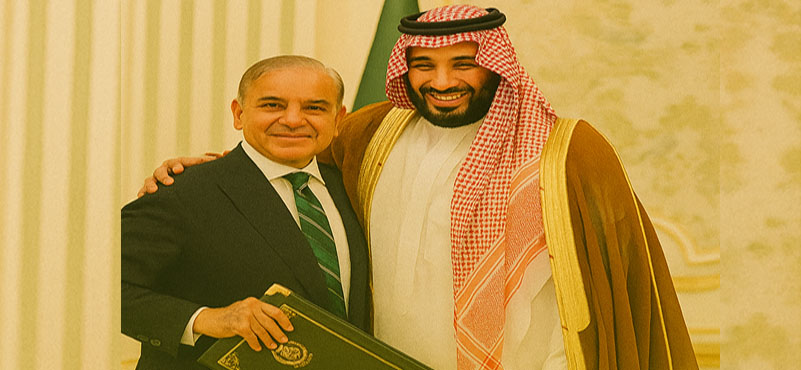
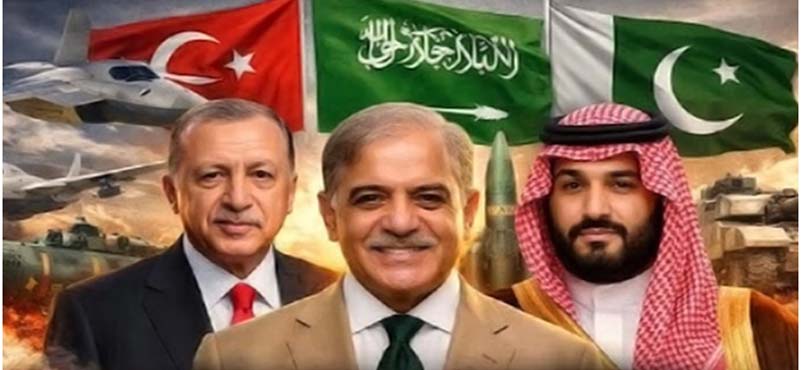
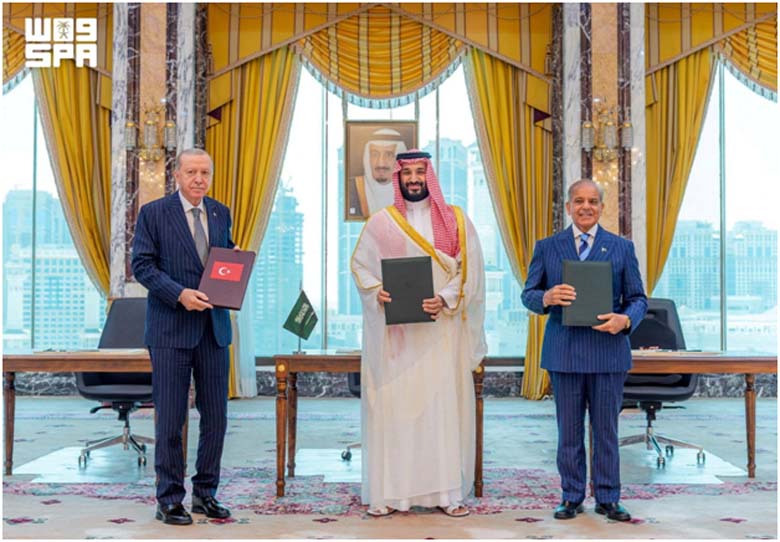
The Mecca Joint Defense Agreement was signed between Saudi Arabia, Türkiye and Pakistan on 07 August 2026 with a far-reaching clause akin to Article V of the NATO Agreement. A trilateral collective-defence framework whose operative sentence reads: “an armed attack on one signatory shall be regarded as an attack against them all.” The agreement was already being touted as the Islamic NATO! However, within a month of its signing seeds of doubt are sprouting.
Collective-defence pacts are meant to deter wars. Yet if signatories make sweeping promises without military integration, decision-making mechanisms, and escalation controls needed to carry them out, the limits of these promises come under question.
In the absence of clearly established mechanisms for military coordination, crisis consultation, and collective response, the agreement is facing serious difficulties in controlling an escalating confrontation. Its strategic significance, therefore, depends less on the declaration of mutual commitment, but on whether its members can translate political solidarity into credible and coordinated capabilities for deterrence and escalation management.
Political Solidarity vs Credible Deterrence
Each signatory has differing strategic motivations. Saudi Arabia seeks greater regional leverage and enhanced deterrence to protect its economic transformation and critical national infrastructure. Türkiye seeks a cooperative framework to manage regional spillover, counter unfavorable strategic shifts, and align its industrial and military capabilities with those of its partners. Pakistan, the only nuclear power aims to leverage its nuclear and conventional military capabilities while deepening economic and defence ties with major West Asian countries.
But the central challenge for them lies in converting political solidarity into a sufficiently credible and flexible deterrence without creating commitments that outpace their capacity to act.
The important question, therefore, whether the ambiguity surrounding how these capabilities might be employed together is sufficient to make potential adversaries including Iran, Israel, or the Houthi’s less willing to test the resolve of any one member.
Divergent Priorities
The most important test for any collective security arrangement is the credibility of its members’ commitment to one another. Although all three have emphasised political solidarity in response to growing uncertainty across the region, the Mecca Joint Defense Agreement remains, largely a political commitment and lacks the military mechanisms necessary for sustained coordination.
The pact is laden with symbolic significance as the three possess military capabilities which are not complimentary. Saudi Arabia contributes substantial financial muscle, advanced Western-origin air and missile defence systems. Türkiye offers a military industrial base manufacturing advanced drones and missile systems and is a part of NATO but is increasingly shifting toward indigenous technologies. Pakistan contributes a large military primarily operating Chinese equipment, with significant combat experience, and a nuclear arsenal.
The fact is that defence-industrial cooperation does not automatically produce military interoperability. Building interoperability across these disparate architectures will require years of investment in common communication standards, data links, doctrines and training. If effectively integrated, these capabilities pose the threat of collective retaliation. But this inter-operability and integration is the pact’s most difficult consequential challenge.
The threat perceptions and strategic priorities are divergent. Riyadh remains primarily concerned with Gulf Security and the protection of critical infrastructure from the Houthi’s. While Ankara’s concerns extend across Syria, Iraq, the Eastern Mediterranean to include Cyprus, Greece and the Caucasus. Islamabad remains heavily focused on India.
These divergent priorities lead potential adversaries questioning whether all three members would incur the costs and risks necessary to defend one another.
No wonder the External Affairs Minister S Jaishankar, when asked about India’s reaction to the agreement said; “There are live military situations which each of the signatories face, what has the Makkah pact done in response to that?”
The Gap
In the aftermath of the agreement’s signing, regional actors continued to challenge the security arrangement: The Houthi’s attacked Saudi strategic targets including Crude oil tank farms at Jazan, and Abha on 08 September, and facilities belonging to state oil giant Aramco, while Israel struck Abu Duhur Air Base, near the Turkish border, shortly after Turkish security officials had visited the area as part of Ankara’s effort to support the development of Syria’s post-civil-war military capabilities. None of these attacks triggered the mutual security promises of the recently signed Agreement.
The lightning advance, by the Houthi’s along Yemen’s Red Sea Coast (that included Perim Island in the Strait of Bab al-Mandab and Mocha, apparently with direct guidance from Iran’s Revolutionary Guards), opened a new front in Iran’s war with the US, as also brought them in direct confrontation with Saudi Arabia.
On 02 September, Mohsen Rezaei, Iran’s Security Chief wrote on X, “You will soon witness that Iran’s new strategy across the battlefield, diplomacy and countering the economic siege will shatter your foundations.”
On 10 September 2026, Pakistan Foreign Ministry Spokesperson Sajjad Haider Khan said, that there were no discussions about a military reaction under the Mecca Agreement in response to the Houthis’ attacks on Saudi Arabia, “when time comes (we) will act under the agreement.” The Defence Minister Khawaja Asif said, that three countries “did not need to respond to aggression with aggression.” The Mecca Joint Defense Agreement is an umbrella agreement, “purely for defensive purposes” and aimed primarily at strengthening regional peace and stability.
The absence of a coordinated military response from the three partners beyond conventional diplomatic condemnations, illustrates the gap between political statements and military action. Unless the pact develops mechanisms for joint planning, intelligence sharing, military exercises, and coordinated responses to aggression, its declaratory commitment may remain insufficient to establish credible collective deterrence.
Each of these countries have regional issues be it with Yemen, Greece and Cyprus or India. In a case of conflict, members would be forced to choose between the alliance’s credibility and their own economic and geopolitical interests. There is thus a wide gap between political ambition and military response.
Implications for India
When you analyse the Mecca Pact, a question crops up is, who will provide security to whom? How will the arrangement work?
The three countries in question, Pakistan, Türkiye, and Saudi Arabia are not neighbouring states. No land borders. Then how exactly are the security guarantees expected to deliver. None of them can boast of super power status with unlimited military hardware.
To evaluate how capacities and capabilities affect the Mecca Joint Defense Agreement in general, and India in particular, we must look at how the alliance is structured. A simple answer to this can be derived from an analysis of the overall military capability of each of the nation states.
The land forces are biased towards Pakistan with approximately 6,00,000 troops, followed by Türkiye with 4,00,000 troops and Saudi Arabia with 2,00,000.
In Air Forces, Turkish Air Force leads with a modernized, heavy-lift transport fleet. Their inventory includes 10 Airbus A400M Atlas strategic airlifters. Each A400M can carry 116 fully geared paratroopers or up to 37 tons of cargo. They also have approximately 19, C-130. A standard C-130, can carry 92 ground troops or 64 paratroopers. There also have 52, CN-235 aircraft, (each can carry up to 44 troops). Therefore, an estimated Single-Wave Troop Lift, of about a brigade (-) worth. They also have a mixed bag of 13-15 fighter aircraft squadrons.
Saudi Arabia has an estimated 30+, Lockheed C-130 Hercules and C-130J Super Hercules variants. 6 Airbus A330 MRTT (Multi-Role Tanker Transport) aircraft. Each A330 can also be configured to fly up to 300 fully equipped troops. Thereby giving it an estimated Single-Wave Troop Lift, of less than a brigade. They have 15-17 squadrons of relatively modern American and European fighter squadrons.
Pakistan has roughly 16 Lockheed C-130 Hercules variants. 4 Ilyushin Il-78 aerial tankers and some CN-235 and Y-12 utility aircraft used for short-range movements. Total estimated Single-Wave Troop Lift of less than two battalions. Their fighter squadrons total to almost 25 squadrons, comprising mainly of legacy fighters, but also include F-16, JF-17, and JF10CE.
The naval lift capabilities of Türkiye, Saudi Arabia, and Pakistan could dramatically expand the scope of the Defense Agreement. However, other than Türkiye, the naval assets of the other two countries are comparatively nascent in size and designed for domestic security challenges. They are not classically designed for “out of area contingencies.”
Türkiye has the most sophisticated naval projection capability. The TCG Anadolu, a multi-purpose amphibious assault ship acts as a floating command center. It can carry a fully equipped battalion-sized marine task force (940 troops) along with tanks, and landing craft. It can deploy armed drones (like the Bayraktar TB3), giving it precision strike capabilities during a naval deployment without needing land-based aircraft, but it is a drone carrier, not an aircraft carrier. Türkiye fields several large tank landing ships (LSTs), each capable of carrying 350 troops and up to 20 MBTs (Main Battle Tanks).
Thus, the naval forces of each country are designed to meet specific regional security requirements. While inter-operability is possible, any such employment would create critical voids in the already limited naval assets.
Theoretically speaking, if the alliance had to deploy a joint task force tomorrow, it would be safe to assume that Pakistan can provide raw manpower for dispatch to a regional staging ground, for which combined heavy lift capability would be required. Such a deployment would face interoperability challenges because it would entail a mix of Western (Airbus, Lockheed) and Eastern (Ilyushin) aircraft. The combined naval sealift assets could be used to sustain medium-scale military operations over limited periods.
The next question is, which is the country from where they are expecting a common threat? Israel/Iran? A simultaneous offensive from both Türkiye and Pakistan, can pose a major threat to Iran. However, there have been no deliberate attacks on targets inside Türkiye or Pakistan, by Iran recently. In fact, Iran has been invited to join the trilateral agreement! Israel does not share land borders with all three. That leaves, India.
To take this argument further, one has to pinpoint the driving force behind the Mecca Joint Defense Agreement. It would be safe to assume that the principal architect behind the security arrangement was Field Marshall Asim Munir. When we dwell into the psyche of Asim Munir further, there is little left to imagination as to whom he perceives as his enemy and a threat to the State of Pakistan. Therefore, while conceiving the pact, he probably was not looking towards West Asia at all. His concern was only India centric.
Let us breakdown this Security matrix as probably perceived by Field Marshal Asim Munir. He hopes that in case of an Op Sindoor type of conflict with India, Türkiye would immediately reach out to assist Pakistan. So, Türkiye would indirectly be at war with India. But Türkiye is a part of NATO, and would India like to be at war with a NATO backed country?
The other partner is Saudi Arabia. If Pakistan is at war with India, then Saudi Arabia will support Pakistan, and therefore also be indirectly at war with India. The net security provider to Saudi Arabia is the USA. If Saudi Arabia is at war, then by virtue of their security agreement USA too would enter the war.
Now look at this from a hypothetical context. India, in response to any Pahalgam like misadventure by Pakistan, would launch Op Sindoor II. (India has already stated that Op Sindoor is unfinished business). Asim Munir will hope that such a response would draw Saudi Arabia and Türkiye into the conflict, and if they do, then indirectly their net security providers, would also be drawn into the conflict. Though this may sound absurd, and whether it will happen or not is conjecture, but theoretically the possibility exists.
Asim Munir is taking on a role in regional politics that he cannot sustain. Sooner or later the veil will drop and his reality exposed. Türkiye and Saudi Arabia are too involved in their own security issues to jump in aid of Pakistan. With the non-existence of land borders between Saudi Arabia, Türkiye and Pakistan, their combined military capability and lack of compatibility, one can safely assume that, the Mecca Joint Defense Agreement is not an immediate threat for India. India must continue to analyse the collective ground, air and naval capabilities of all three, to arrive at logical and militarily sustainable conclusions. While doing so there should be no letup in modernizing our military hardware. With the kind of mindset of our neighbour, we cannot afford to wish away the threat, instead, we must prepare for the worst.
Conclusion
India has to reconstruct its stand on “Strategic Autonomy.” This is a time to make friends. The India-Saudi relationship, for example, has always been good. PM Narendra Modi recently visited Saudi Arabia in 2025. This bilateral relationship must be strengthened.
Türkiye and Indian relationship hit an all-time low given Türkiye’s open support to Pakistan over Kashmir and during Op Sindoor last year. However, there is room for improvement, for which efforts must be made.
Overall, the diplomatic effort towards entire West Asia needs recalibration. Sustained efforts with Iran will nullify any adversity that the US-Israel-Iran war might have had.
Pakistan-Saudi Arabia defence cooperation is nothing new. They have had written agreements since decades. Pakistan has traditionally had military presence in Saudi Arabia. Both Saudi Arabia and Türkiye actively supported Pakistan during the 1971 Indo-Pak war, by providing fighter planes and other military wherewithal. There was no Mecca Agreement then. Therefore, India can surely expect similar support in any future Indo-Pak war, however, with their own regional security issues, anything substantial may not be practical in the present scenario.
As deduced that unless the agreement’s political commitments are matched by credible capabilities and mechanisms for coordination, the Mecca Agreement risks overpromising while underdelivering. Such a gap could not only weaken its deterrent value, but also complicate crisis management. No wonder the pact currently appears less like the foundation of a new deterrence architecture and more like a high-stakes political experiment. Its significance should therefore be assessed realistically rather than be viewed by promises it has not been designed to fulfil. It remains, like a rainbow in the sky, on a sunny day.
ABOUT THE AUTHOR
 Maj Gen VK Singh, VSM was commissioned into The Scinde Horse in Dec 1983. The officer has commanded an Independent Recce Sqn in the desert sector, and has the distinction of being the first Armoured Corps Officer to command an Assam Rifles Battalion in Counter Insurgency Operations in Manipur and Nagaland, as well as the first General Cadre Officer to command a Strategic Forces Brigade. He then commanded 12 Infantry Division (RAPID) in Western Sector. The General is a fourth generation army officer.
 Major General Jagatbir Singh was commissioned into 18 Cavalry in December 1981. During his 38 years of service in the Army he has held various command, staff and instructional appointments and served in varied terrains in the country. He has served in a United Nations Peace Keeping Mission as a Military Observer in Iraq and Kuwait. He has been an instructor to Indian Military Academy and the Defence Services Staff College, Wellington. He is a prolific writer in defence & national security and adept at public speaking.