Brent crude, which touched nearly $108 a barrel on September 14, 2026—its highest level since July amid renewed fighting in the Middle East—together with August retail inflation of 4.82%, does not yet signal a macroeconomic crisis for India. It does, however, leave considerably less room for policy error. If crude remains above $100 long enough to lift freight, input and inflation-expectation pressures beyond the food basket, the RBI’s scope for easing will diminish while the government faces renewed pressure to cushion fuel costs. India’s external buffers make the shock manageable; they do not make imported-energy dependence irrelevant.
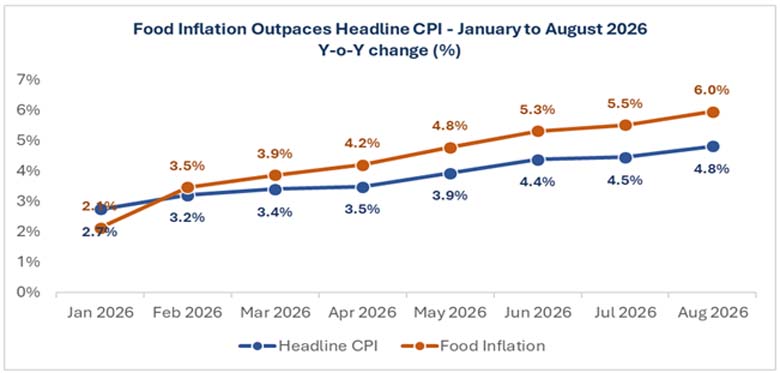
India’s Consumer Price Index (CPI) inflation rose to 4.82% in August, from 4.45% in July—the third consecutive month above the RBI’s 4% medium-term target. Food inflation accelerated to 5.95%, with especially sharp increases in essential kitchen items. India has huge foreign-exchange reserves, a manageable current-account deficit in the recent past, and a financial system more resilient than it was in earlier episodes of external stress. Yet the combination is manifestly unedifying. My views on these issues were prominently featured in sections of the national and international press, viz., Reuters, Bloomberg, The Economic Times, ANI, Business World, Hindu Business Line, Business Standard, etc.
Surging Oil Prices
A sustained oil shock can feed directly into transport and fuel costs and indirectly into food, manufactured goods and services. Food inflation is particularly worrisome because its burden falls disproportionately on rural and lower-income households, eroding their real purchasing power. It also makes the RBI’s task of sustaining economic growth while preventing inflationary expectations from becoming entrenched more difficult.
The risk transcends a larger oil-import bill. Higher crude prices could compound imported inflation, persistent food-supply pressures, fiscal constraints and pressure on the rupee, while narrowing the RBI’s scope for a more accommodative monetary-policy stance. India has the capacity to absorb oil at $108 a barrel, but a prolonged period of elevated prices would make the policy trade-offs considerably more difficult. The central risk is not a brief spike in crude prices, but Brent remaining at or above $100 a barrel for a prolonged period. Such persistence would materially worsen the trade-off between supporting growth, containing inflation and preserving fiscal stability.
Rising Crude Prices and India’s Vulnerability
India remains structurally exposed to crude-oil shocks because it imports the overwhelming bulk of its oil requirements. Between April and January of FY26, crude imports accounted for 88.6% of the country’s requirement. This dependence means that any sustained rise in dollar-denominated oil prices goes well beyond its immediate impact on petrol pumps, airlines and refineries. It becomes a national income shock, as India must pay more abroad for the same volume of energy, thereby transferring a larger share of its national income to the rest of the world.
The immediate impact of higher crude prices is visible in the oil-import bill. But the larger macroeconomic effect unfolds through several channels. First, costlier crude worsens the merchandise trade deficit. India’s petroleum imports are among the most consequential items in its import basket. Unless higher oil prices are offset by stronger merchandise exports, buoyant services receipts or lower non-oil imports, the trade deficit widens. This in turn places pressure on the current account deficit (CAD). Second, a larger oil bill raises demand for dollars. If global risk aversion is already elevated because of geopolitical tension, tighter global financial conditions or concern over inflation, foreign portfolio flows can weaken just as India’s dollar demand rises. The result can be pressure on the rupee. A weaker currency then magnifies the local-currency cost of crude and other essential imports, including fertilisers, edible oils, chemicals, machinery and electronic components. Thus, oil inflation and currency depreciation can become mutually reinforcing. Third, high oil prices impose a fiscal-policy dilemma. The Centre and the states collect substantial revenues from petroleum taxation. However, when international prices rise sharply, governments face political and economic pressure to soften the blow through excise-duty cuts, reduced cesses, delayed retail-price adjustments, LPG support or other forms of fiscal accommodation. Such measures can cushion consumers in the short run, but they carry a budgetary cost. If oil marketing companies absorb part of the increase instead, their balance sheets and investment capacity suffer.
RBI research has estimated that a $10-per-barrel increase in crude can add roughly 49 basis points to headline inflation if the shock is passed through, while absorbing it through fiscal measures may add approximately 43 basis points to the fiscal deficit. The eventual impact will depend on movements in the exchange rate, the tax structure, the extent of administered-price adjustments, global petroleum-product prices, and how long the shock persists. Nevertheless, the underlying policy reality is unmistakable: the cost cannot disappear; it can only be shifted—onto consumers, the exchequer, oil companies or future taxpayers.
A sustained average crude price near $100 a barrel could widen India’s FY27 CAD substantially, with some assessments putting it in a 1.9–2.2% of GDP range, compared with earlier projections below 1%. That would not, by itself, indicate external-sector stress. It would, however, narrow India’s buffer at a time of potentially volatile capital flows and continuing geopolitical risks to energy supplies.
Inflation: Beyond A One-Month Aberration
The August inflation reading is significant not because 4.82% breaches the RBI’s formal tolerance band but because it suggests a clear deterioration in the inflation trajectory. CPI inflation was above the 4% target for the third consecutive month, while the August reading was the highest in several months. Food inflation rose from 5.52% in July to 5.95% in August. The distinction between the 4% target and the 2–6% tolerance band matters. The target is the desired medium-term inflation anchor; the band is not a zone in which the RBI can be indifferent. An inflation rate of 4.82% is legally tolerable, but it is not policy-neutral when price pressures are broadening and when household perceptions of inflation are being shaped by the visible cost of food, transport and daily necessities.
The food component deserves particular emphasis. India’s CPI is not experienced uniformly across income classes. Households with lower incomes devote a considerably greater share of their budget to food, cooking fuel and transport. For such households, a headline CPI number can understate lived inflation. The rise in prices of onions, garlic and ginger illustrates the point: these are not discretionary purchases that can easily be postponed. Official and media reporting indicated that onion inflation reached 48.27% year-on-year in August, garlic inflation 43.60%, and ginger inflation 73.82%.
The rural-urban differential is also noteworthy. Rural CPI inflation stood at 5.23% in August, compared with 4.31% in urban areas. Rural food inflation was 6.13%, higher than the 5.64% recorded in urban areas. This matters not only from the standpoint of welfare and consumption but also because rural demand has been an important component of the broader growth narrative. Persistent erosion of purchasing power can weaken demand for consumer goods, two-wheelers, entry-level housing inputs, durables and other mass-market products.
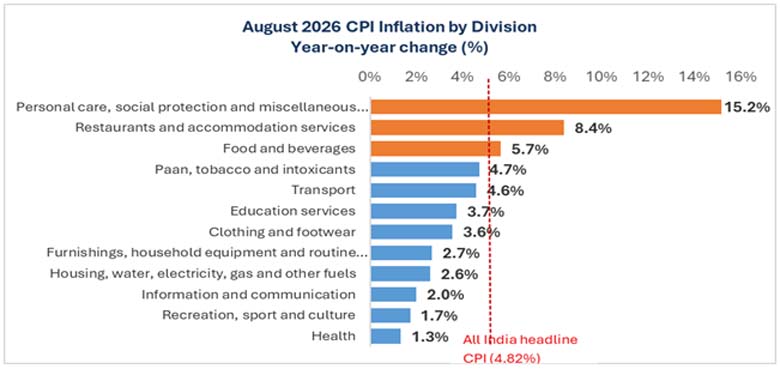
Inflation driven by weather, crop cycles or local supply bottlenecks is not automatically a case for monetary tightening. The RBI cannot produce onions, improve rainfall or unclog a disrupted supply chain through a higher policy rate. But monetary policy cannot ignore food inflation either, especially when an external oil shock threatens to transmit price increases beyond the food basket. This is the central concern: the economy may be moving from isolated food-price volatility to a broader second-round inflation process. Higher fuel and freight costs raise the expense of transporting farm produce to wholesale and retail markets. They increase the cost of operating irrigation pumps, cold storage, tractors and agricultural logistics. They also feed into fertiliser production and distribution. As transport costs rise, construction, consumer goods, restaurants, delivery services, travel and other sectors are impacted. What begins as an oil shock can eventually become an economy-wide cost shock.
WPI-CPI Divergence: Wholesale Cost Pressures Need Constant Vigilance
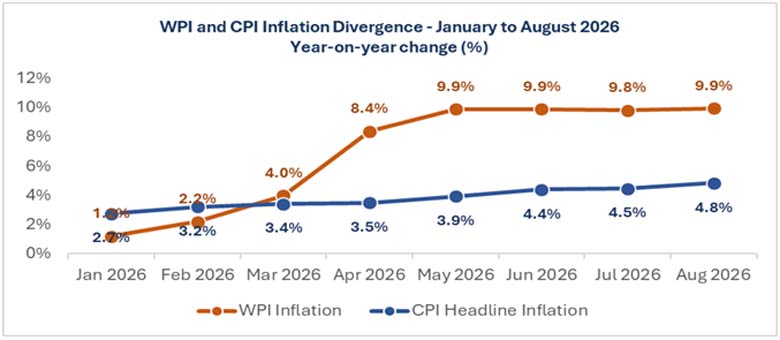
A significant feature of the current inflation landscape is the wide divergence between wholesale and consumer price inflation. While headline CPI inflation stood at 4.82% in August 2026, WPI inflation rose to 9.92%, up from 9.78% in July. The gap of more than 5 percentage points highlights the substantially stronger price pressures currently visible at the wholesale level.
The composition of WPI inflation is particularly important. Fuel and power inflation accelerated to 22.93% in August from 20.05% in July, while manufactured products inflation increased to 8.37% from 8.29%. At the same time, primary articles inflation moderated to 7.76% from 8.52%, indicating that the August increase in wholesale inflation was driven increasingly by energy and manufactured-product prices rather than a broad acceleration in primary articles.
The manufacturing component also points to the breadth of wholesale price pressures. Inflation remained in double digits across seven manufacturing sub-groups – tobacco products, textiles, chemicals, rubber and plastics, base metals, electrical equipment and other manufacturing. Together, these sub-groups account for around 26.3% of the WPI basket, suggesting that elevated wholesale inflation is not confined to a single commodity.
The gap between WPI and CPI does not imply that higher wholesale prices will pass through fully or immediately to consumer inflation. Wholesale prices are more sensitive to movements in commodities, energy and production inputs, while consumer prices also reflect retail margins, services and household consumption patterns.
The key concern is, therefore, persistence and transmission. If elevated energy and manufacturing input costs continue, businesses may gradually pass higher transportation, logistics and production costs through to final prices. In such a scenario, the current WPI-CPI gap could become an important source of future consumer-price pressure. WPI therefore serves as an important pipeline indicator. It does not imply that CPI will follow mechanically, but persistent wholesale price pressures could eventually feed into retail inflation if they are transmitted through higher input and production costs.
The Monetary-Policy Conundrum
The RBI’s task has become more difficult. If the recent rise in inflation were confined largely to vegetables and other temporary food-price shocks, there would be little case for responding through interest rates. The more appropriate course would be to allow supply-side measures and normal seasonal corrections to work through. The situation changes, however, if higher food prices are accompanied by firmer core inflation, costlier fuel and transport, and continued pressure on the rupee. In that event, what initially appears to be a series of supply shocks could begin to acquire a more persistent character.
Core inflation deserves particular attention in this context. Unlike headline inflation, it provides a better indication of whether price pressures are spreading beyond food and fuel into the wider economy. Higher input costs, wage pressures, stronger demand or the gradual pass-through of earlier commodity shocks can all contribute to such a process. For the RBI, the real concern is not a temporary rise in the headline number, but whether inflation is becoming sufficiently broad-based to alter expectations and pricing behaviour.
There is, therefore, a genuine policy trade-off. Higher interest rates can help contain demand, steady inflation expectations and provide some support to the rupee. But they also come with costs. Borrowing becomes more expensive for households and businesses, investment decisions can be deferred, and debt-servicing pressures can rise. At a time when India is seeking to sustain the momentum of private investment, monetary tightening cannot be viewed as costless.
But easing monetary policy too quickly in the face of persistent inflation carries its own risks. Once households and businesses begin to factor higher inflation into wages, prices and contracts, bringing inflation back down can become considerably more difficult. The RBI, therefore, has to strike a careful balance. Its 4% inflation target must remain a credible anchor, even though the present rate is still within the statutory tolerance band.
At present, a cautious and data-dependent approach is appropriate. The crucial questions are whether the September and October inflation readings confirm a broader diffusion of price pressures, whether Brent crude remains elevated, whether pressure on the rupee persists, and whether the monsoon and food-supply conditions provide some relief. The RBI should not respond aggressively to what may prove to be a temporary supply shock. Equally, it would be unwise to assume that every food-price increase will simply reverse on its own. The distinction between a temporary disturbance and a more persistent inflationary process will ultimately determine the appropriate monetary-policy response.
Fiscal Choices and Market Consequences
The government’s policy options are constrained but not absent. A blanket fiscal response, such as large, open-ended fuel subsidies or sweeping tax cuts, may provide temporary relief but would be expensive and poorly targeted. It could also undermine fiscal consolidation, reduce revenue flexibility and increase government borrowing. Higher borrowing, in turn, can put upward pressure on bond yields and partly neutralise the relief intended for the economy. A more prudent approach would distinguish between broad price suppression and targeted protection. If support is required, it should focus on vulnerable households, essential cooking fuel, public distribution mechanisms and supply-chain interventions rather than indiscriminate subsidisation of all fuel consumption. Strategic use of buffer stocks, faster movement of perishables, action against avoidable hoarding, calibrated import management where appropriate, and improved market intelligence can help moderate food-price spikes more effectively than interest-rate changes alone.
The oil shock will affect companies and equity markets unevenly. In the near term, however, investors are likely to adopt a risk-off stance as higher energy costs threaten corporate margins, inflation expectations and the outlook for interest rates. Higher crude threatens corporate margins, pushes up inflation expectations and bond yields, raises concerns about a weaker rupee, and can deter foreign portfolio investors. The pressure is likely to be greatest on oil-intensive and price-sensitive sectors:
- Airlines face higher aviation-turbine-fuel costs, often without the ability to fully pass them on immediately.
- Logistics and transport companies confront higher diesel expenses.
- Paint, chemicals, plastics and packaging businesses face more expensive petroleum-linked inputs.
- Cement manufacturers may see higher freight and energy costs.
- Consumer-goods companies may face a difficult choice between raising prices, reducing package sizes or accepting lower margins.
- Downstream oil-marketing companies can be hurt if retail fuel prices do not reflect higher procurement costs.
There are, however, partial beneficiaries. Upstream producers such as ONGC and Oil India may gain from higher crude realisations, subject to taxes, windfall levies and policy interventions. Refiners’ performance will depend less on crude prices alone and more on refining margins, product cracks, inventory gains and the degree of pricing freedom. Over the longer term, high and volatile petroleum prices strengthen the economic rationale for renewable energy, electric mobility, domestic natural-gas development, storage, energy efficiency and electrified public transport.
This is the broader strategic lesson. India’s exposure is not merely cyclical; it is structural. Every oil shock is a reminder that energy security is inseparable from macroeconomic stability. Faster expansion of renewable generation, grid investment, battery storage, rail freight, urban public transport, fuel efficiency, biofuels and domestic exploration cannot eliminate crude dependence overnight. But they can steadily reduce the severity of future external shocks.
Not Yet a Crisis, But No Room for Complacency
It would be premature to describe the present situation as a macroeconomic emergency. India is better placed to absorb an oil-price shock than it was during earlier episodes, with a relatively strong external position. The CAD was 0.8% of GDP in the first half of FY26, while sizeable foreign exchange reserves provide a meaningful cushion against volatile capital flows and pressure on the rupee.
The distinction that matters most is between a short-lived price spike driven by market nerves and a genuine, lasting disruption to physical supply. Should Brent ease once the immediate geopolitical episode passes or should the flow of crude through West Asia continue undisturbed, the macroeconomic consequences would prove containable. Accordingly, fiscal prudence need not be sacrificed, and the RBI would retain the latitude to look through the shock rather than respond to it.
Complacency, however, would be just as mistaken as alarm. The risk profile changes materially if three conditions arrive together: Brent holds above $100 for several months; shipping lanes or supply flows through West Asia are interrupted; and food inflation stays elevated well past the monsoon. Should those converge, India would confront the most awkward variety of inflation to manage — supply-driven in origin, yet steadily widening in its effects on costs, expectations and household consumption.
The immediate policy priority is to prevent higher oil and food prices from feeding into a broader and more persistent inflationary cycle. This requires policy to move on several fronts at once — a watchful central bank, assistance aimed at vulnerable households rather than dispersed across all consumers, swift action to clear food-supply bottlenecks, orderly handling of exchange-rate pressure, and sustained progress in loosening the country’s grip on imported energy.
Conclusion
Brent crude at $108 a barrel and retail inflation at 4.82% do not, by themselves, constitute a crisis. Taken together, however, they leave little room for policy complacency. India enters this episode with meaningful macroeconomic buffers—substantial foreign-exchange reserves, a relatively modest current-account deficit and stronger institutional resilience. These provide a measure of protection, but they do not alter India’s underlying vulnerability to imported energy.
With 88.6% of its crude requirements met through imports, India remains highly exposed to a prolonged rise in oil prices. A sustained increase would swell the import bill, put pressure on the rupee and widen external imbalances, while leaving policymakers with the difficult choice of either passing the higher costs on to consumers or absorbing them through the fiscal system.
August CPI inflation of 4.82%, together with food inflation of 5.95%, reflects a real erosion of household purchasing power, particularly in rural India and among lower-income consumers whose expenditure is concentrated in food and fuel. The concern, therefore, extends well beyond a temporary rise in petrol prices or a seasonal spike in vegetable prices. The more consequential risk lies in the transmission of these initial shocks into the broader economy—through higher freight and logistics costs, rising input and production expenses, costlier services and a squeeze on real household incomes. If such pressures persist, they could also begin to influence inflation expectations, creating second-round effects that make the inflation process more broad-based and persistent, and potentially complicate the conduct of monetary policy.
Where do we go from here? The appropriate response is calm, sustained vigilance—avoiding an over-reaction and complacency. As I have repeatedly emphasised over the decades, the RBI must remain alert to persistent and broadening price pressures, without using interest rates as a substitute for food-supply management. If inflationary pressures persist, particularly in retail inflation, the RBI may face the difficult task of recalibrating its monetary policy stance in the forthcoming policy reviews. While remaining attentive to the growth–inflation trade-off, the central bank may need to tighten monetary conditions gradually, including through a possible repo rate increase, if broad-based price pressures persist. The aim would be to prevent inflation from becoming entrenched and to keep it within the RBI’s mandated tolerance band, alongside its efforts to absorb surplus liquidity from the financial system.
The government should avoid broad-based fiscal giveaways and focus its resources where they matter most—supporting vulnerable households, strengthening supply chains and ensuring that temporary shortages do not turn into persistent inflation. More fundamentally, the episode highlights a strategic imperative for India: reducing dependence on imported oil is not merely an environmental priority. It is essential for strengthening economic sovereignty, insulating the economy from external shocks and building greater macroeconomic resilience.
ABOUT THE AUTHOR
 Dr. Manoranjan Sharma is Chief Economist, Infomerics, India. With a brilliant academic record, he has over 250 publications and six books. His views have been cited in the Associated Press, New York; Dow Jones, New York; International Herald Tribune, New York; Wall Street Journal, New York.