There are moments when the numbers themselves become unbearable.
Hundreds dead. Thousands missing. Entire settlements swallowed. Families standing outside hospitals, rescue centres and military camps, holding photographs of people who have suddenly become names on a list of the missing.
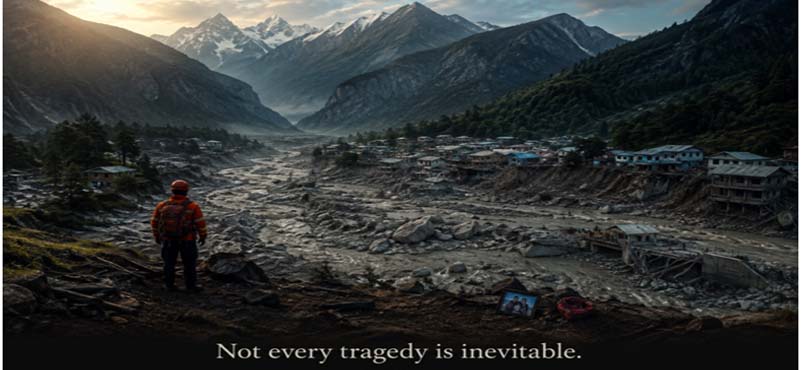
The tragedy unfolding in the High Himalayas is one such moment. On August 26, a glacial collapse and massive debris flow triggered flash floods along the Nepal–Tibet border, sending an unimaginable wall of water, rock, mud and ice through valleys and settlements. Roads disappeared. Bridges were swept away. Homes and infrastructure vanished within minutes. As rescue teams continue their desperate search, the death toll has risen into the hundreds and thousands remain unaccounted for.
It is difficult to comprehend what “hundreds missing” actually means.
It means hundreds of families waiting for a telephone call that may never come. It means mothers, fathers, children, brothers and sisters staring at photographs and refusing to accept the possibility that the person in the picture may never walk through the door again. It means an empty chair at a dining table, a phone that does not ring and a life suddenly divided into everything that existed before one terrible morning and everything that came after it.
And yet, perhaps the most troubling thought is not that nature can be so destructive. It is that we have become accustomed to tragedies that we could have prevented.
The Himalayas remind us of the first kind of tragedy: the catastrophe that arrives with forces vastly larger than human beings. A mountain can collapse. A glacier can move. A river can change its course. Nature does not negotiate with our plans, our borders or our ambitions.
But even here, the boundary between a “natural disaster” and a human tragedy is becoming increasingly blurred. Scientists have repeatedly warned that a warming Himalayas is becoming more hazardous as glaciers retreat, ice and rock destabilise and extreme events become harder to predict. The people living beneath those mountains have contributed very little to the forces accelerating the climate crisis, yet they are among those increasingly exposed to its consequences.
That is the cruel irony of climate change. Those who often have the smallest footprint can find themselves standing beneath the largest consequences. Not every tragedy can be prevented. But many can be.
We cannot stop every earthquake. We cannot prevent every glacier from collapsing. We cannot guarantee that a river will never flood or that a mountain will never give way.
But we can build early-warning systems. We can map vulnerable settlements. We can regulate construction in fragile valleys. We can ensure that pilgrims, trekkers and workers are not left exposed to known risks. We can establish evacuation routes and communication networks that continue to function when roads disappear. We can share data across borders. We can listen to scientists before catastrophe rather than after it. And we can invest in resilience not as an abstract development goal but as an insurance policy for human life.
These are not spectacular acts. They do not produce dramatic headlines. No politician gets photographed cutting a ribbon on an early-warning system with the same enthusiasm as inaugurating a bridge or a power project. But when disaster comes, these invisible investments can be the difference between a frightening event and a mass grave.
That is why Nepal should not merely make us grieve. It should make us ask questions. How much did we know? How much could we have known? What warnings existed? Were they communicated? Were people equipped to act on them? Were vulnerable communities included in the planning of development around them? And when the next disaster comes—and another one inevitably will—will we be better prepared?
The same questions apply far beyond the Himalayas.
Every year, people die in floods because drainage systems were inadequate. People die in fires because exits were blocked or safety regulations were ignored. Workers die at construction sites because safety was treated as an expense. Buildings collapse because corners were cut. Roads claim lives because engineering standards were compromised. Industrial accidents become disasters because warnings were overlooked.
None of these tragedies makes as much noise as a war or a Himalayan catastrophe. There are no dramatic satellite images of them. No international rescue teams. No television correspondents standing in front of ruins. Yet they are tragedies all the same.
Perhaps we need to change the way we think about human progress. Progress is not merely the ability to build higher, faster and larger. It is the ability to make human beings safer while we build.
A nation is not truly prepared because it possesses sophisticated technology. It is prepared when that technology reaches the last person standing in the path of danger. Some tragedies belong to the mysterious and uncontrollable forces of nature. Others are made larger by our complacency, our greed, our failures of planning and sometimes our inability to imagine tomorrow.
The Himalayas remind us of the forces before which all human beings are vulnerable. We cannot command the mountains. We cannot silence every river. We cannot eliminate every danger. But we can make fewer people stand helplessly beside the ruins and ask the most painful question of all: Could this have been prevented? That question should become one of the most important measures of civilisation.
Because ultimately, progress is not about how much destruction we can survive. It is about how much suffering we have the wisdom to prevent.
ABOUT THE AUTHOR

Lt Gen Rajeev Chaudhry (Retd) is a social observer and writes on contemporary national and international issues, strategic implications of infrastructure development towards national power, geo-moral dimension of international relations and leadership nuances in changing social construct.