Pakistan’s Economic Fragility and Military Resurgence
The Planes Are Landing
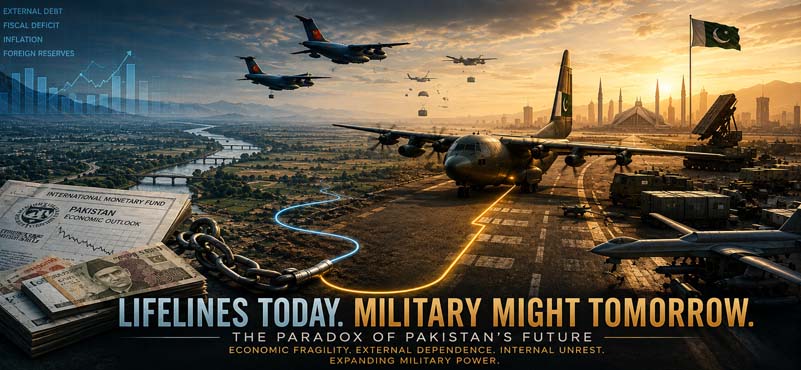
There is something unsettling about military transport aircraft repeatedly landing at Pakistani air bases. Between August 19 and 21, multiple Turkish C-130 aircraft reportedly made repeated sorties to Pakistan, while reports have also pointed to increased Chinese military air traffic. Indian defence circles are watching the movement closely amid speculation about transfers of drones, air-defence systems and other military equipment.
These aircraft, however, may be carrying something more consequential than weapons. They may be carrying the early signs of a new strategic equation in India’s neighbourhood.
Pakistan is economically fragile, internally restless and increasingly dependent upon external strategic partners. Yet its military capabilities are being replenished and its diplomatic space is widening. On August 7, Pakistan, Türkiye and Saudi Arabia signed the Makkah Joint Defence Agreement, committing themselves to collective defence and declaring that an armed attack on one would be regarded as an attack on all.
The question confronting India is therefore no longer simply what Pakistan can do to India. It is what a weakened but increasingly militarised Pakistan, backed by a widening external security network, may become.
Why Is Pakistan Recalibrating?
- Operation Sindoor and the “Thousand Cuts” Doctrine. For decades, Pakistan’s strategy against India rested on a carefully calibrated proposition: bleed India through terrorism and proxy warfare, deny direct responsibility, shelter behind nuclear deterrence and rely upon international pressure to restrain India’s response. The strategy worked because Islamabad assumed that India would always have to calculate the enormous cost of escalation with a nuclear-armed neighbour.
Operation Sindoor altered that calculation. India demonstrated that nuclear weapons would not provide an unlimited shield against a calibrated and precise response to terrorism. The significance of Sindoor therefore lies not merely in the targets destroyed, but in the strategic message it delivered: terrorism emanating from Pakistani soil could invite direct consequences. The old doctrine of a thousand cuts depended upon India being unable—or unwilling—to respond proportionately. Sindoor has challenged that assumption. - Indus Waters: When Economic Vulnerability Becomes Strategic. The second pressure point is water. Pakistan’s economy, agriculture and food security are deeply dependent upon the Indus river system. The Indus Waters Treaty, for decades, was therefore treated in Pakistan almost as a permanent strategic guarantee. India has now kept the treaty in abeyance, linking its restoration to Pakistan’s credible and irreversible renunciation of support for cross-border terrorism. The strategic significance lies elsewhere. Pakistan has discovered that something it considered almost immutable can become part of the larger national-security equation. For an economy already dependent upon external financial lifelines, that introduces another layer of uncertainty.
- Balochistan: The Federal Question. Then comes Balochistan. The Baloch problem is not simply another law-and-order challenge. It combines ethnic nationalism, resource grievances, political alienation, opposition to Islamabad and growing hostility towards Chinese projects. The reported claims surrounding an August 11 independence declaration should be treated cautiously. But even without such a declaration, the persistence of the Baloch insurgency is significant enough. The issue is no longer whether Pakistan can suppress individual militant attacks. The larger question is whether coercion can permanently manufacture political loyalty. That is a question about the future of Pakistan’s federal structure.
- POJK and the Periphery. The continuing discontent in Pakistan-occupied Jammu and Kashmir adds another layer. Balochistan and POJK are not identical political movements and should not be presented as such. But Islamabad faces a difficult strategic reality when dissatisfaction emerges simultaneously at different points of the federation. A state can contain one rebellious periphery. It becomes considerably more difficult when multiple peripheries begin questioning the authority, competence or legitimacy of the Centre.
- CPEC: China’s Investment Meets Pakistan’s Instability. This is where Pakistan’s internal problem becomes China’s problem. CPEC was intended to convert Pakistan’s geography into an economic and strategic advantage. Yet a substantial part of that strategic geography passes through precisely the territory where Pakistan’s political and security control is most contested. Chinese citizens and projects have already become targets of Baloch militants. The more China invests in Pakistan, therefore, the more deeply it becomes exposed to Pakistan’s internal contradictions. Pakistan’s weakness is consequently no longer merely an Islamabad problem. It is becoming a Chinese strategic liability.
- Gwadar: The Arabian Sea Dream. Gwadar is the logical extension of this problem. For China, its location on the Arabian Sea gives the port importance beyond commerce. It has long figured in discussions about China’s access towards the Indian Ocean and the strategic possibilities of CPEC. But geography alone does not create strategic access. A port is only as useful as the security of its hinterland. Persistent instability in Balochistan complicates China’s ability to convert Gwadar’s geographical promise into dependable strategic infrastructure. It does not mean that China’s Gwadar ambitions have collapsed. It means that Beijing may have to invest increasingly not merely in the port, but in the security architecture surrounding it.
- The Makkah Equation. The Makkah Joint Defence Agreement introduces another dimension. Saudi Arabia contributes financial and geopolitical weight. Türkiye contributes an increasingly sophisticated defence industry and military technology. Pakistan contributes a large, experienced military and the Islamic world’s only nuclear arsenal. The agreement formally commits the three states to collective defence. The emerging equation is therefore larger than Pakistan’s bilateral relationship with China. Chinese technology, Turkish defence capability and Saudi financial strength could together give Islamabad greater strategic resilience than its economic condition would suggest. The repeated Turkish military flights into Pakistan acquire greater significance in this context.
- The Military Becoming Indispensable. And here lies the central paradox. Economic weakness increases dependence on external support. Internal unrest increases dependence on security forces. External military partnerships increase the importance of the armed forces. And every new crisis provides another justification for greater military involvement in governance. Pakistan may therefore not return to military rule through the dramatic coup of an earlier era. Something subtler—and potentially more enduring—may be taking shape. The military may gradually become the institution to which Pakistan turns whenever the economy falters, the provinces revolt, the borders become insecure or foreign policy becomes complicated. The question then becomes unavoidable: Does the military remain the guardian of the Pakistani state—or gradually become the Pakistani state?
A Weaker Pakistan Is Not Necessarily a Safer Pakistan
- New Pakistan. A country can be financially fragile and militarily dangerous at the same time. Pakistan’s defence modernisation can increasingly be underwritten by partners whose strategic interests extend beyond Pakistan’s economic capacity. China has long been its principal military supplier; Türkiye has emerged as an important defence partner; and the new Saudi–Türkiye–Pakistan framework adds another layer of strategic depth. India must therefore prepare for a Pakistan that may be economically weak but militarily resilient.
- Unpredictability. A government struggling simultaneously with economic stress, insurgency, federal tensions and questions of legitimacy may have greater incentives to externalise domestic pressure. Pakistan’s internal instability therefore cannot be treated as an exclusively Pakistani problem.
- China Factor. It would be a mistake to assume that a weaker Pakistan will automatically produce a weaker China–Pakistan relationship. The opposite may happen. As Pakistan becomes more dependent upon China for economic and military support, Beijing may become more deeply invested in protecting its interests in Pakistan.
- Maritime Dimension. The Pakistan problem is no longer confined to the Line of Control or the international border. CPEC, Gwadar and China’s interests in the Arabian Sea bring the Western Indian Ocean into India’s strategic calculus.
- New Arms Race. And finally comes the possibility of a new arms race—one driven not merely by fighter aircraft and missiles, but by drones, counter-drone systems, air defence, electronic warfare, surveillance and precision weapons.
India must therefore prepare not for the Pakistan of yesterday, but for a more networked, more militarised and potentially more unpredictable Pakistan of tomorrow.
Prepare for the Shock Before It Arrives
- Do Not Wish for Pakistan’s Collapse. India’s objective should not be Pakistan’s collapse. A stable neighbour is preferable to a fragmented nuclear-armed neighbour. India should neither underestimate Pakistan’s internal problems nor celebrate them. Its strategic objective must be simpler: ensure that instability across the border never becomes instability inside India.
- Preserve Escalation Dominance. Operation Sindoor has already demonstrated the importance of precision, intelligence and calibrated force. India must now consolidate that advantage. Future deterrence will depend upon the ability to detect, decide and respond faster than the adversary can calculate. Drones, missiles, electronic warfare, space-based surveillance, cyber capabilities, precision weapons and integrated air defence must increasingly operate as one system rather than as separate capabilities. The objective should be unmistakable: Pakistan must never believe that nuclear weapons provide immunity from a measured Indian response.
- Build a Western Multi-Domain Shield. India’s Western frontier needs more than manpower. It requires persistent surveillance, counter-drone systems, layered air defence, electronic warfare, cyber resilience, satellite intelligence and precision strike capability. The battlefield is becoming transparent, unmanned and increasingly automated. The side that sees first, decides first and strikes first will possess the advantage. India must ensure that advantage remains overwhelmingly on its side.
- Turn the Arabian Sea into India’s Strategic Advantage. Gwadar should not dictate India’s maritime strategy. India’s maritime superiority should dictate how India views Gwadar. The Indian Navy must continue strengthening maritime-domain awareness, submarine capability, anti-submarine warfare, long-range surveillance and the protection of India’s Western seaboard. Any Chinese attempt to convert commercial access into sustained military presence must be monitored long before it becomes an established fact. India’s island territories, naval infrastructure and partnerships across the Western Indian Ocean will consequently become increasingly important.
- Build Diplomatic Depth. Pakistan’s expanding relationships with Saudi Arabia and Türkiye also demand a diplomatic response. India should deepen its own strategic engagement with Saudi Arabia, the UAE, Oman and other Gulf states. The objective should not be to create competing blocs. It should be to ensure that Pakistan’s new strategic relationships do not automatically translate into an anti-India coalition. India’s greatest diplomatic strength remains its ability to maintain relationships across competing geopolitical camps without surrendering strategic autonomy.
- Build Economic and Defence Resilience. Strategic autonomy ultimately rests upon economic strength. India must therefore continue building domestic defence production, ammunition reserves, secure energy supplies, resilient supply chains, critical technologies and indigenous capabilities in drones, sensors, missiles, electronic warfare and space systems. The lesson of modern warfare is brutally simple: Wars may begin with weapons, but they are sustained by economies.
- Prepare for the Black Swan. Finally, India must war-game the scenario nobody wants to imagine. A terrorist attack coinciding with a border crisis. A drone swarm accompanied by cyber disruption. A maritime confrontation accompanied by disinformation. An economic shock occurring alongside a military mobilisation. The next India–Pakistan crisis may not look like the wars of 1965, 1971 or even 1999. It may be simultaneous, ambiguous, technological and deliberately designed to overload decision-making.
India must therefore build not merely military strength, but national resilience. The aim should be to absorb the first shock, deny the adversary strategic surprise and retain political freedom of action.
From Thousand Cuts to Total Control
The planes landing in Pakistan may eventually prove to have carried less than the speculation surrounding them suggests. But their timing is important. They arrive as Pakistan confronts an unusual convergence of pressures: an economically fragile state, continuing internal unrest, a recalibrated Indian military response, uncertainty over the Indus Waters framework, growing Chinese stakes in CPEC and Gwadar, and a new defence relationship linking Islamabad with Ankara and Riyadh.
Pakistan’s answer appears increasingly to be external support and internal militarisation. That may provide short-term stability. But it carries a deeper danger. Every crisis that makes the military indispensable weakens the space available to civilian institutions. Every province that becomes a security problem increases centralisation. Every external threat becomes another justification for military primacy.
Pakistan’s transition, therefore, may not be from democracy to dictatorship in one dramatic moment. It may be a gradual journey from calibrated democracy to military control. For India, the answer cannot be complacency. Nor can it be panic. It must be preparedness.
India does not need to wait for Pakistan to fail. It needs to ensure that whatever Pakistan becomes, India is ready for it.
ABOUT THE AUTHOR

Lt Gen Rajeev Chaudhry (Retd) is a social observer and writes on contemporary national and international issues, strategic implications of infrastructure development towards national power, geo-moral dimension of international relations and leadership nuances in changing social construct.