
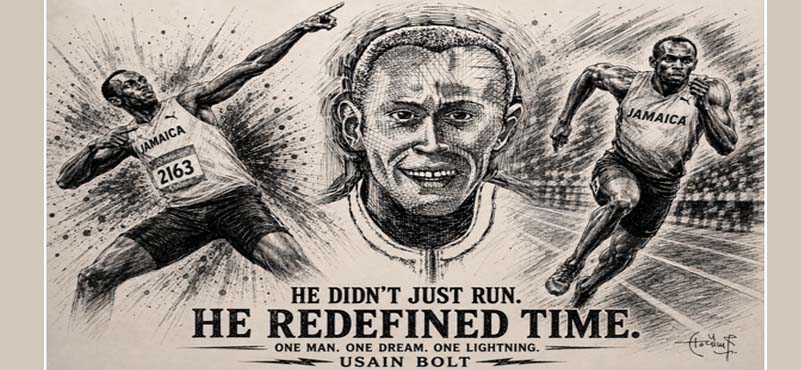
A humble tribute to Usain Bolt at Forty
There are athletes who win races. There are athletes who break records. And then there are those rare human beings who change the way we imagine what the human body can do.
Usain Bolt belongs to the third category.
On 21 August 2026, the man who made the 100 metres look almost too short for him turns forty. Forty. The number seems strangely ordinary for a man whose name became synonymous with something as extraordinary as speed.
For more than a decade, the world watched a tall, smiling Jamaican appear on a track, bend down at the starting line, and then somehow transform himself into lightning. He did not merely run faster than everyone else. He made speed look effortless.
And perhaps that is why his story deserves to be remembered not merely as a sporting triumph, but as a lesson in the indomitable human spirit. Because Bolt did not fit neatly into the old picture of the perfect sprinter.
At 6 feet 5 inches, he was exceptionally tall for a 100-metre runner. Conventional thinking had long favoured shorter, compact athletes who could explode out of the blocks. Bolt’s height seemed almost inconvenient. His acceleration was not his greatest weapon.
But once he opened those enormous strides, the equation changed.
At his 9.58-second world-record run in Berlin on 16 Aug 2009, Bolt covered the 100 metres in just 41 steps, averaging roughly 2.44 metres per step. His peak velocity was measured at more than 43.2 kmph. The very feature that seemed to be a disadvantage became part of his genius. He did not try to become a smaller sprinter.
He became the greatest tall sprinter in history.
And there was more. Bolt has spoken about having scoliosis, with the condition contributing to an asymmetry in his legs. Research into his running mechanics found something remarkable: his right leg produced about 13 per cent more peak force, while his left foot remained in contact with the track about 14 per cent longer.
To the casual eye, this might sound like a defect. To Bolt, it became simply part of the machinery. That may be the most beautiful lesson in his story.
Perfection is not always symmetry.
Sometimes greatness comes from learning how to live with one’s asymmetries, compensate for one’s weaknesses and exploit one’s strengths. Bolt’s body did not conform perfectly to an imagined textbook. So he rewrote the textbook.
There were years when his physical problems were not theoretical. His back and hamstring issues demanded attention, discipline and painstaking conditioning. Behind the flamboyant celebrations and the infectious smile was an athlete who had to work relentlessly to keep his body capable of producing what his talent demanded.
That part of the story is easily forgotten.
Bolt’s greatest gift, therefore, may not have been his extraordinary stride. It may have been his ability to accept himself completely and then extract everything possible from what he had been given. He never needed to look like anybody else’s idea of the perfect sprinter. He simply needed to become the best version of Usain Bolt. And when the gun fired, the world discovered what that version looked like. Lightning.
His greatest races contained another remarkable quality: joy.
This was not the grimacing, tortured face with which we sometimes associate extreme athletic effort. Bolt ran with an almost mischievous freedom. He seemed to enjoy the absurdity of what he was doing.
He would look across at rivals. He would smile. He would celebrate before the race was even over. And occasionally, his celebration became part of sporting folklore.
At Beijing in 2008, he even began celebrating before crossing the line, yet still produced a world-record performance. Later analysis suggested that he might have gone even faster had he maintained full effort through the finish.
There was something profoundly human about that. He was not merely chasing numbers. He was having a conversation with history. And history listened.
Eight Olympic gold medals. World records. Championship victories. A decade of dominance. Yet perhaps the most enduring image of Usain Bolt is not a medal around his neck. It is that familiar pose. One arm pointing upward. The other bent across his body. A grin on his face. Lightning.
A man acknowledging that he had done something extraordinary—and somehow making it look like fun. That is why his legacy extends beyond athletics. Bolt teaches us something that has little to do with running.
Do not spend your life mourning the things you were not given.
You may not have the perfect body and perfect circumstances. You may not begin with the advantages others possess. You may have weaknesses that everybody can see. You may carry invisible burdens that nobody understands. But none of these necessarily determines the distance you can travel.
The question is not whether the machine is perfect. The question is whether you can learn to make the machine you have sing. Bolt did. He took height that seemed inconvenient and turned it into extraordinary stride length. He took asymmetry and adapted to it. He took physical vulnerability and built strength around it. He took pressure and converted it into performance. And perhaps most importantly, he retained his joy.
That may be his greatest victory. At forty, the clock has finally caught up with the man who spent his youth outrunning it. But the irony is delicious.
Usain Bolt may no longer be running against time.
He has already defeated it. His records may one day fall. Another young athlete will eventually stand on a starting line and run faster. Sport is merciless that way. Every record is eventually invited to surrender.
But some records are not measured in seconds. Some are measured in inspiration. And those are harder to break. Bolt showed millions of young people that the limits we inherit are not always the limits we must accept. He showed that an unconventional body can produce extraordinary performance. He showed that discipline and talent need not be enemies of joy. He showed that greatness can wear a smile. And he showed us that sometimes the person who does not fit the textbook is precisely the person who deserves to rewrite it.
So, on his fortieth birthday, perhaps the finest tribute is not to call him the fastest man who ever lived. That is already written in the record books.
Instead, let us say something simpler.
He taught the world to stop asking what a human being is supposed to look like—and start asking what a human being is capable of becoming.
He didn’t just run. He redefined time.
ABOUT THE AUTHOR

Lt Gen Rajeev Chaudhry (Retd) is a social observer and writes on contemporary national and international issues, strategic implications of infrastructure development towards national power, geo-moral dimension of international relations and leadership nuances in changing social construct.