
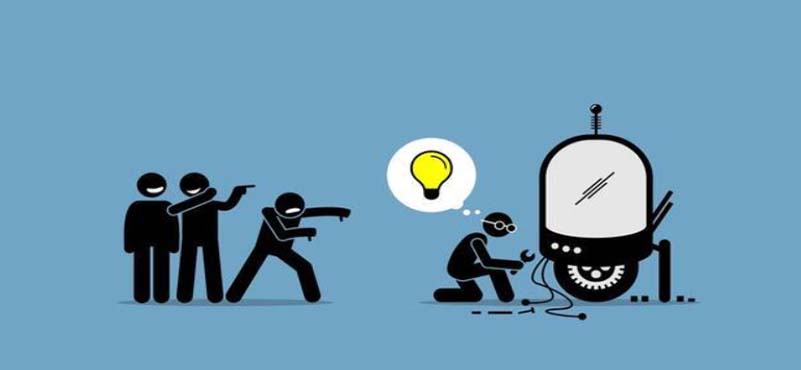
Across cultures and institutions, management practice may differ, but one principle commands wide agreement: praise should be generous, while criticism should be measured, fair and responsible.
Praise costs little, yet it can strengthen confidence, recognise effort and encourage better work. Criticism is also easy to offer, but it is much harder to make useful. Its purpose should not be to display intellectual superiority or humiliate another person. Good criticism identifies a problem, explains why it matters, and, where possible, suggests a better course of action.
That distinction matters well beyond the workplace. In public life, academia, policymaking and social media, it has become effortless to point out flaws in the work of others. It is far more demanding to offer an alternative, because that requires knowledge, thought, experience and a willingness to accept responsibility for the consequences.
The more useful question, therefore, is not merely, “What is wrong?” It is: “What would you do differently, and why?” The first requires observation; the second requires competence and accountability. Criticism without any willingness to contribute remains commentary. Criticism that points towards a workable alternative can become a form of leadership.

From Easy Judgment to Hard Work
“Criticism is easy; contribution is rare” is more than a moral aphorism of Francis Bacon’s variety. It reflects a basic difference in the effort demanded by judgment and by action.
To criticise, one needs only a viewpoint and a platform. To contribute, one must acquire knowledge, understand constraints, invest time and accept responsibility for outcomes. Criticism is often quick, categorical and low risk. Contribution is slower, uncertain and exposed to failure.
Human beings are also inclined towards rapid judgment. We rely on mental shortcuts, make snap assessments and often respond to error or disagreement with instinct rather than reflection. It is easier to conclude than to remain with a difficult problem long enough to understand its complexity.
Modern life has made this imbalance more visible. Much work is specialised, bureaucratic and abstract. A person may perform a role competently without seeing clearly how it contributes to society. The satisfaction derived from useful work can therefore become less immediate. Criticism, by contrast, can provide an instant sense of judgment and attract quick approval from others.
 Reflection and Rumination
I have encountered this tendency repeatedly during my professional life. For nearly twenty-five years as the Chief Economist—and during the years preceding that appointment—I was routinely expected to ghostwrite speeches, policy papers, research notes and other important documents for my senior bosses. This work demanded analytical rigour, clarity of thought, precision of language and the ability to present complex ideas accessibly.
Out of about a score senior officers for whom I wrote, only a handful—perhaps three in all—regularly dismissed my drafts as “verbose.” Interestingly, none could identify a substantive weakness in the argument, point out a flaw in the logic, suggest a better formulation or improve the language. Their criticism invariably remained confined to the vague and fashionable charge of verbosity.
Over time, I came to believe that such remarks revealed more about the critic than about the writing. They could not find fault with the ideas, the structure of the argument, the choice of words or the command of English. More significantly, they could not themselves write a coherent paragraph, let alone a persuasive speech or analytical paper. Unable to contribute constructively, they resorted to the safest and most nebulous criticism available: “This is verbose.”
I rarely challenged these observations. I would smile, accept them courteously and revise the draft where revision was genuinely needed. Empty criticism, especially criticism unsupported by reason or example, has a curious way of exposing the intellectual limitations of the person making it.
The great Urdu poet Raghupati Sahay “Firaq” Gorakhpuri expressed this with characteristic elegance:
“जो मुझको बदनाम करें हैं,
काश वो इतना सोच सकें—
मेरा पर्दा खोलें हैं,
या अपना पर्दा खोलें हैं।”
A free English rendering would be:
Those who seek to defame me,
If only they paused to realise this:
They do not unveil my character—
They merely reveal their own.
There was another reason why casual allegations of verbosity never troubled me greatly. My father, Professor D. D. Sharma, PhD (Edinburgh), was an eminent Professor of English and an accomplished linguist who taught in India and abroad. For more than three decades, he served as a paper setter and examiner for the Union Public Service Commission, several State Public Service Commissions and numerous universities across the country.
Growing up in that academic environment gave me an early appreciation of language, disciplined writing and intellectual precision. In those days, examination systems placed considerable emphasis on précis writing. Students were trained to reduce a long passage to roughly one-third of its length without losing accuracy, coherence or elegance. That exercise taught economy of expression: unnecessary words had to be eliminated, but essential meaning had to be preserved.
Shakespeare’s maxim, “Brevity is the soul of wit,” was, therefore, not merely a literary aphorism to me. It was a principle of effective communication. Succinctness became second nature. When detailed exposition was necessary—as it often is in economics, public policy or legal drafting—I wrote at the length required by the subject, not from any fondness for unnecessary words. Sophisticated arguments cannot always be compressed without sacrificing accuracy for the illusion of brevity.
I never thought it necessary to explain this background to my superiors. It would have served little purpose and might have appeared self-congratulatory. Anne-Marie Bigot de Cornuel, once the mistress of King Louis XIV, observed: “No man is a hero to his valet.” Georg Wilhelm Friedrich Hegel later quoted a similar saying in The Philosophy of History: “No man is a hero to his valet-de-chambre.” Familiarity can make people blind to merit, just as it can sometimes breed contempt.
I felt—perhaps not unjustifiably—that it was better to let the quality of the work speak for itself. Those with genuine literary or intellectual ability usually appreciated concise, well-reasoned writing. Those without it often mistook substance for verbosity and assumed that attaching a fashionable label amounted to intelligent criticism.
Digital Criticism and False Expertise
The distinction between real life and “reel life” is increasingly blurred. Digital media has democratised expression in valuable ways: ignored voices can now be heard, information can travel rapidly and public debate is no longer confined to traditional gatekeepers.
But this democratisation has also made criticism extraordinarily easy. Online visibility is not necessarily awarded to what is most thoughtful or useful. It often goes to what is immediate, provocative or emotionally charged. A carefully argued article may require ten minutes of attention; a sharp one-line criticism can be understood, shared and applauded within seconds.
The economics of attention favours speed over substance. A clever put-down can attract more engagement than a serious attempt to understand an opposing argument. In online echo chambers, criticising the other side often earns approval from one’s own side. Disagreement then becomes less a search for truth than a display of identity and allegiance.

Anonymity can make matters worse. People are frequently harsher behind a screen than they would be face to face. The person criticised becomes a name, an institution or a public figure rather than a human being. Civility weakens; sarcasm, ridicule and abuse become easier.
The same pattern produces an illusion of expertise. Search engines and link-sharing make it possible to find fragments of information on almost any issue. A few articles or videos can create the impression of mastery. On subjects as varied as vaccines, monetary policy and climate change, conflicting opinions can be found and selectively cited to support sweeping judgments.
This tendency is evident in art and sport as well. People who have never studied music theory or painting techniques may confidently dismiss classical compositions or modernist works as “overrated.” Years of riyaaz in Hindustani vocal music, or mastery of perspective and form in painting, disappear.
Likewise, someone who has never faced elite bowling in a Test match may readily dissect the batting technique of Sunil Gavaskar or Sachin Tendulkar. Pitch conditions, bowling strategy, psychological pressure and physical fatigue vanish behind the spectator’s commentary. Observation is mistaken for expertise.
Public Policy and Constraints
The tendency becomes particularly visible when the Union Budget is presented. Within hours, countless articles, posts, threads and memes declare the Budget either a “masterstroke” or a “betrayal.” Many of these reactions show little awareness of fiscal arithmetic, tax buoyancy, intergovernmental transfers or macro-stabilisation. Yet critics confidently prescribe what the Finance Minister should have done, often without considering political feasibility, administrative capacity or medium-term sustainability.
Meaningful contribution in public policy is rarely a matter of choosing simply between right and wrong. Governments work with limited resources, competing demands and substantial uncertainty. Policy choices often involve trade-offs: growth and redistribution, inflation control and employment, fiscal prudence and political pressures.
What Roy Harrod and Evsey Domar described as a “knife-edge equilibrium” in another context offers a useful reminder of how delicate economic balances can be. Raising capital expenditure on infrastructure may require restraint in subsidies, taxation or other expenditure. Similarly, as I have argued for more than three decades, monetary policy in India must continually negotiate the trade-off between growth and inflation. There is no uniform formula that can be applied mechanically in all circumstances.

Every decision affects different regions, social groups and time horizons. Serious policy work requires evidence, modelling, scenario-building and attention to institutional constraints. It often produces recommendations that are gradual rather than dramatic: a change in sequencing, an improvement in implementation, an adjustment of a parameter or a compromise between competing objectives.
Such policies may not sound as impressive as a sweeping denunciation or a radical prescription. But responsible policymaking is usually concerned with what is workable, not merely with what sounds perfect in a debate. The real test of an idea is whether it can survive contact with reality.
Criticism That Serves Society
None of this is an argument for silencing criticism. A healthy society needs it. Science progresses because ideas are questioned, evidence is tested, and methodology is scrutinised. Peer review, replication and rigorous debate improve knowledge. In a democracy, criticism exposes corruption, reveals policy failures and brings abuses of power into public view.
The question is not whether people should criticise, but how.
Good criticism should rest on a reasonable understanding of facts, evidence and context. One need not be an expert on every matter, but one should make a serious effort to understand before passing judgment. Intention matters as well. There is a difference between identifying an error because one wants it corrected and pointing it out merely to score a debating point or embarrass another person. Nor must every critic produce a complete alternative policy. That would be unrealistic.
But criticism becomes more useful when it offers some direction: a better way to measure a problem, communicate a decision, test a reform or improve implementation. The move from “This is wrong” to “This might work better” marks the beginning of contribution.
Institutions also shape incentives. Universities, media organisations, think tanks and corporations should create space for patient, careful work that may not immediately attract attention. In academia, replication, reliable data work and incremental improvements may contribute more to knowledge than extravagant theoretical claims. Journalism need not always be driven by confrontation; explanatory, evidence-based and solution-oriented journalism can be equally valuable.
Contribution does not always have to be grand or visible. A teacher taking additional interest in a student, an officer improving an institution’s functioning, a researcher building a reliable database, or an individual strengthening a community initiative—all are making valuable contributions. Societies depend on such quiet work.
 The task, especially in Indian policy debate, is to move beyond simplistic binaries of growth versus welfare, markets versus the State, fiscal prudence versus social spending, reform versus inclusion and examine trade-offs and policy choices. Given the complexity of the real world, the useful question is: given our circumstances and constraints, how can we move closer to the outcomes we seek?
Contrary to popular perception, criticism and contribution are not opposites. Good criticism clarifies problems; sincere contribution tests solutions and builds institutions. The danger lies in criticism that becomes uninformed, cynical or performative criticism detached from knowledge, responsibility and any desire to improve what it attacks.
A wiser approach is to speak with understanding rather than haste, question with responsibility rather than malice, and contribute with sincerity rather than spectacle. In the long run, societies are not strengthened by the loudness of their criticism, but by the quality of the institutions, ideas and lives they help to improve.
ABOUT THE AUTHOR
 Dr. Manoranjan Sharma is Chief Economist, Infomerics, India. With a brilliant academic record, he has over 250 publications and six books. His views have been cited in the Associated Press, New York; Dow Jones, New York; International Herald Tribune, New York; Wall Street Journal, New York.