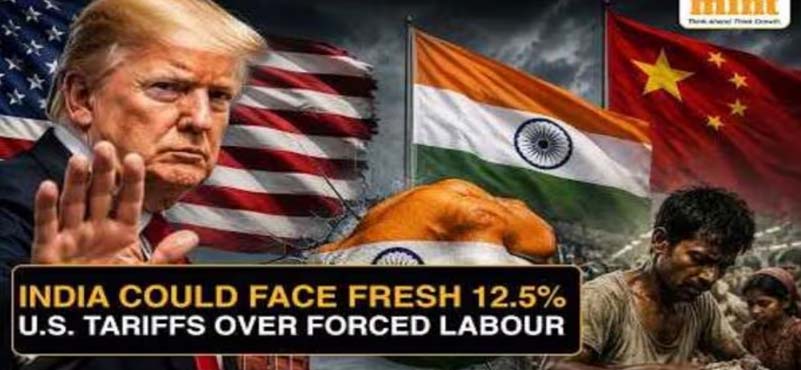
Washington’s decision to propose a 12.5 per cent tariff on imports from India and dozens of other countries has been framed as a response to inadequate action against forced labour. On paper, that sounds principled. In practice, it is difficult to separate the moral language from the strategic context in which it has appeared.
The announcement arrived at a curious moment. India and the United States were discussing the contours of a broader trade arrangement. Global manufacturers are increasingly looking at India as a destination for investment. Supply chains that were once concentrated elsewhere are beginning to diversify. Against that backdrop, the simultaneous discovery of concerns about labour practices in more than fifty countries inevitably raises questions.
Those questions become harder to ignore when one examines how the allegations have been presented. Countries with vastly different labour systems, governance structures and economic realities appear to have been assessed through remarkably similar language. Britain, India, Vietnam and several others may have their own labour-related challenges, but they are not the same challenges. When identical conclusions emerge from very different circumstances, scepticism is a natural response.
What makes the American position particularly difficult to accept, however, is not the tariff itself. Great powers have always used economic tools to advance national interests. There is nothing unusual about that. What is unusual is the attempt to cloak such measures in a language of moral superiority that Washington itself struggles to uphold.
The United States continues to maintain a prison labour system made possible through an exception in the Thirteenth Amendment. Hundreds of thousands of incarcerated individuals work for extremely low wages. For years, civil rights groups and labour advocates have questioned the ethics of the arrangement. The debate remains unresolved. Yet the same country now seeks to position itself as an international authority on labour exploitation.
There is a broader pattern here. Labour concerns are highlighted in some countries while ignored in others. Human rights become a matter of urgency when strategic competitors are involved but somehow attract less attention when violations occur within friendly jurisdictions. Such selectivity weakens the credibility of the entire enterprise.
None of this means India should dismiss the issue itself. That would be a mistake.
Labour exploitation exists in India. Bonded labour has not disappeared despite decades of legislation. Human trafficking remains a challenge. Certain sectors continue to suffer from weak enforcement and poor compliance. These are realities that deserve acknowledgement because denying them serves no national purpose.
At the same time, there is a tendency in some Western commentary to discuss India as though it were indifferent to these problems. That portrayal is detached from reality. The country has spent decades attempting to address them through legislation, judicial intervention and administrative reform. Progress has often been uneven, but the direction of travel has been unmistakable.
What is frequently overlooked abroad is the scale of the task. India is not reforming a labour market of ten million people, or even a hundred million. It is attempting to improve conditions across a vast and extraordinarily diverse society while simultaneously lifting millions out of poverty, expanding industrial employment and maintaining democratic accountability. Success is rarely linear under such conditions.
The more important question is not whether India faces challenges. Every major economy does. The question is whether those challenges are being used as a pretext for economic pressure.
Viewed from New Delhi, that possibility cannot be dismissed. India today occupies a different place in the international system than it did two decades ago. It is no longer merely an emerging market. It is a competitor in sectors ranging from pharmaceuticals and digital services to advanced manufacturing. As India’s economic footprint grows, friction with established powers is likely to become more common.
This is why India’s response should be measured but firm. Anger may be politically satisfying, yet it rarely produces durable outcomes. What India requires is confidence. The government should challenge the assumptions underlying the American case, demand evidence where allegations are made and expose the inconsistencies that characterise Washington’s own labour record.
At the same time, New Delhi should accelerate reforms that strengthen India’s position irrespective of American pressure. Better labour enforcement, transparent compliance mechanisms and stronger oversight of vulnerable sectors are not concessions to Washington. They are investments in India’s future competitiveness. A country that aspires to become a leading manufacturing and technological power cannot afford weak links in its labour ecosystem.
There is also a diplomatic opportunity that should not be overlooked. More than fifty countries have found themselves on the receiving end of the same American approach. Many of them are long-standing partners of the United States. India should work with like-minded governments to question methodologies that appear arbitrary, and challenge attempts to transform unilateral judgments into global standards.
The larger issue extends beyond tariffs. What is unfolding is part of a wider contest over who sets the rules of international commerce in an era of shifting power balances. Labour standards, environmental norms, technology regulations and supply-chain requirements are increasingly becoming instruments of geopolitical competition. India will encounter similar pressures again, perhaps under different labels and in different sectors.
For that reason, the country’s response must be guided neither by indignation nor by insecurity. India does not need lectures from abroad, but it also does not need to pretend that reform is complete. A mature power can do two things at once: reject double standards and improve its own systems.
That is the course India should follow. It should resist economic coercion, continue reform where reform is needed and refuse to accept the proposition that moral authority belongs exclusively to those who claim it the loudest.
ABOUT THE AUTHOR
 Lieutenant General A B Shivane, is the former Strike Corps Commander and Director General of Mechanised Forces. As a scholar warrior, he has authored over 200 publications on national security and matters defence, besides four books and is an internationally renowned keynote speaker. The General was a Consultant to the Ministry of Defence (Ordnance Factory Board) post-superannuation. He was the Distinguished Fellow and held COAS Chair of Excellence at the Centre for Land Warfare Studies 2021 2022. He is also the Senior Advisor Board Member to several organisations and Think Tanks.