
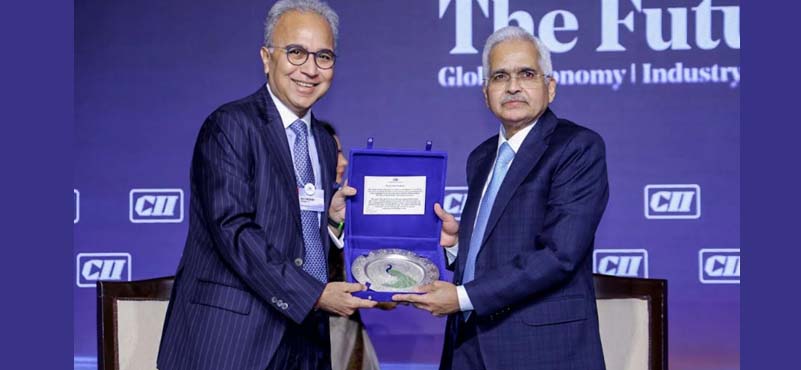
CII has long stood out as a trusted and influential platform for sustained engagement between policymakers, industry leaders and other key stakeholders. At the current juncture when the global economic landscape is in a state of flux, and when there are significant structural opportunities at home, forums such as this, assume high relevance in shaping shared understanding and collective responses.
- This is perhaps my fourth or fifth engagement with the CII since the outbreak of COVID-19 pandemic. During this period, the global economy has been subjected to a relentless succession of shocks. What began as a pandemic-induced disruption was followed by several external shocks like the war in Ukraine, monetary tightening in Advanced Economies, tariff barriers, supply chain disruptions and a series of conflicts in West Asia. The net outcome of all these is reflected in slower growth, inflationary pressures, fragmented supply chains, heightened financial-market volatility and unprecedented energy crisis.
- Today’s Business Summit focuses on Vision for India @100. Let me start by emphasising that Independent India was born in 1947, but India’s existence and greatness goes long back in time. Prior to colonisation, India commanded nearly 25 per cent of global GDP and was a hub of trade, culture, and innovation. In 1600 AD, when the East India Company was founded, Britain was generating merely 1.8 per cent of the world’s GDP, while India was producing 22.5 per cent. While we cannot live in the past, we must not forget the reality of the past: that we were once a leading economic power in the world. As we approach 2047, the centenary of our independence, the vision must be to reclaim that stature – not through nostalgia, but through enterprise, technology and inclusive growth. Against this background, I propose to first reflect on the evolving global and Indian economic landscape and what it means for business leaders and other stakeholders in our economy.
Global Macroeconomic Landscape
- We are living in a world of unknown unknowns. Uncertainties arising from unforeseen shocks and geopolitical conflicts have become the new normal for the world economy. Global growth, which expanded by an estimated 3.4 per cent in 2025, is projected by the IMF to slow down to 3.1 per cent in 2026, with growth potentially falling to 2.0–2.5 per cent in adverse scenarios. Global inflation, on the other hand, could rise to 5.4–6.0 per cent under adverse scenarios. In its April 2026 World Economic Outlook, the IMF has noted that the supply shock triggered by the Middle East crisis poses a serious threat to the global economy, even if the conflict were to end tomorrow. The lasting impact of the damage to infrastructure and supply disruptions will continue to impose high costs for quite some time to come. Every additional day of disruption can potentially translate into significant economic costs for the world economy, with cascading effects on energy supply, fertilizers, food security and global prices.
Domestic Economic Developments
- Amidst such unsettled and turbulent global backdrop, India stands out as a clear outlier of resilience and renewal. India has not only absorbed successive disruptions since the COVID-19 pandemic, but repeatedly converted adversity into opportunity and momentum. The Indian economy has delivered an average annual GDP growth of about 7.4 per cent between 2022-23 and 2025-26, making it the fastest-growing major economy during this period. What is even more striking is that this growth is anchored not in over-leveraging, but in macroeconomic stability: contained inflation, prudent fiscal consolidation, a resilient financial system, and strong domestic demand. Growth and stability have moved in tandem, reinforcing India’s emergence as a key pillar of global growth and stability.
- The fiscal position of the Government of India is stable, with a decisive shift towards capital expenditure, especially infrastructure spending. The banking sector today stands on a much stronger footing than in previous business cycles. Years of balance-sheet repair, improved asset-quality recognition, and tighter supervisory oversight have significantly reduced non-performing assets and enhanced capital adequacy across banks. Improved quality of governance, profitability, adequate capital buffers and prudent lending standards have enabled banks to resume sustainable credit growth, which supports both consumption and investment.
This renewed strength has positioned our banking system as a pillar of stability amid global financial uncertainty.
- Corporates have also contributed to overall financial stability by consciously deleveraging their balance sheets, especially during the COVID-19 pandemic and its immediate aftermath. Many firms replaced high-cost borrowings with lower-cost and longer-tenure financing, improved cash-flow management and reduced dependence on short-term debt. This shift has strengthened debt-servicing capacity, lowered vulnerability to interest-rate movements, and enhanced investor confidence. As a result, corporate balance sheets today are better positioned to support fresh investment and expansion.
- If we take a step back a little and reflect, every global shock in the last 5-6 years has compounded the previous shock, leaving very limited time for recovery. The notion of resilience has, therefore, been tested worldwide like never before. In such a scenario, the Indian economy not only withstood each of these shocks but emerged even stronger after every crisis. These outcomes are not by accident – they are the result of thoughtful policy choices and resilient buffers built over the last 10-12 years.
The Current Context
- In the prevailing situation, quite naturally, there are multiple questions in the mind of every stakeholder in the Indian Economy about the ability of our economy to navigate through the current crisis originating from the West Asian conflict and other challenges emanating elsewhere. I now propose to highlight some of these challenges and how we are dealing with them.
Energy Security
- Let me start with the global energy crisis. India’s energy demand is projected to grow faster than almost any other major economy through 2035. In fact, India is expected to account for over 23 per cent of global incremental energy demand by 2050, the highest for any country.
- To meet this growing demand, India has focused on strengthening its energy systems through reforms, infrastructure expansion and cleaner energy pathways. In June 2025, India reached a major milestone by achieving 50 per cent of its cumulative installed electricity capacity from non-fossil fuel sources, five years ahead of its 2030 Nationally Determined Contribution (NDC) target under the Paris Agreement. Reforms in the hydrocarbons sector, expansion of energy infrastructure, and rapid scale-up of renewable energy are jointly supporting economic growth, employment creation, energy security, and India’s evolving role in global energy markets.
- India has made sustained push towards reliance on alternative energy. Investment in renewable energy has risen sharply. The share of renewables9 in installed electricity generation capacity increased from around 27.3 per cent in 2014-15 to about 51.6 per cent as at end March 2026. Within this, solar power capacity went up from 2.63 GW in March 2014 to 150.26 GW in April-May, 2026. Further, policy support for electric vehicles and ethanol blending has enhanced the role of domestic energy resources in the economy. The country’s trajectory in renewable energy suggests that India will remain a key player in the global transition towards sustainable energy.
- In April 2026, India faced record electricity demand of about 256 GW, driven by extreme heatwaves. The system met this peak demand without any national shortage. This underscores the significant strides India has made in energy security, reflecting stronger capacity addition, grid preparedness, and operational coordination. India is better positioned today to confront extreme demand conditions head-on and emerge resilient.
- India’s renewable surge is being matched by advances in digital grid management, storage and new technology. Emerging sectors such as bioenergy and green hydrogen are receiving top priority. The GOBARdhan initiative (i.e. Galvanizing Organic Bio-Agro Resources Dhan) smartly combines solid and waste management in villages with energy security. The enactment of the SHANTI Act, which enables private participation in nuclear energy, will open a new chapter in our energy security.
Infrastructure Growth
- On the infrastructure front, especially amidst global geopolitical and geoeconomic tensions, India offers a striking counter-narrative. New mega infrastructure projects are being delivered to the nation in quick succession. Major expressways, bridges, tunnels, railway lines, airports, seaports, together with major healthcare infrastructure, are reshaping our infrastructure ecosystem. Each of these new projects is unclogging long-standing bottlenecks. By improving logistics efficiency, reducing distances in terms of time and length, and lowering transaction costs, these infrastructure projects are boosting productivity across sectors. In doing so, they are integrating markets, expanding opportunities, and fundamentally transforming the way India does business.
- The unprecedented expansion in infrastructure facilities is anchored in the rising capital expenditure of the central government, which rose from ₹1.9 lakh crore in 2013-14 to ₹12.2 lakh crore in the Budget Estimate, 2026-27. Further, if grants to states for capital expenditure are included, the total effective capex would reach nearly ₹17.15 lakh crore in 2026-27.
- Complementing this unprecedented infrastructure expansion, is the focus of the government on urban infrastructure. Urban transport, especially metro rail systems, is emerging as a flagship outcome of this approach. India now has the world’s third-largest metro network, expanding from 248 km in 2014 to over 1,095 km across 26 cities by 2025, with nearly 650 km under construction. Beyond mobility and environmental benefits, metro expansion improves household financial resilience. In an interesting insight, the Prime Minister’s Economic Advisory Council, using granular home loan data, finds statistically significant reduction in mortgage delinquency (1.7 – 4.4 per cent) and higher prepayment (1.4 – 3.5 per cent) in metro-connected areas of Delhi, Bengaluru and Hyderabad. This is driven, among others, by lower dependence on private vehicles and reduced recurring transport costs. These findings highlight that infrastructure investment generates not only macroeconomic gains, but also financial stability spillovers for households, and also stronger credit ecosystem.
FTAs with major trading partners
- Another remarkable feature which enhances India’s capacity and confidence in the prevailing unsettled global conditions is the Free Trade Agreements (FTAs) concluded in the recent months. By securing predictable market access, adjusting tariff and non-tariff barriers, and strengthening rules on services, investment, and standards, FTAs would enable our firms to scale faster and integrate into global value chains. Modern FTAs go beyond goods; they unlock gains in services, digital trade, and professional mobility. When aligned with strong domestic capabilities, FTAs would transform our national strengths into sustained global economic influence. With trade openness and strategic autonomy, India is building resilience, enhancing competitiveness, and positioning itself as a constructive and reliable participant in the evolving architecture of global trade. Indian industry and businesses must capitalise on the opportunities opened up by the FTAs. They must focus on further improving the quality of their products and services to enhance international competitiveness.
India@100: A Vision for a Viksit Bharat 2047
- The theme of today’s summit, i.e., Vision for India@100 aligns very well with the bold road map spelt out by the Prime Minister for Viksit Bharat 2047. With a sharp focus on self-reliance, innovation, and citizen empowerment, the Prime Minister has highlighted India’s journey from a nation dependent on others to a globally confident, technologically advanced and economically resilient India.
- As we are aware, India’s resilience and sustained growth are rooted in a series of proactive and forward-looking structural reforms undertaken over the past decade. Some of these reforms include the implementation of inflation targeting framework, the goods and services tax (GST), the Insolvency and Bankruptcy Code (IBC), re-capitalisation of public sector banks, the Real Estate (Regulation and Development) Act (RERA), the India digital stack, Ease of Doing Business measures, ‘Strategic’ schemes for self-reliance, the new Labour Codes and the Jan Vishwas Acts. The details of these reforms are well known and I have already elaborated on them in my recent speeches.
- What is more important in India’s journey towards Viksit Bharat@2047 is that there is no reform complacency and the government remains steadfast in pursuing the reform agenda. Policy consistency, combined with timely and calibrated reforms, are expected to ensure that India not only maintains macroeconomic stability but also emerges as a globally competitive and inclusive economy.
- In parallel to reforms, India is taking bold and forward looking measures to enhance strategic self-reliance in a number of critical sectors – from rare earth permanent magnets to critical minerals, shipbuilding, cotton productivity and Artificial Intelligence, to name a few. These measures are not isolated steps; they are the building blocks of our future economy.
- Let me now elaborate a few of these strategic measures.
i. Rare Earth Permanent Magnet: India’s permanent magnet imports range from 85 to 90 per cent in quantity terms. It was, therefore, necessary to build resilient domestic capability across the entire value chain – from mineral processing and refining, to advanced manufacturing and technology development. The government has, therefore, approved Rs. 7,280 crore Rare Earth Permanent Magnets Manufacturing Scheme to build a complete domestic value chain.
ii. Critical Minerals: Critical minerals are increasingly becoming the oil of the 21st century and are central to economic and geopolitical competitiveness. They are critical for sectors ranging from automobiles, renewable energy and electric mobility to advanced manufacturing and defence. With a total projected outlay of nearly Rs.34,300 crore over the period 2024-25 to 2030-31, the National Critical Mineral Mission is expected to strengthen long term supply security, promote domestic capability, attract investment, foster innovation and position India as a critical player in the emerging global value chains.
iii. Shipbuilding: Over the years, India’s shipbuilding and ship repair sector has faced several long-standing structural challenges that have constrained its growth, scale and competitiveness. The absence of large and integrated shipyard clusters have further restricted economies of scale and development of robust ancillary and supplier ecosystem. The Shipbuilding Financial Assistance and Development schemes, together with the Maritime Development Fund and the India Ship Technology Centre are expected to address these long standing structural impediments.
iV. Cotton Productivity: Cotton production in India has declined by nearly 23 per cent over a period of time due to pest attack and other factors. On the other hand, our cotton consumption continues to rise. The Government has, therefore, recently approved the Mission for Cotton Productivity with an outlay of Rs. 5,659 crore for the period 2026 – 2031. This Mission is closely aligned with the Government’s 5F vision – from Farm to Fibre to Factory to Fashion to Foreign. This initiative is expected to strengthen the entire cotton and textile value chain in an integrated manner.
v. Private Sector Research and Development (R&D):
India’s innovation ecosystem stands at an important inflection point. There is need for greater and more active collaboration between the Government and the private sector in this area. The establishment of the Anusandhan National Research Foundation (ANRF) by the Government is expected to significantly expand collaborative research between academia, industry and government institutions. The Research, Development and Innovation (RDI) Scheme with an outlay of Rs. 1 lakh crore was approved by the Government last year.
Vi. Artificial Intelligence (AI): Artificial Intelligence is emerging as a key driver of future growth and productivity. Systemic measures implemented under the India AI Mission are expected to provide a major boost to the AI growing ecosystem in India. The strong technical talent available within the country will provide a major fillip to this initiative.
Apart from these measures, several other initiatives are also in the pipeline to strengthen long term resilience of our economy.
Strategic Reorientation by Indian Industry and Business
- In the evolving global economic order, it becomes necessary for Indian industry and business to undertake strategic reorientation of their businesses. As I have stated elsewhere, over the years and across the world, firms have optimised efficiency through single-source supply chains spreading beyond their national borders. But in today’s world of geoeconomic fragmentation and supply-chain disruption, the “world of corner-solution”13 is increasingly becoming less efficient. It is now evident that no country or single supply chain remains the cheapest, safest or the most predictable on a sustained basis. In fact, ‘resilience maximisation’ is increasingly replacing ‘cost minimisation’ as a priority for corporates and businesses. Resilience maximisation can indeed be highly cost effective in the long run. Operational strategies of industry and businesses need to be reoriented from concentration to diversification, and from short term efficiency to long term resilience.
- As I proceed to conclude, I would like to share a few more thoughts with you on the way forward for Indian industry and business.
i. Build organisational resilience: Indian businesses must embed resilience into their operating models by strengthening risk management, improving decision-making agility, and proactively anticipating market, technological, and other emerging developments in the world of business. This would enable firms to absorb shocks, adapt quickly, and emerge stronger, turning uncertainty into opportunity. The message that we must give to the international community is that India is ready – ready to do business, ready to innovate, and ready to contribute to global prosperity.
ii. Strengthen balance sheets: Periods of global stress inevitably test the financial strength of companies. Strong balance sheets provide the flexibility to withstand external shocks, manage cash-flow pressures, and invest when opportunities arise. Indian firms should prioritise prudent leverage, robust liquidity buffers, and forward looking capital allocation.
iii. Build new supply chains: As I said a little while ago, companies and firms must proactively diversify sourcing, localise critical inputs to the extent feasible, and integrate into multiple global value chains. By doing so, firms can reduce exposure to external shocks while positioning themselves as reliable partners in the evolving global trading system.
iV. Reskill the available manpower: As technology, automation, and artificial intelligence reshape industries, the future competitiveness of Indian firms will depend heavily on workforce readiness. Continuous reskilling and upskilling through vocational training and industry-academia collaboration, particularly in digital, manufacturing, and advanced technical domains must become an organisational priority. Investing in human capital would not only improve productivity but would also ensure strong and inclusive corporate culture and promote long term efficiency.
v. Diversify into new markets: Over-dependence on a narrow set of markets or geographies increases vulnerability during global slowdowns, especially for exporters. Indian businesses should actively explore and engage with new export markets, and leverage on India’s growing economic and diplomatic footprint. Market diversification would spread the risks, stabilise revenue streams, and allow firms to tap into new growth corridors and demand patterns.
vi. Invest strategically for future readiness and for capitalising on new opportunities: Moments of global disruption often sow the seeds of future business leadership. Strategic investments in technology, innovation, sustainability, and capacity building etc., would enable firms to capitalise on structural shifts rather than merely reacting to them. Indian businesses that invest with a long-term perspective today will be best placed to lead tomorrow. In other words, there is need to think strategically and invest strategically.
vii. Increase expenditure on research & development: Knowledge is a key driver of growth. As you are well aware, frontier knowledge is generated through sustained R&D. Expenditure on R&D by corporates should not be seen as a cost centre. It must be seen as a strategic investment. It is said that innovation propels growth through creative destruction. To realise the true potential of corporates and the economy, we must significantly scale up R&D investment, both individually and through collaborative efforts.
- These measures, I feel, can significantly enhance sustainability, competitiveness, and long-term growth of Indian businesses and industry. This would enable us to not only weather global uncertainties but emerge stronger and more confident. As Mahatma Gandhi had said, “The future depends on what we do in the present”. This truth must guide today’s business leadership.
Conclusion
- In conclusion, I would like to say that this is the moment for enterprises to think boldly, innovate fearlessly, and invest strategically in emerging opportunities. Indian industry must move beyond incremental progress to transformative action – creating global champions, building resilient supply chains, pioneering new technologies, and solving national challenges at scale. Leadership now means daring to take risks, reimagining business models, and aligning growth with future opportunities. What and how industry chooses to build, disrupt, and lead today will define India’s economic strength, social progress, and global standing tomorrow. The road to India@2047 begins not in ambition alone, but in strategic action in the present. The reforms and hard work of today will be the pillars of tomorrow’s India – an India that is prosperous, inclusive and innovative. This approach, I feel, would enable India to consolidate its transformative journey from being an Incredible India to a Credible India – an India that inspires trust and confidence, both at home and abroad.
Keynote address delivered by Shaktikanta Das, Principal secretary to the Prime Minister, at the Confederation of Indian Industry (CII) Annual Business Summit 2026.
ABOUT THE AUTHOR
 Shakti Kanta Das is a former IAS officer of Tamilnadu cadre; served as secretary in Ministry of Finance, served two terms as Governor of RBI; presently in the PMO as one of the two Principal Secretary to the prime minister.