A year after Operation Sindoor, its significance lies not in the spectacle of precision strikes but in the quiet, consequential shift it triggered in India’s strategic grammar. It was not merely an operation. It was a statement of intent, a recalibration of thresholds, and a test of India’s ability to translate episodic resolve into enduring doctrine.
Op Sindoor did what previous responses had attempted but not fully achieved. It collapsed the comfortable ambiguity between state and non-state actors. By striking deep into terror infrastructure and signalling that sponsorship would invite punishment, India reframed the problem. Terrorism was no longer to be managed. It was to be met with cost.
Yet anniversaries are best used not for celebration but for clarity. The real question is not what Sindoor achieved, but whether India has absorbed its lessons with the seriousness they demand.
The Strategic Inflexion
Operation Sindoor marked a decisive shift from strategic restraint to strategic assertion and from a reactive disposition to proactive compellence. It demonstrated that calibrated force, backed by political will and technological integration, could be applied below the nuclear threshold without triggering uncontrolled escalation. It also highlighted a whole-of-nation approach, with the integrated application of political, diplomatic, economic and military power.
Equally important was the restoration of deterrence credibility. For decades, Pakistan’s strategy rested on a simple calculation: that a nuclear overhang would paralyse India’s conventional response, allowing proxy warfare to continue at low cost. Sindoor challenged that assumption. It showed that there is room for precise, limited, and punitive action, and that escalation can be managed with discipline.
But deterrence is not a one-off achievement. It is a continuous negotiation of perception. What Sindoor established must now be sustained, refined, and institutionalised.
The Three Lessons That Matter
First, clarity of purpose is non-negotiable. Sindoor worked because it was anchored in clear political objectives. It was not a reflexive reaction but a calibrated response designed to impose costs, restore deterrence, and signal resolve. This may sound obvious, yet it is often where strategy falters. Military action without political clarity risks becoming performative. Sindoor avoided that trap.
Second, modern conflict is no longer confined to the battlefield – it spans a multidomain battlespace. The operation underscored the centrality of multi-domain integration. Precision strikes, drones, cyber activity, space-based enablers, and information flows operated as part of a single ecosystem. This is not a future trend. It is the present reality. Wars are now fought as networks, not sequences.
Third, narratives shape outcomes as much as missiles do. India’s operational success was not matched by dominance in the information domain. Adversarial narratives created confusion and diluted strategic messaging. In a world of real-time perception, silence is not neutrality. It is a vulnerability.
The Gaps That Persist
If Sindoor was a success, it was also a diagnostic.
The most visible gap lies in institutional coherence. India demonstrated capability, but not yet a fully integrated system. The absence of a formal National Security Strategy continues to create voids in the whole-of-nation approach. Without a clearly articulated framework, responses risk being effective but episodic.
The second gap lies in intelligence and anticipation. The triggering event itself exposed weaknesses in early warning and inter-agency coordination. A doctrine of compellence cannot rely on reaction. It must be anchored in prediction.
The third gap lies in information warfare. India still treats narrative management as an adjunct rather than a core cognitive domain. Meanwhile, adversaries treat it as a primary instrument of conflict.
This asymmetry will only widen if left unaddressed.
Finally, there is the question of scale. Sindoor proved that India can execute precision operations. The challenge now is whether it can sustain them, repeat them if necessary, and integrate them into a broader strategic campaign. Capability, capacity and collaboration are today synonymous with national security.
The Adversary Will Adapt
One of the enduring lessons of conflict is that success is never static. The adversary learns.
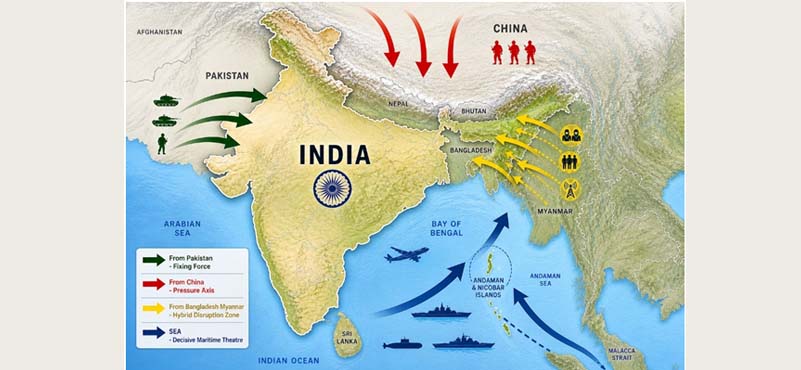
Pakistan is unlikely to abandon proxy warfare. Its institutional logic is tied to keeping the conflict alive at a manageable level.
What will change is the method. Expect greater dispersion of terror networks, deeper use of cyber tools, and increased reliance on deniable technologies such as drones and loitering munitions.
More significantly, the role of external enablers will grow. The emerging alignment among Pakistan, China, Saudi Arabia and Turkey points to a more networked challenge, in which technology, intelligence, and narrative support are shared. The Trump-Munir factor of buyer-seller status has given Pakistan a favourable tilt in the US, both for the economy and for defence.
The next confrontation, therefore, is unlikely to resemble Sindoor. It will be faster, less transparent, and more complex.
From Event to Doctrine
The central challenge before India is simple to state but difficult to execute: Sindoor must move from event to doctrine.
This requires institutionalisation at multiple levels.
At the strategic level, India needs a clearly articulated National Security Strategy that defines thresholds, escalation ladders, and the integration of national power. Ambiguity may serve tactical purposes, but strategy demands clarity.
At the operational level, the focus must shift to building a seamless multi-domain architecture. The future lies in what military thinkers increasingly describe as a “kill web” where sensors, shooters, and decision-makers are linked in real time. The speed of decision will matter as much as the accuracy of the strike.
At the technological level, the emphasis must be on scale and sustainability. Indigenous platforms performed well, but deterrence requires depth. Production capacity, supply chains, and rapid innovation cycles will determine long-term advantage.
At the cognitive level, India must treat narrative warfare as a core capability. This means building institutions, not ad hoc responses. It means shaping perception, not reacting to it.
The Logic of “Precise Mass”
Perhaps the most important conceptual takeaway from Sindoor is the emergence of what may be called “precise mass.” The combination of large-scale drone deployment, precision targeting, and scalable escalation offers a new rung in the ladder of conflict.
This is neither the blunt force of traditional warfare nor the limited symbolism of surgical strikes. It is something in between. It allows for calibrated intensity, repeatability, and control.
India must invest aggressively in this space. Not just in platforms, but in doctrine, training, and industrial capacity.
Deterrence Beyond Kinetics
Sindoor also highlighted that deterrence is not purely military in nature. Diplomatic space, economic leverage, and psychological impact played critical roles.
The temporary strategic space India enjoyed internationally was not accidental. It reflected a shift in global perception, with India’s actions seen as legitimate counter-terrorism responses.
This must be preserved. Diplomatic coherence and strategic communication are as important as military readiness.
Similarly, economic levers, such as the signalling around water treaties, introduced new pressure points. Future strategies will need to integrate such tools more systematically. The urgent need is to adopt a ‘Cold Strike Doctrine’.
Cold Strike is not just a doctrine; it is India’s sharpened sword of calibrated multidomain deterrence, fusing speed, precision, and narrative dominance to seize the initiative, strike preemptively, and control escalation across all domains without flinching in the face of nuclear blackmail.
Preparing for the Next Round
If there is one uncomfortable truth that emerges from all assessments, it is this: Sindoor is not the end of a cycle. It is the beginning of a new one.
The pattern of conflict in the region suggests recurrence. Periods of calm are often preparation phases, not resolution.
India must therefore prepare not for a repeat of Sindoor, but for a more intense and complex iteration.
This means faster decision cycles, deeper domain integration, and greater resilience at home. It also means accepting that future conflicts may unfold in grey zones long before they become visible.
Conclusion: From Preparedness to Pre-eminence
Operation Sindoor will be remembered as a turning point. But turning points only matter if they are followed by direction.
India has crossed a threshold. It has demonstrated its ability to impose costs, manage escalation, and shape outcomes. The task now is to convert that demonstration into a durable framework.
The next war, if it comes, will not announce itself. It will emerge in fragments, across domains, at machine speed.
The real tribute to Sindoor, therefore, is not in recalling what was done but in ensuring that when the next test arrives, India is not responding anew but executing from a position of prepared, integrated, and confident strength.
ABOUT THE AUTHOR
 Lieutenant General A B Shivane, is the former Strike Corps Commander and Director General of Mechanised Forces. As a scholar warrior, he has authored over 200 publications on national security and matters defence, besides four books and is an internationally renowned keynote speaker. The General was a Consultant to the Ministry of Defence (Ordnance Factory Board) post-superannuation. He was the Distinguished Fellow and held COAS Chair of Excellence at the Centre for Land Warfare Studies 2021 2022. He is also the Senior Advisor Board Member to several organisations and Think Tanks.