
Introduction
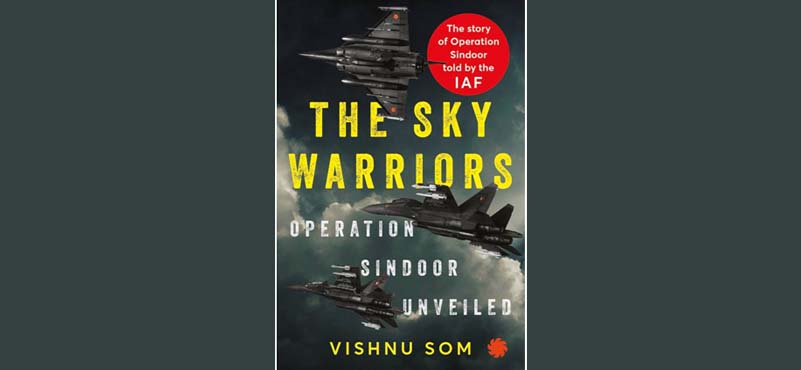
Between 07 May and 10 May over a period of 88 hours, India and Pakistan fought their most intense air battles since the 1971 war. ‘The Sky Warriors’ by Vishnu Som the acclaimed journalist is a definitive account of Operation Sindoor as told by the men who flew the missions and planned the strikes. It offers an air warrior’s view of the Indian Air Force ( IAF ) operations against Pakistan in response to the Pahalgam terrorist attack.
The book is an operational analysis of this high-intensity clash, delivering a narrative on modern SEAD (Suppression of Enemy Air Defence). An extremely gripping and sharply written combat chronicle which gives the reader a rare insight into not only the technical but also the human dimension of combat.
About The Book
The book begins with the Pahalgam incident following which there was no doubt that the IAF would be part of the response and would be put to the ultimate test. Preparations that followed involved finalising target lists and redeploying assets with the aim of sending a ‘precise punitive message by striking terrorist infrastructure without opening a wider front’.
The book is a rare account of the ensuing air operations. The author writes how a Sukhoi pilot is manoeuvring towards hostile airspace as the enemy radar attempts to lock on to his aircraft. It reveals how a senior officer commanding a cutting-edge war room is orchestrating the operations under immense pressure. It also gives a glimpse of missile unit commander on the LoC facing wave after wave of Pakistani drones.
The book tells the reader what it truly means to go into combat. The split-second choices, the weight of command, the handling of modern state of the war waging equipment and the commitment of those who fly these war machines and man the weapon systems.
He writes about BVR radar locks, BrahMos launch sequences, and the engagement envelopes of the S-400, India’s critical shield against missile attacks. While the first-day dogfights following the IAF strikes on terrorist camps grabbed headlines, what stood out was the subsequent degradation of the Pakistan Air Force. Som reveals the overwhelming kinetic response against Pakistan’s air defence assets, airfields, and command-and-control (C2) centres. Using BrahMos-NG, SCALP, Harop, and other precision-attack munitions and drones.
The IAF induced paralysis and altered the trajectory of this 88-hour war. Beyond the initial scramble of the first day, the Pakistan Air Force (PAF) had little left to demonstrate. Within 48 hours, it was rendered largely inconsequential with its air defence in shambles, its fighter fleet reduced to ineffective patrols, while the IAF’s Integrated Air Command and Control System (IACCS) nodes were monitoring every inch of the air picture.
One of the critical moments of the 88-hour war involved a Wing Commander serving in Group Captain Animesh Patni’s S-400 unit. As the Pakistani aircraft and missiles attempted to probe and breach Indian territory, they faced the immense pressure of executing a counter-strike.
Seeking final clearance in a highly charged atmosphere, he requested for confirmation to fire.” Upon receiving a firm “Affirm. You are cleared to launch,” a towering 25-foot S-400 interceptor missile was fired, accelerating to hypersonic speeds into the night sky.
The narrative describes the sheer force of the launch, which shook the ground below. High above, the targeted Pakistani fighter jet desperately attempted evasive manoeuvres, frantically deploying countermeasures like chaff and flares to break the lock.
However, the S-400’s highly advanced radar and tracking systems proved impossible to shake. A massive explosion illuminated the dark sky, followed by confirmation of a successful hit as the enemy aircraft vanished from radar screens. The intense, clinical focus inside the control room instantly gave way to cheers and patriotic chants from the Indian troops manning the system.
This interception was part of a broader, highly successful deployment of India’s layered air defence network. With runways cratered, assets destroyed both in the air and on the ground, and logistics and command nodes under severe pressure, Pakistan’s Director General Military Operations ultimately sought a ceasefire, thereby averting further losses of PAF capabilities.
The author also covers the Pakistani response in detail including details their weapons used and states that; ‘both sides took hits’ and ‘each denied losses’.
The air warriors, Som profiles, men and women in blue, going beyond the call of duty, embody a brand of quiet, lethal professionals that inspire national pride with their courage and resolve.
Conclusion
Deeply researched and intensely gripping, The Sky Warriors combines operational intelligence, forensic detail and edge-of-your-seat storytelling. The Sky Warriors isn’t just another military account. It is fast-paced, gripping, and deeply relevant at a time when air dominance is defining geopolitical power. It also highlights the professionalism, dedication and the sheer grit of pilots who executed their assigned tasks with clinical precision.
The book is not just a record of conflict; which it clearly brings out was not a one-way affair and it’s a tribute to the technical and operational evolution of the Indian Air Force. An outstanding read. The level of research is phenomenal; detailed, credible, and clearly built on a deep understanding of the subject.
What truly elevates the book, though, is the manner in which the story has been told.
The narrative flows effortlessly, making even complex operational details easy to follow and genuinely compelling. It is engaging in a manner that’s seldom seen in non-fiction and hence hard to put down. Although the broad contours of the operation were known, the details and individual accounts makes it a memorable read.
A must-read for anyone interested in military affairs which gives an insight into how modern wars are fought and won. The fact is that stand off weaponry has fundamentally altered combat.
His analysis of the escalation matrix is also outstanding. The book clearly highlights the air aspects of a multi-domain environment and brings to fore the manner in which the IAF was able to unleash its decisive force and redefine the rules of engagement.
ABOUT THE AUTHOR
 Major General Jagatbir Singh VSM, (Retd), has held various command, staff and instructional appointments and served in varied terrains in the country. He has served in a United Nations Peace Keeping Mission as a Military Observer in Iraq and Kuwait. He has been an instructor to Indian Military Academy and the Defence Services Staff College, Wellington. He has commanded the prestigious 1 Armoured Division. He is a prolific writer in defence& national security and is a Distinguished Fellow at USI.