
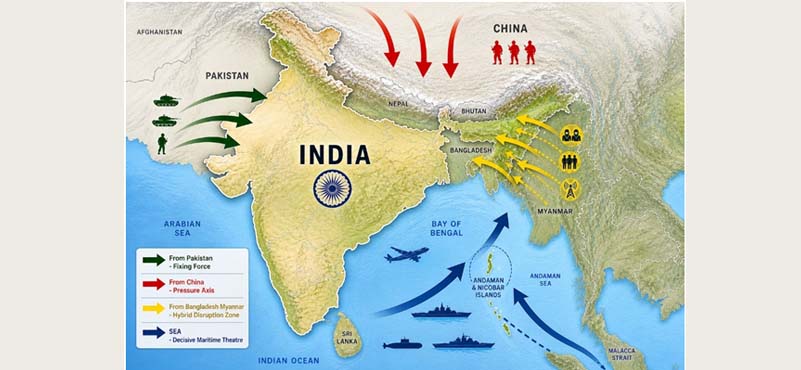
From Siliguri to Nicobar, the emerging battle-space where disruption, delay, and sea control will shape the next conflict.
A Signal Beyond Rhetoric: Reading the “Eastern Vector”
A sharp domestic debate has emerged over the strategic trajectory of India’s Eastern seaboard. Rahul Gandhi has publicly criticised the Great Nicobar project, while indicating his intent to raise the issue in Parliament. The government, in contrast, frames the project as one of strategic national importance—seeking to balance development with environmental safeguards and the protection of indigenous communities.
Such divergence is intrinsic to a democracy. Yet in a shifting security landscape, it acquires a wider strategic resonance. Infrastructure in the Andaman and Nicobar region is not merely developmental—it is tied to India’s forward maritime posture, surveillance reach, and ability to influence critical sea lanes.
It is against this backdrop that the remarks of Asim Munir, as reported by Reuters, made at a black-tie dinner in Florida in August 2025 —that a future conflict with India could “begin from the East and then move Westwards”—invite deeper examination. Read together, these strands do not imply causation, but they do point to a more consequential question: are we entering a phase where internal contestation, hybrid pressure, and maritime strategy intersect to shape the battle-space even before open conflict begins? It is this possibility—grounded in strategic prudence rather than conjecture—that compels a deeper exploration of how India’s next war may be conceived and contested.
Pakistan cannot mount a conventional Eastern invasion. The significance of the statement lies elsewhere: it hints at a shift in how war against India may be conceptualised. Traditionally, conflict has been imagined along predictable axes—primarily the Western front, with contingencies in the North involving China. The “Eastern Vector” reframes this paradigm. It suggests a conflict where geography is not the starting point, but an instrument—where multiple theatres are activated not for decisive breakthroughs, but for simultaneous pressure.
The objective is not immediate victory. It is to disrupt coherence.
Objective of the Conflict: Shaping, Not Seizing
Any serious analysis must first answer a foundational question: what is the war for?
In a conflict involving India, Pakistan, and China, the objective is unlikely to be territorial conquest in the classical sense. The presence of nuclear thresholds imposes limits on escalation, making large-scale annexation both risky and strategically unnecessary. Instead, the objective shifts toward strategic shaping.
The aim would be to influence the conditions under which India operates—militarily, politically, and psychologically. This manifests in multiple ways:
- Slowing mobilisation cycles.
- Fragmenting decision-making.
- Forcing reactive deployments across multiple fronts.
- Creating uncertainty in command and control.
For China, the strategic objective would likely centre on maritime and regional leverage—constraining India’s role in the Indo-Pacific and shaping its behaviour as a regional actor. For Pakistan, the objective remains more limited but still consequential: fixing Indian forces, sustaining pressure, and achieving narrative parity.
A secondary objective lies in testing India’s internal resilience—its ability to maintain political cohesion, public stability, and information integrity under pressure. The decisive domain, however, extends beyond land.
The real centre of gravity in such a conflict lies in the maritime domain, where control over sea lanes and forward positions shapes long-term strategic outcomes. This reframing is critical. The conflict is not about immediate victory, but about reshaping the strategic environment in which India must operate thereafter.
Thus the ultimate objective is subtle but powerful: Not to defeat India, but to slow India at the moment speed matters most.
From Two-Front War to Multi Domain Pressure
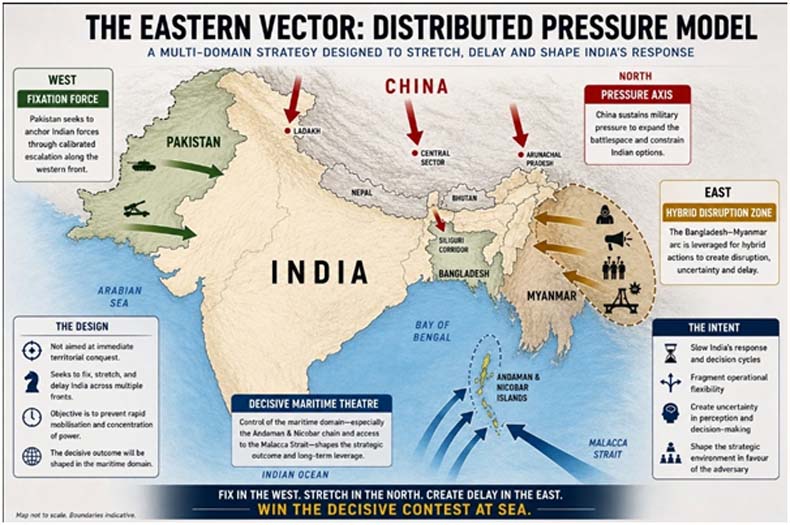
India’s traditional doctrinal concern has been a two-front war—with Pakistan in the West and China in the North. While this remains relevant, it is no longer sufficient to explain the emerging threat matrix.
The evolving model is one of distributed, multi-domain pressure, where different fronts serve different strategic purposes. Four interlinked axes define this battle-space:
- The Western Front, where Pakistan seeks to fix Indian forces.
- The Northern Front, where China applies sustained pressure and expansion of the battle-space.
- The Eastern Arc, where hybrid actions create disruption and delay.
- The Maritime Domain, where the decisive contest may unfold.
The Eastern theatre—bordered by Bangladesh and Myanmar and opening into the Bay of Bengal—thus shifts from a rear area to an active operational space.
The defining characteristic of this model is simultaneity. No single front needs to collapse. It is sufficient that all fronts remain active enough to prevent India from concentrating force decisively at any one point. The result is a form of warfare that targets not just military strength, but coherence, speed, and integration.
It is enough that all fronts remain active enough to prevent decisive concentration of force.
Campaign Design: Fixation, Pressure, and Delay
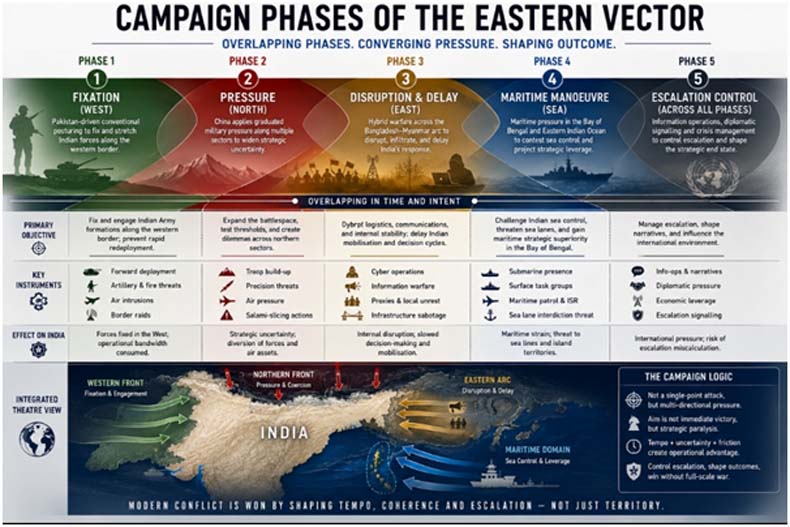
If the objective is to shape India’s strategic environment rather than seize territory, the campaign logic follows a pattern of distributed pressure. The intent is not rapid victory, but to ensure that India cannot concentrate power at a decisive point.
In this construct, Pakistan functions as the fixation force. Through calibrated escalation along the Western front, it compels India to retain significant formations in place. The aim is not territorial breakthrough, but operational anchoring—to limit flexibility and constrain redeployment.
Simultaneously, China sustains pressure in the North. Activity along sectors such as Arunachal Pradesh need not escalate into full-scale conflict; it is sufficient that the threat remains credible enough to expand the battle-space and force India into a cautious, distributed posture.
Between these two axes, India is already engaged.
The Eastern theatre then emerges as the third operational layer, where the objective is neither combat nor territory, but time. Time lost in mobilisation, coordination, and decision-making becomes the critical variable.
The campaign design, therefore, is not linear. It is cumulative:
Fix in the West. Stretch in the North. Create delay in the East—so that the decisive phase unfolds under favourable conditions elsewhere.
Geography of Vulnerability: Siliguri and the Eastern Arc
At the centre of India’s Eastern vulnerability lies the Siliguri Corridor—a narrow land bridge connecting mainland India to the Northeast. Barely 20–22 kilometres wide at its narrowest point, it is one of the most critical geographic chokepoints in the country. Its significance is absolute:
- It sustains connectivity to eight North-Eastern states.
- It supports military logistics and reinforcement.
- It represents a single point of strategic failure if disrupted.
The surrounding geography compounds the challenge:
- Riverine and densely populated terrain in West Bengal and Assam.
- Mountain warfare zones in Arunachal Pradesh.
- Long, complex borders with Bangladesh and Myanmar.
The Eastern Arc along Bangladesh and Myanmar presents a complex operational environment ideally suited for hybrid warfare. This is not about overt military action from these directions. It is about exploiting geography, density, and ambiguity. This terrain does not favour sweeping offensives. It favours attrition through disruption. In such an environment, even limited interference—whether physical, cyber, or informational—can create cascading effects. Individually, such actions remain below the threshold of conventional war. Collectively, they generate friction at scale. The operational effect is disproportionate:
- Slowing movement of forces toward the Northeast.
- Diverting internal security resources.
- Increasing cognitive load on command structures.
The Eastern Arc, therefore, is not just a boundary. It is a system of vulnerabilities.
Internal Friction: The Unseen Half Front
Hybrid warfare derives its effectiveness from its interaction with internal dynamics. It does not create divisions; it amplifies existing ones and aligns with moments of institutional stress.
In this context, domestic debates—however legitimate—acquire strategic relevance when viewed against the timeline of a crisis. The controversy surrounding infrastructure in the Andaman and Nicobar region illustrates this intersection. However, in a compressed operational timeline, prolonged contestation over infrastructure with strategic implications can affect readiness and deployment cycles. Delays in decision-making, execution, or consensus—even when procedurally valid—can intersect with external pressure in ways that shape outcomes.
The issue is not intent. It is timing.
Hybrid warfare succeeds when external pressure and internal friction overlap at critical moments. An adversary does not need internal actors to align with its objectives. It needs only that the system experiences enough delay, distraction, or diffusion of focus when speed and clarity are essential.
Hybrid warfare does not require alignment. It only requires overlap with friction.
The Maritime Pivot: Where the Conflict Is Decided
If the preceding phases are designed to shape conditions, the decisive arena lies at sea. The cumulative effect of fixation in the West, pressure in the North, and delay in the East is to prepare a shift in the centre of gravity toward the maritime domain.
The Bay of Bengal is therefore not peripheral—it is central. It connects Indian Ocean trade routes to Southeast Asian chokepoints, carrying energy flows and commercial traffic that underpin regional stability. Control in this space influences not only military outcomes, but economic and geopolitical leverage.
At the heart of this theatre lies the Andaman and Nicobar chain. Its forward position allows India to monitor and influence movement toward the Strait of Malacca—one of the world’s most critical maritime arteries. The Nicobar axis, in particular, functions as a strategic hinge, linking surveillance, reach, and deterrence.
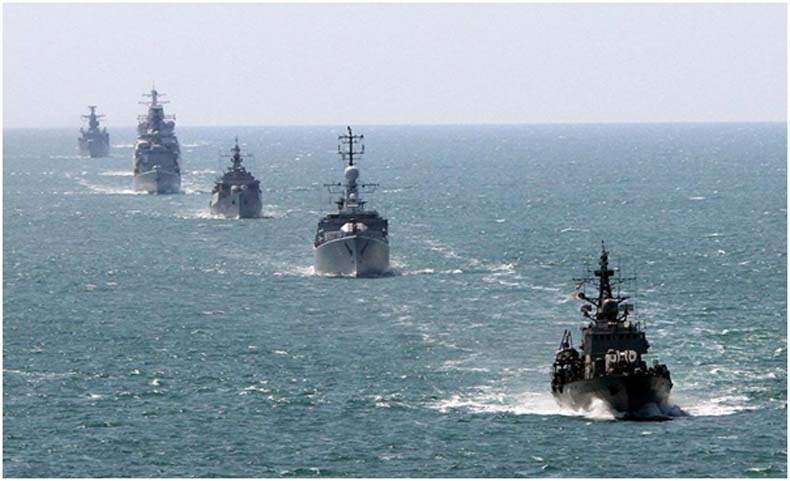
In such a scenario, the adversary’s objective need not be outright seizure. Even the ability to contest, probe, or threaten India’s maritime posture could generate disproportionate effects—raising uncertainty, diverting resources, and shaping perceptions of control.
The logic is clear:
If land fronts fix and delay, the sea becomes the domain where advantage is translated into outcome.
India’s Counter: Preserve Coherence, Deny Delay
India’s response to such a design must be systemic rather than sequential. The objective is not merely to respond to pressure, but to preserve coherence across domains while denying the adversary its intended effects.
The first requirement is to stabilise the Eastern rear. Along the arc of Bangladesh and Myanmar, the aim is to ensure that hybrid activity does not translate into operational delay. This demands:
- Integration of intelligence across agencies and commands.
- Rapid containment of localised disruptions.
- Protection of logistics corridors as strategic assets.
At the centre of this effort lies the Siliguri Corridor. Its defence must be reimagined as active denial, with redundancy in connectivity, layered surveillance, and assured protection of movement.
Simultaneously, India must balance the Western and Northern fronts without over-commitment. Against Pakistan, the aim is to neutralise fixation through credible deterrence and precision response. Against China, the objective is controlled deterrence—maintaining posture without triggering escalation spirals.
This balance is sustained through integration, with air power playing a central role in maintaining flexibility, surveillance, and rapid response across theatres.
The decisive effort, however, must focus on the maritime domain. The Bay of Bengal and the Andaman Sea are where the conflict’s strategic centre of gravity may ultimately reside. The Andaman and Nicobar Command therefore becomes pivotal. From here, India can:
- Monitor and control critical sea lanes.
- Interdict hostile naval movement.
- Project power into the Eastern Indian Ocean.
The strategic imperative is unambiguous:
Preserve maritime dominance while denying the adversary the ability to convert distributed pressure into strategic gain.
At the centre of this posture lies the Nicobar axis.
Thus infrastructure development here transforms the islands into:
- Forward operating bases.
- Surveillance hubs.
- Deterrence platforms.
In a conflict scenario, their defence is absolute: If Nicobar holds, India holds the maritime balance.
The Conflict Termination and Strategic Outcomes
A conflict involving India, Pakistan, and China cannot be resolved through decisive battlefield victory alone. Nuclear thresholds impose limits on escalation, ensuring that the contest remains bounded even as it intensifies below that threshold.
Termination, therefore, is unlikely to arise from outright defeat. It would instead emerge from a combination of mutual risk recognition, external pressure, and diminishing returns from continued operations.
Each actor’s objectives shape its exit calculus. Pakistan seeks continued fixation and international attention. China aims to shape the strategic environment and test India’s resilience without crossing into uncontrolled escalation. India’s objective is to preserve territorial integrity, maintain operational coherence, and deny any shift in the strategic balance—particularly in the maritime domain.
External actors would inevitably influence this phase. The United States, with its stake in Indo-Pacific stability and uninterrupted flow through the Strait of Malacca, is likely to act as a maritime stabiliser—ensuring freedom of navigation while exerting diplomatic pressure to contain escalation. Russia, maintaining ties across all sides, could function as a quiet intermediary, facilitating communication and de-escalation.
The Quadrilateral Security Dialogue (QUAD) is unlikely to activate as a formal alliance, lacking treaty obligations. However, a convergent response is plausible:
- Japan enhancing surveillance and maritime monitoring.
- Australia supporting logistics and naval coordination.
The result would be a controlled internationalisation of the maritime domain—not to fight India’s war, but to prevent disruption of global commons.
And within this emerging battle-space, the strategic focus sharpens on a single point: Nicobar.
Thus the conflict would likely culminate in a negotiated stabilisation, shaped by realities on land and at sea rather than formal settlement.
Strategic gains would be uneven. If India retains maritime control—particularly around the Andaman and Nicobar region—it reinforces its role as a net security provider in the Eastern Indian Ocean. China gains by demonstrating its ability to stretch India across multiple fronts and impose strategic cost. Pakistan’s gains remain largely tactical and narrative-driven, tied to its ability to sustain pressure rather than alter the balance.
Conclusion: The Contest for Strategic Coherence
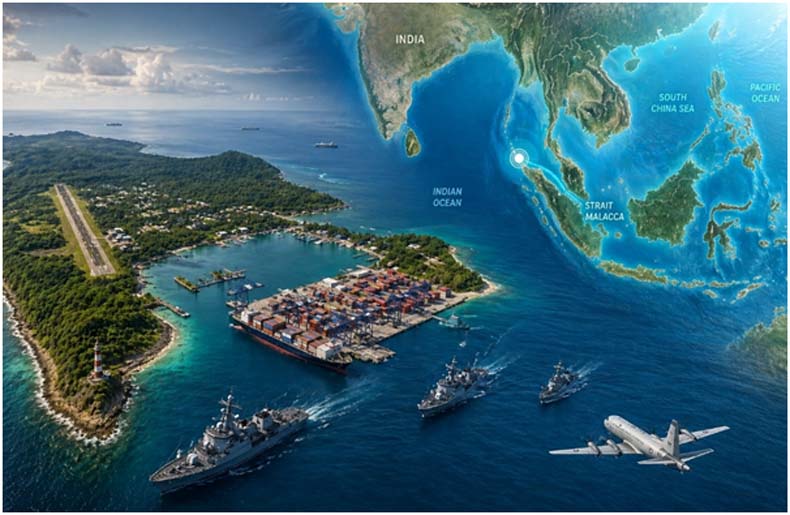
The “Eastern Vector” is not a direction—it is a doctrinal shift in the conduct of war. It represents a form of conflict designed to operate across domains, compress decision cycles, and exploit both geography and systems. It seeks to:
- Stretch India across fronts.
- Slow its response.
- Shift the decisive contest to the maritime domain.
In such a conflict, victory is not defined by territorial gain alone. It is defined by the ability to:
- Maintain internal stability.
- Mobilise without delay.
- Balance pressure across fronts.
- Control the decisive maritime domain.
India’s counter must therefore be equally systemic:
Balance the fronts. Stabilise the rear. Dominate the sea.
And to dominate the sea, the strong maritime pivot is required at Great Nicobar in an earliest time frame. Ultimately, the real battlefield is not defined by geography alone. It lies in India’s ability to function as a coherent, integrated strategic system under pressure.
If India preserves coherence under pressure, the Eastern Vector remains a strategic proposition. If it falters, the consequences will extend far beyond the battlefield—reshaping the balance of power in the region.
In this emerging security environment, the development of the Great Nicobar Project is no longer a matter of infrastructure alone, but a strategic compulsion essential for safeguarding India’s maritime reach, sea-lane security, and Indo-Pacific balance.
ABOUT THE AUTHOR

Lt Gen Rajeev Chaudhry (Retd) is a social observer and writes on contemporary national and international issues, strategic implications of infrastructure development towards national power, geo-moral dimension of international relations and leadership nuances in changing social construct.