The real risk in seizing Kharg Island is not the assault; it is what follows.
The possible military operation by the United States to capture Kharg Island, the oil export centre of Iran, is a strategic challenge full of risks that resonate with the past examples of American military overreach in disputed regions. It is reported that the USS Tripoli amphibious battle group, which consists of the landing platform USS New Orleans and USS San Diego with the 31st Marine Expeditionary Unit on board, has passed through the Malacca Strait and may reach the Strait of Hormuz by the end of March 2026. This scenario suggests the possibility of repetition in which the use of tactical entries without strategic end state and exit policies results in long-term, expensive commitments. Yet history suggests vulnerabilities of such operations to unconventional denial strategies in confined maritime spaces.
Kharg is not just another island objective; it is the fulcrum of Iran’s oil exports. Any disruption there will not stay confined to the battlespace. Energy markets react quickly and sharply. The Arab oil embargo of 1973 made prices rise four times; the 1979 Iranian Revolution doubled the price; the Iraqi invasion of Kuwait in 1990 reduced production by half, and supply was disrupted. Severing Kharg would push Brent sharply upward, disrupt supply chains, and trigger second-order effects no operational plan can fully contain.
Hard Lessons, Hard Terrain
Recent history offers a sobering pattern. When military force is committed without a clear political end state, early success rarely holds. It stretches, hardens, and eventually turns into strategic fatigue.
Vietnam made that plain. What began in 1965 as a limited deployment to secure Da Nang became a drawn-out war that blurred lines between conventional battle and insurgency. A decade later, it ended not in victory but in withdrawal, at a cost far exceeding the original intent.
Afghanistan followed a familiar script in a different century. The Taliban fell quickly under the weight of precision strikes and special operations. But the war did not end there. It settled into the mountains, into time, into an insurgency that could not be decisively closed. Twenty years on, the exit was sudden and unresolved.
Iraq repeated the cycle in compressed form. Baghdad fell with speed and precision. Stability did not follow. The absence of a coherent post-war design turned battlefield success into a prolonged struggle for control.
The lesson is neither new nor ambiguous. Tactical brilliance cannot compensate for strategic ambiguity. Wars that begin without a defined end tend to find one on their own terms.
Kharg Island brings this lesson into sharper relief. Small, narrow, and seemingly manageable, it sits off Iran’s coast as a critical energy hub. Yet its geography is not neutral. Shallow waters, reefs, and limited landing points compress any assault into predictable avenues. The defender, by contrast, operates with the advantage of being able to observe, channel, and strike.
History has seen this before. At Tarawa, a small island imposed outsized costs because the attacker had no room to manoeuvre. Kharg presents a modern version of the same problem, now compounded by surveillance and precision firepower.
In such terrain, the question is not whether ground can be seized. It is whether it can be held without triggering a longer, costlier contest. Geography, in the end, decides that more often than strategy admits.
The Illusion of Controlled Entry and the Reality of Iran’s anti-access/area denial (A2/AD) Strategy
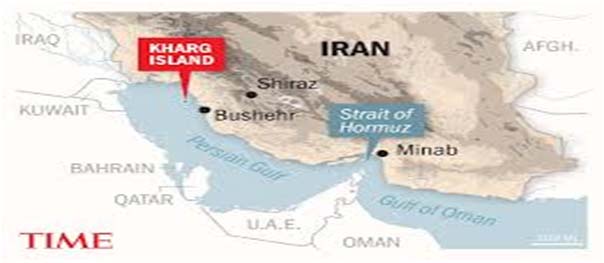
The entry to Kharg Island runs through the narrow and heavily contested waters of the Strait of Hormuz, a corridor that has historically punished complacency. Any amphibious or air assault on the island would not be an isolated tactical action.
For an attacker, this creates a paradox. The very objective of preserving the oil infrastructure limits the use of overwhelming firepower. Precision becomes a constraint rather than an advantage. Destroy too much, and the strategic objective collapses. Destroy too little, and defenders retain the ability to deny access.
The surrounding waters are shallow, cluttered, and ideal for asymmetric naval warfare. Mines, fast attack craft, anti-ship missiles, and drones can quickly turn the approach into a killing zone. Iran’s anti-access/area denial (A2/AD) layered coastal defence network, integrated with mainland systems, ensures that Kharg is not an isolated outpost but an extension of the Iranian mainland’s defensive envelope. It transforms the Strait of Hormuz, which narrows to 33 km at its narrowest point, and shipping lanes with buffers to 3 to 4 km, into a multi-layered defensive bastion.
Passing of naval forces, such as the Tripoli group, will need to be protected by surface combatants, aircraft carriers, and undersea resources. Nevertheless, the threat of massive salvos disrupting defences remains.
Staging by Omani facilities in Khasab or Muscat is feasible, but it would require vertical manoeuvres across the Gulf of Oman, which could raise neutrality concerns among regional countries. Any disruptive attack on Kharg activities could lead to retaliatory strait disruptions that have historically resulted in higher maritime insurance rates and tanker diversions.
Evaluation of Amphibious and Air Assault Options
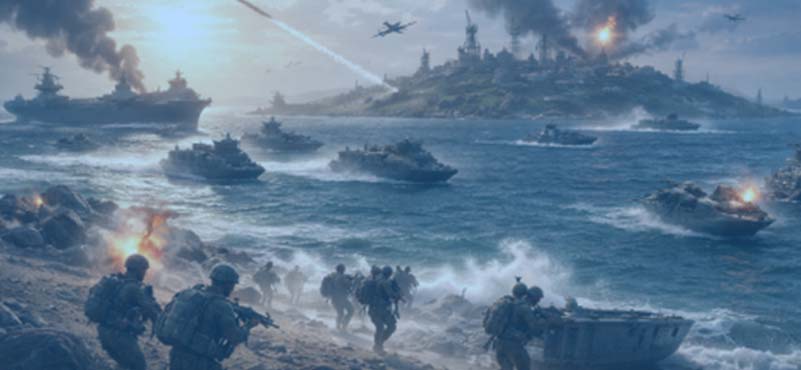
A conventional amphibious operation would utilise the Tripoli group’s landing craft air cushion capabilities, supported by naval gunfire and F-35B strike aircraft, to land amphibious task forces. This option offers both logistics and synchronised firepower, but comes at a heavy price in cost, time and casualties. Historical examples show increased personnel losses early on, with reinforcements from Iran turning initial footholds into difficult-to-defend salient points.
In comparison, an air assault with medium-lift, multi-mission aircraft such as the V-22 Osprey tiltrotor and support helicopters can quickly deliver to targets, such as export terminals, within the aircraft’s established 900-nautical-mile operational range when positioned in standoff locations. Marine expertise in vertical operations provides speed and reduces exposure on open beaches. But it trades mass for mobility. Light forces inserted deep remain dependent on fragile resupply chains and exposed aviation assets. In a contested air and maritime environment, that dependence becomes a critical vulnerability.
Both paradigms encounter structural limitations within Iran’s A2/AD envelope. Amphibious operations wrestle with navigation, swarming, and exorbitant sustainment costs, while air operations drain mass and endurance to achieve speed, leading to rapid operational deterioration without neutralisation of threats.
Prognosis: Regional and Global Implications
Beyond the immediate operation lies the wider risk. Any strike on Kharg is unlikely to remain localised. Retaliation in the Strait would raise insurance costs, divert shipping, and strain already fragile energy flows. The Gulf would now be engaged in an energy destruction war. The effects would travel quickly to energy-dependent economies. For countries like India, the impact would be immediate, visible in prices, supply stability, and inflationary pressure.
The interaction between Kharg’s topography, Iran’s A2/AD configurations, and the challenges of Hormuz resembles the patterns of historical traps, which are further strengthened by interconnected energy security. Such operations are easier to begin than to control. The consequences would not remain local.
ABOUT THE AUTHOR
 Lieutenant General A B Shivane, is the former Strike Corps Commander and Director General of Mechanised Forces. As a scholar warrior, he has authored over 200 publications on national security and matters defence, besides four books and is an internationally renowned keynote speaker. The General was a Consultant to the Ministry of Defence (Ordnance Factory Board) post-superannuation. He was the Distinguished Fellow and held COAS Chair of Excellence at the Centre for Land Warfare Studies 2021 2022. He is also the Senior Advisor Board Member to several organisations and Think Tanks.