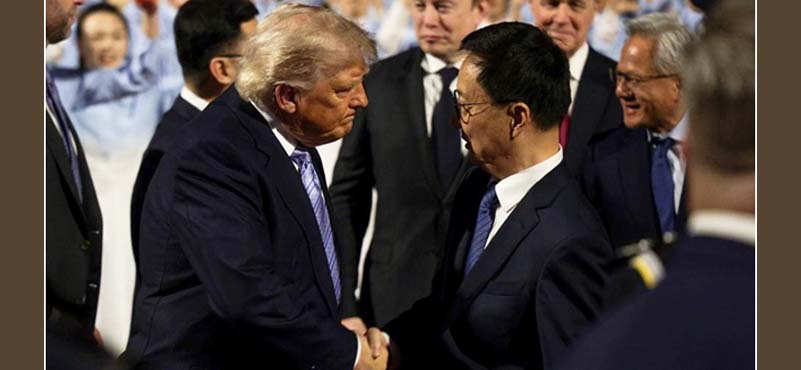
Faced with huge trade and economic disruptions thanks to US President Donald Trump’s unilateral tariff impositions, India and Europe have just signed a historic Free Trade Agreement that could pave the way for a realignment of New Delhi’s economic and strategic priorities.
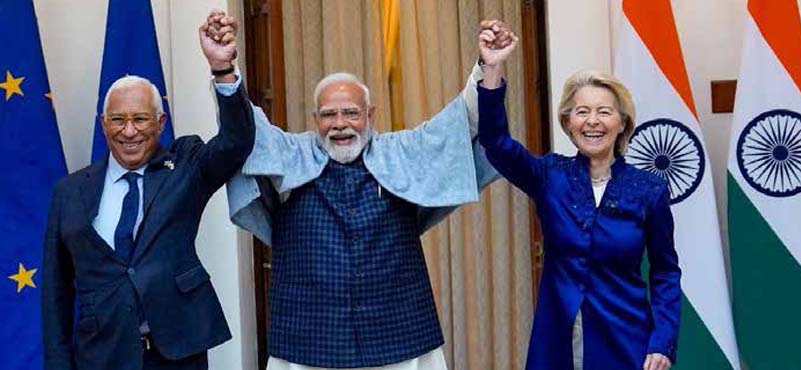
There was a picture-perfect moment that set the stage for the just announced Free Trade Agreement (FTA) between India and the European Union. Two of the key players from the European side, European Commission President Ursula von der Leyen, and European Council Chief Antonia Costa, were chief guests at India’s Republic Day parade on January 26, a day before the two sides signed the historic FTA. Von der Leyen’s India-inspired designer jackets were a sartorial announcement to the world that Europe’s embrace of India was without borders. A day later, the path-breaking FTA was signed
Just a week earlier, addressing global leaders at the World Economic Forum in Davos, Von der Leyen had described the prospective India-EU Free Trade Agreement (FTA) as part of Europe’s broader strategy to champion what she described as “fair trade over tariffs, partnership over isolation, sustainability over exploitation.” She added that the FTA could reshape global commerce and supply chains and that the European Union was committed to de-risking its economy and diversifying supply chains by deepening ties with the world’s major growth centres. According to her, the agreement would create a combined market of around two billion people and account for nearly a quarter of global GDP, giving European companies a crucial first-mover advantage in one of the world’s fastest-growing regions.
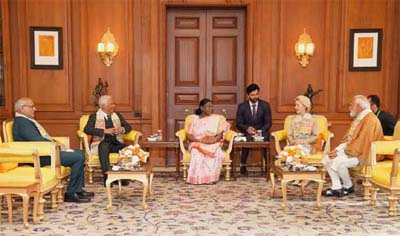 In a post-signing statement, Prime Minister Narendra Modi said two of the world’s biggest democratic trading blocs with trade valued at 180 billion Euros had “sealed the biggest FTA in our history”. The timing of the deal could hardly be more opportune. The global economy is navigating renewed turbulence: US President Donald Trump’s return to aggressive tariff postures has unsettled markets, supply chains remain fragile, global institutions like the World Trade Organisation have lost their relevance, and the Russia-Ukraine war shows no sign of resolution. Against this backdrop, an India-EU FTA sends a strong signal in favour of open, predictable and diversified trade at a moment when economic nationalism is on the rise. The two sides also unveiled a defence framework pact and a strategic agenda. The new partnership comes at a time when Europe is seeking to reduce its dependence on the US and China, and deepen its diplomatic and economic ties to other regions.
A lighter moment was injected by Costa who held up his OCI card after the signing of the deal. Goa-born Costa received the card while serving as Portuguese Prime Minister. Costa said: “I’m the President of the European Council, but I’m also an overseas Indian citizen. Then, as you can imagine, for me it has a special meaning. I’m very proud of my roots in Goa, where my father’s family came from, and the connection between Europe and India is something personal to me.”
The FTA, which has been in the making since 2007, faced major bureaucratic hurdles which had derailed it during negotiations in 2007. Negotiations restarted in 2022 but impediments remained, mainly over Indian tariffs on European autos and wines, apart from Europe’s carbon tax issue. Agriculture and diary, another bugbear for India, was largely kept out of the deal. Trump’s tariffs, including the ones he threatened Europe with, gave it fresh impetus. What makes this “the mother of all deals” is that the agreement is not just restricted to trade and economic cooperation but both sides are also set to sign a security and defence partnership agreement to add momentum to the evolving partnership. While trade is the cornerstone of the FTA, it also has a vital strategic element along with stronger political ties. The proposed Security and Defence Partnership (SDP) will facilitate deeper defence and security cooperation between the two sides. The SDP will bring interoperability in the defence domain and will open up avenues for Indian firms to participate in the EU’s SAFE (Security Action for Europe) programme. SAFE is the EU’s instrument designed to provide financial support to member states to speed up defence readiness.
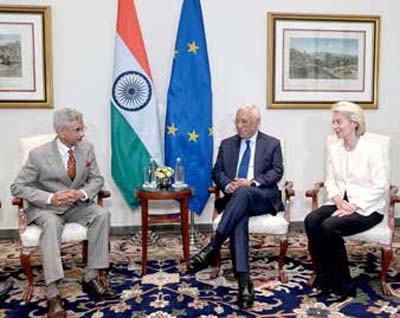 Trump’s attacks on India have prompted New Delhi to reassess its diplomatic strategy, leading to an emphasis on what it calls “multi-alignment”, which includes the pivot to Europe. While relations with the US are important (despite Trump’s criticism of the Indo-Europe FTA), Europe offers a promising alternative to balance risks going forward. One hurdle that has delayed the Indo-EU FTA is that European leaders have expressed their concerns about India’s traditional partnership with Russia and its purchase of oil from that country. For the EU, defence of Ukraine remains a steadfast commitment and India’s purchase of Russian oil has been an irritant in the FTA talks. As former ambassador to Germany Gurjit Singh wrote in a recent essay: “India has been a stabilising force amidst a rapidly changing global dynamic. However, a strong push was required to elevate their transactional relationship into something more meaningful for both parties.”
That push, a major impetus, was the 27/28 February 2025, visit to India by Von der Leyen and 22 of the 27 European Union (EU) College of Commissioners. The meetings sought to deepen and diversify the strategic partnership between the EU and India, focusing on trade, technology, defence, clean energy, and digital innovation. This was the first visit of the College of Commissioners in the history of India-EU bilateral relations. It also signified a major geopolitical shift. India has gained a higher profile in EU for reasons other than trade and defence. There is the need for New Delhi to balance its thorny relationship with China by enhancing its engagement with Europe. The EU is India’s largest trading partner in goods, with bilateral trade touching about USD 136 billion in 2024-25, and a steadily growing services trade as well. Over the past decade, European companies have expanded their footprint in India’s manufacturing, clean energy and digital sectors, while Indian firms– from IT services to pharmaceuticals– have deepened their presence across Europe. France, Germany, the United Kingdom and the Netherlands collectively represent a major part of EU-India trade, further enhanced after the January 2026 visit by German Chancellor Friedrich Merz who was accompanied by a high-level delegation of German business leaders.
On his part, Prime Minister Modi has, over the past year, visited France, Italy, Greece, Ukraine, and Poland to strengthen engagement with European leaders at a time when the uncertainty of U.S. policy has become a unifying concern for both sides. For India, it promises greater access to a 450-million-strong consumer market. For Europe, it offers a deeper anchor in one of the world’s fastest-growing major economies.
The sticking points which seem to have been ironed out, included lower tariffs on automobiles and alcoholic beverages, including wines, while India is keen on securing better entry for its textiles, pharmaceuticals, and chemical exports into the European market. The EU’s carbon tax (CBAM) was an added problem in the negotiations. Both sides signed key agreements on semiconductor research and high-performance computing to tackle global tech challenges. India and the EU are also working on green hydrogen, renewables, and sustainable energy systems. The European Investment Bank has pledged support for Indian hydrogen projects while the EU’s support in initiatives like the International Solar Alliance and offshore wind energy highlights the shared commitment to tackling climate change.
The collaboration between the EU and India from 2020 to 2025 has been guided by the EU-India Strategic Partnership Roadmap, the EU Strategy for Cooperation in the Indo-Pacific, and the Global Gateway Strategy. There are over 50 EU-India sectorial dialogues underway, reflecting the growing partnership. However, there are some downsides as well. For the EU, the Ukraine crisis is a dominant focus, while India’s concern is that China’s growing influence in European markets could upset its own calculations in terms of enhancing trade ties. Those concerns seem to have been overcome.
More important is that the establishment of the India-EU Trade and Technology Council in 2022, only the EU’s second such council after the one with the US, was a recognition that trade, technology and security are now inseparable. Security cooperation has accelerated too, with joint naval exercises in the Indian Ocean and growing dialogue on defence industrial collaboration. On climate and energy, Europe has become a key partner in India’s transition to renewables, green hydrogen and sustainable urban mobility. Connectivity is another strategic thread. The India-EU Connectivity Partnership and the ambitious India-Middle East-Europe Economic Corridor (IMEC) reflect a shared interest in building transparent, sustainable infrastructure networks across continents. An FTA would give these strategic initiatives a powerful economic backbone. The FTA spans 24 chapters covering goods, services, intellectual property, environment and labour and data protection. India will reduce or remove tariffs on a majority of EU exports, including wine, spirits and beer and a reduction in tariffs on cars from 100 per cent to 10 per cent for 25,000 vehicles annually. These are mostly luxury cars from Mercedes, BMW, Audi, etc, where there is no competition from Indian car-makers who dominate the lower end of the auto market.
This FTA signals a new strategic opening by New Delhi, which has traditionally been stymied by its need to protect local industries and producers. Despite that, there are still some hurdles to cross. The deal has been signed but ratification by the European parliament and approval by all 27 member states remain a hurdle which could take a year or so, although New Delhi is pushing for a 2026 deadline. There are also likely to be follow-up negotiations on agriculture, intellectual property rights, and the EU’s Carbon Border Adjustment Mechanism, among other issues. That said, the fact that there is unfinished business should not diminish the accomplishment of reaching agreement on preferential tariff schedules and a large number of detailed rules chapters, such as Technical Barriers to Trade. The bottom line, however, is that the India-EU FTA is a game changer in the context of the undermining of the rules-based order in which global umpires like the World Trade Organization, continues to decline in relevance and new structures emerge to fill the vacuum.
ABOUT THE AUTHOR
 Dilip Bobb is a former senior managing editor, India Today (1975 -2010), and Group Editor, Features and Special Projects, Indian Express (February 2011-October 2014)