
Beyond Headline Numbers: Why Surakshit Bharat Precedes Viksit Bharat
The aspiration of a Viksit Bharat rests squarely on the assurance of a Surakshit Bharat. Economic ambition, technological progress and global stature lose meaning if national security is treated as a residual priority rather than a strategic foundation. The Defence Budget 2026 offers moments of optimism, but it also exposes persistent structural limitations that could constrain India’s military preparedness in an increasingly unforgiving security environment.
India takes pride in being the world’s fastest-growing major economy and a projected five‑trillion‑dollar economy in the near future. Yet, economic bugles are sounded by soldiers standing watch across contested borders, turbulent seas and contested domains beyond land, air, sea, space and cyber. The soldier of tomorrow will fight in a battlespace shaped by data, networks, artificial intelligence, space assets and cyber resilience. Empowering that soldier requires foresight, investment and policy coherence, not incrementalism.
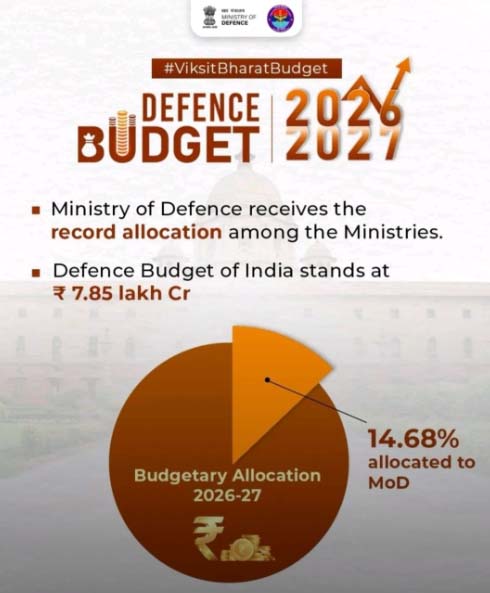
The Defence Budget presented on 1 February 2026 reflects a cautious middle path. While the overall defence allocation has increased, it remains well below the level demanded by India’s evolving threat matrix. The aftershocks of Operation Sindoor, continued Chinese assertiveness along the Line of Actual Control, and the deepening China‑Pakistan military nexus collectively underline the cost of under‑preparedness. In such circumstances, defence budgeting cannot afford timidity.
Expectations of a 20–25 per cent increase in defence outlay were well-founded and based on the clear operational lessons of recent years. The aim was not fiscal extravagance, but a calibrated movement towards a more credible 2.5 per cent of GDP for defence. This debate is not about numbers in isolation. It is about time. Conflicts can erupt overnight, but capabilities take years to build. Technology cycles move faster than procurement cycles, and deterrence fails when preparation lags behind intent.
What India requires is not episodic generosity but a stable, predictable defence ecosystem anchored in technology sovereignty. This demands sustained capital investment, long‑term budgetary assurance and a defence industrial base capable of supporting future wars without strategic vulnerability.
Defence as National Insurance, Not Discretionary Expenditure
Defence expenditure carries a price, but insecurity carries a far higher cost. The government’s declaration of 2025 as the Year of Reforms and 2026 as the Year of Networking and Data Centricity is conceptually sound. It recognises the need for military modernisation, jointness and digital transformation. However, ambition must be matched by resources if reform is to move beyond intent.
No single defence budget can meet all requirements. What is needed is a long‑term, integrated national vision that aligns threat assessment, capability development and fiscal commitment. The absence of a formally articulated National Security Strategy remains a critical gap. Without it, defence planning risks becoming reactive, budget‑driven and fragmented.
Sustainable military transformation requires more than structural reorganisation. It demands cultural change, a transformed defence planning process, budgetary reform and genuinely integrated joint capabilities. Institutional silos continue to impede integrated outcomes, diluting the effectiveness of even well‑intentioned reforms.
Defence Budget 2026 in Perspective: Size, Structure and Strategic Context
 The Ministry of Defence has been allocated ₹7,84,678 crore for FY 2026–27, marking an increase of about 15.2 per cent over the Budget Estimates of the previous year. Compared with the Revised Estimates of FY 2025–26, the rise is approximately 7.1 per cent. In absolute terms, this is a substantial figure and continues the trend of defence receiving the highest allocation among all ministries.
The total defence budget is 14.67% of the Central Government expenditure and is the highest among the Ministries. The stated intent is to balance security, development and self‑reliance. Yet market reactions were telling. Defence sector stocks declined sharply, reflecting industry expectations of a significantly larger push, particularly in capital expenditure. This response underlines the perception gap between incremental improvement and transformational investment.
Over the last three fiscal cycles, defence allocations have grown steadily, but the pace has been modest when measured against expanding responsibilities and technological disruption. The focus areas have evolved from infrastructure and indigenisation to modernisation and aerospace, but the underlying structural ratios have remained largely unchanged.
Defence Budget Estimates (BE) Comparison
The following table compares the Budget Estimates for the Year 2026-27 with the previous two fiscal cycles.
| Financial Year | Budget Estimate (BE) | Per cent Change (YoY) | Key Focus |
| 2026–27 | ₹7,84,678 crore | 15.2per cent | Modernisation and Aerospace |
| 2025–26 | ₹6,81,210 crore | 9.5per cent | Domestic Procurement and Reforms |
| 2024–25 | ₹6,21,941 crore | 4.7per cent | ‘Atmanirbharta’ and Infrastructure |
Demand-Wise Comparison Table
| No. | Demand Description | Net FY25-26(₹ Cr) | Net FY26-27(₹ Cr) | per cent Change |
|---|---|---|---|---|
| 1. | MOD(Civil) | 28,682.97 | 28,554.61 | -0.45per cent |
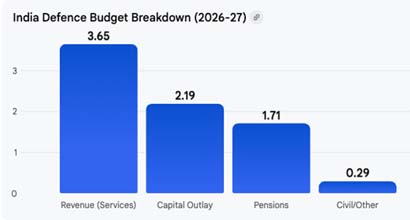
| 2. | Defence Services (Revenue) | 3,11,732.30 | 3,65,478 | +17.24per cent |
| 3. | Capital Outlay (Defence) | 1,80,000 | 2,19,306.47(including modernisation 1.85 lakh crore) | +21.84per cent |
| 4. | Defence Pensions | 1,60,795 | 1,71,338.22 | +6.53per cent |
What the Budget Delivers: Key Allocations and Strategic Emphases
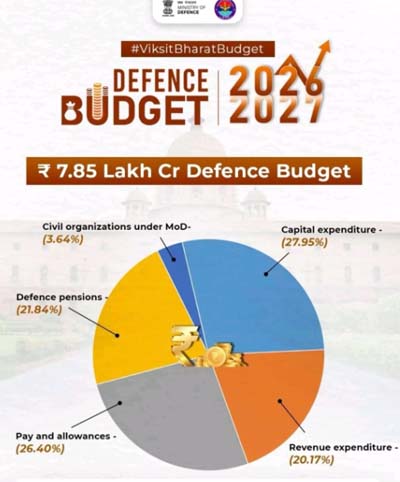
Capital Outlay: Capital expenditure has risen by nearly 22 per cent to ₹2.19 lakh crore. This is a welcome step, yet capital spending still constitutes less than 28 per cent of the total defence budget. When inflation and cost escalation are accounted for, the real increase is far less impressive. A significant portion of this allocation will be absorbed by committed liabilities for existing contracts, reducing headroom for new capabilities.
Aerospace and Naval Focus: Allocations for aircraft, aero engines ₹63,733 crore (29per cent) and naval platforms ₹25,023 crore (11.41per cent) indicate a continued emphasis on air and maritime power. These investments are essential, but they must be balanced with parallel investments in enabling domains such as electronic warfare, cyber operations and space‑based assets.
Revenue Expenditure: Revenue spending continues to dominate, at ₹5,53,668 crore (70.56per cent), which includes ₹1,71,338 crore (21.84per cent) specifically for defence pensions. While necessary for sustenance and readiness, this imbalance constrains modernisation and delays capability infusion.
GDP Share: Defence expenditure remains at approximately 1.99 per cent of GDP. This figure has declined from the earlier 2.25 per cent in FY20 and remains below the global average of 2.5. In comparison, Pakistan’s defence allocation last year was 2.3 per cent of its GDP. According to data from the Stockholm International Peace Research Institute (SIPRI), the United States spends about 3.4 per cent of its GDP on defence, while China spends an estimated 1.7 per cent. In relative terms, India continues to under‑invest in defence compared to the scale of its strategic responsibilities. Ironically, for every ₹1 spent by the Govt, allocation for defence is just 11 paisa.
Capital Outlay and Modernisation: Progress Undercut by Commitments
The capital component has a non-modernisation component and a modernisation component, which has a committed liability sub-component and a new schemes sub-component. Of the total capital outlay of ₹2.19 crore, around ₹1.85 lakh crore is earmarked for modernisation. Rs 1.39 lakh crore, i.e., 75% of the Capital Acquisition budget, has been allotted for procurement through domestic industries during the FY 2026-27, reinforcing Atmanirbhar Bharat and strengthening private sector participation. Priority areas must include cyber security, space warfare, artificial intelligence, robotics, unmanned and counter‑unmanned systems, and machine learning.
However, the weight of committed liabilities continues to crowd out new schemes. This structural issue limits flexibility and delays the induction of emerging technologies. Additional allocations at the Revised Estimate stage and timely high‑value approvals could partially mitigate this constraint, but they cannot substitute for systemic reform.
Industry had viewed Budget 2026 as a potential inflexion point for indigenisation. The drop in defence stocks indicates disappointment. While progress continues, greater visibility of long‑term procurement pipelines, faster contracting and deeper participation of Tier‑2 and Tier‑3 industries remain essential.
Revenue Dominance and the Pension Debate: Separating Myth from Reality
Revenue expenditure supports pay, allowances and operational sustenance. The revenue-to-capital ratio stands at 68:32 from 63:37 in the previous year, which is adverse and impacts modernisation. The ratio of Capital Outlay to Revenue Expenditure (excluding pensions and civil) is approximately 0.60:1. When considering the total revenue-related burden (including pensions), the share of capital expenditure in the total Ministry of Defence budget is approximately 27.95 per cent, while revenue-related costs (sustenance, salaries, and pensions) account for nearly 68 per cent.
 Pensions and salaries are based on actuals and included in revenue expenditure. The reality is MoD budget directly pays nearly 5.1 million people, of which 1.44 million are active uniformed personnel, 3.2 million pensioners (a quarter of defence civilians) and 0.4 million serving defence civilians and other heads.
The Defence Pension Budget, big in absolute numbers, is due to the large number of retired personnel, which itself is a function of soldiers being compulsorily retired early from 36 years of age onwards, owing to the requirement of maintaining a young and physically fit military. Thus, India has 2.4 defence pensioners for every serving soldier, while the ratio for civilians is approximately one pensioner for each serving employee. It is also worthwhile to mention that the average per capita pension of defence personnel is much lower than that of a Central Govt civil employee. These facts remain hidden and treasured.
Where the Budget Gets It Right: Quiet but Meaningful Gains
- The enhanced allocation to BRO has been enhanced to Rs 7,394 crore from Rs 7,146.50 crore for border area infrastructure development, which is a strategic necessity. The financial provision made during the budget this year will, apart from promoting strategic infrastructural development in the border areas, improve mobility and strategic reach.
- The budget for the Coast Guard helps in acquiring Advanced Light Helicopters, Dornier aircraft, and Fast Patrol Vessels to enhance maritime security and disaster response capabilities, which will add teeth to its arsenal to address the emerging challenges.
- The Defence Research and Development Organisation (DRDO) hike to Rs 29,100.25 crore in FY 2026-27 from Rs 26,816.82 crore in FY 2025-26, though limited, will bolster indigenous technological advancements. Yet the R&D allocation as a percentage of GDP remains one of the lowest for India at below 1per cent of GDP. This requires a long-term perspective and a substantial increase.
- There has also been an increase in the ECHS budget by a significant 45 per cent, by way of ₹12,100 crore for FY 2026-27, prioritising veterans’ healthcare access, polyclinic upgrades, and cashless treatment expansions.
- Customs Duty Exemptions: To boost the domestic aerospace sector, the government announced exemptions on basic customs duty for certain raw materials used in the maintenance and repair of defence units.
The Strategic Imperative Ahead: From Incrementalism to Preparedness
India’s defence budgeting is inseparable from its economic and strategic doctrine. National ambition has progressed from import substitution to strategic resilience and now towards strategic indispensability. In a world of geopolitical fragmentation, trade weaponisation, and supply-chain insecurity, economic security is national security. Defence preparedness is defined as much by industrial depth and technological integration as by platforms and force levels.
Prolonged import dependence undermines credibility, while inward-looking self-sufficiency is insufficient. India must become a non-substitutable node in global defence value chains, offering technology, scale, and reliability indispensable to trusted partners. Defence manufacturing must be treated as strategic infrastructure, with Tier-I and Tier-II industries recognised as critical sectors. Co-production and co-development with trusted partners such as Russia, the United States, France, the UK, Israel, and Japan should embed technology transfer in long-term manufacturing, while private industry scales alongside public sector undertakings. Export-led growth offsets R&D costs and establishes global credibility.
Capital allocation alone is insufficient; state capacity is critical. Procurement must enable multi-year contracts, predictable demand, and calibrated professional risk-taking. Capacity, credibility and capability are complementary. Regulatory reform is essential to accelerate private-sector participation.
Global polycrisis demand technology-driven, multi-domain warfare capabilities— AI and autonomous systems, semiconductors, networking, defence electronics, resilient digital and space infrastructure, advanced aerospace and naval materials, and cyber capabilities.
Conclusion
No defence budget can meet every operational aspiration. Constraints are inevitable. Yet prioritisation itself is a strategic act. Defence Budget 2026 reflects continuity and caution. What it now requires is complementarity through reform: non-lapsable modernisation funds, accelerated procurement pathways, realistic risk-sharing with industry and protected R&D allocations.
Preparedness carries a cost, but unpreparedness carries far greater consequences. The armed forces do not seek extravagance. They seek credibility, predictability, and the means to prevail across domains. Defence Budget 2026 provides a foundation. Whether India moves decisively from resilience to indispensability will determine the credibility of its military power in the decade ahead.
ABOUT THE AUTHOR
 Lieutenant General A B Shivane, is the former Strike Corps Commander and Director General of Mechanised Forces. As a scholar warrior, he has authored over 200 publications on national security and matters defence, besides four books and is an internationally renowned keynote speaker. The General was a Consultant to the Ministry of Defence (Ordnance Factory Board) post-superannuation. He was the Distinguished Fellow and held COAS Chair of Excellence at the Centre for Land Warfare Studies 2021 2022. He is also the Senior Advisor Board Member to several organisations and Think Tanks.