
2025 was a testing year for India on the geopolitical front. Confronted with the Trumpian revolution that aggravated trade tensions, major power rivalries, secondary effects of wars and structural economic shifts, India needed to navigate turbulent waters with continuous tactical calibration. India did follow Minister Jaishankar’s 2020 mantra on major power play, albeit with a few twists: ‘engage America, manage China, cultivate Europe, reassure Russia’ became ‘manage a volatile Trump, tactically accommodate a rising China, befriend a friendless Europe, and embrace a weakened Russia’.
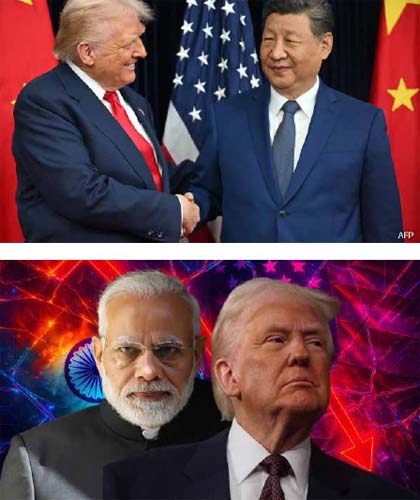 It was, of course, the US under Trump that required the most managing and the most diplomatic energy. India also brought Japan into play and gave leadership to the Global South, but foreign policy required several more contortions. Beyond diplomatic catchphrases, it was newer operational priorities that animated India’s global posture in 2025.
As we step into 2026, a natural question arises: can matters get worse—or better? A reasoned projection suggests that India may soon strike its geopolitical “sweet spot”: a year in which diplomatic balance, economic momentum and global relevance converge. More ambitiously, could 2026 also mark a phase when India begins to play a constructive role not merely in stabilising its global relationships, but also in easing global conflicts?
Managing America Without Losing the Plot
India’s engagement with the United States in 2025 captured the paradox of continuity amid disruption. For over a quarter century, Washington’s relationship with New Delhi had been among its fastest growing and most stable, deepening across administrations and surviving ideological shifts in both capitals. Even Donald Trump’s first term, despite its turbulence, left the partnership largely intact. That sense of continuity appeared to hold early in Trump’s second term, when Prime Minister Narendra Modi was invited to a White House summit in February 2025, signalling that India remained central to American strategic thinking in Asia.
Then the relationship deteriorated with startling speed. In August, Washington shocked New Delhi by imposing punitive tariffs of up to 50 percent on Indian exports, placing India—alongside Brazil—among the most heavily tariffed U.S. trading partners. These measures were accompanied by intense pressure on India to curb purchases of Russian oil and by a very public revival of U.S.–Pakistan engagement. Together, they pushed bilateral ties to their lowest ebb in decades, reviving old suspicions in South Block about American transactionalism and strategic inconsistency.
 Yet the relationship did not rupture. Even as trust eroded at the political level, cooperation endured where institutional ballast now runs deep. Defence ties remained steady, marked by continued joint military exercises and the signing of a new ten-year defence framework agreement reinforcing interoperability, co-development and intelligence sharing. Space collaboration advanced with the successful launch of a joint satellite. Law-enforcement cooperation delivered tangible results, including FBI action against individuals wanted in India. These continuities underscored a critical reality: U.S.–India relations have matured beyond personality-driven diplomacy, even if they remain vulnerable to it.
New Delhi’s response to American pressure was telling. Rather than retaliate or escalate rhetorically, India chose calm. Trade negotiations continued through the year, with both sides signalling intent to conclude a framework agreement that could reduce punitive tariffs below 20 percent in early 2026, followed by a wider bilateral trade deal. A Trump visit to India in the first half of the year—possibly calibrated to balance his expected China visit in March—could showcase a trade deal, provide the political reset and revive momentum, including a reinvigoration of the Quad as a credible Indo-Pacific instrument.
The broader context matters. On December 1, 2025, the United States assumed the G20 presidency, ending an unprecedented run of four consecutive Global South–led chairs. Under Trump, the forum is expected to shift from an expansive, development-centred agenda toward a narrower “back-to-basics” vision focused on national economic interests. This normative contraction may weaken the G20’s legitimacy, particularly since the G7 club is also fractured by disagreement—but it also enhances the relative salience of BRICS, which India will chair in 2026.
Strategically, Trump’s America is operating under a doctrine of flexible realism., espoused in its National Security Strategy. China remains the primary adversary in the Indo-Pacific, but Washington increasingly recognises it cannot dominate every theatre simultaneously. For India, this creates both risk and opportunity. Managing Trump will be about shielding the long-term partnership from domestic turbulence in the US, while extracting tangible gains where possible. Whether India can sustain this balancing act will be central to whether 2026 becomes a sweet spot—or merely another year of diplomatic triage.
China: Deterrence Without Drama
After years of border tensions since 2020, India and China appeared to settle into a cautious equilibrium in 2025, tactical accommodation rather than a strategic reset. Following leader-level interactions on the margins of BRICS and the SCO, Prime Minister Modi invited President Xi Jinping to attend the BRICS summit in India in 2026, an invitation Xi accepted.
For India, managing China is about preventing escalation while preserving channels for trade, dialogue and multilateral coordination. Strategic competition remains real—over borders, supply chains and China’s deepening military partnership with Pakistan—but India has resisted the logic of permanent hostility. That restraint creates strategic space: space to deepen partnerships elsewhere, strengthen economic resilience and focus on regional leadership. In 2026, this uneasy equilibrium may allow India to concentrate less on firefighting and more on shaping outcomes.
Europe’s Moment, India’s Opportunity
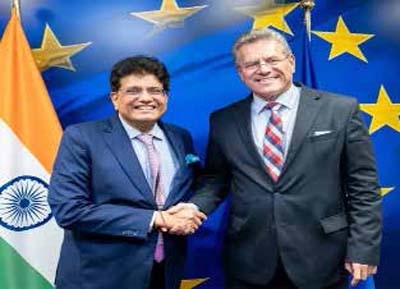
If 2025 was difficult with America and delicate with China, it was quietly productive with Europe. The European Union approved a new Strategic EU–India Agenda, laying the groundwork for deeper cooperation across trade, technology, climate and defence-industrial collaboration. For a Europe battered by war, energy shocks and a volatile trans-Atlantic partner, India emerged as a credible long-term anchor.
For India, Europe offers diversification—of markets, technologies and regulatory ecosystems. January 2026 could see the signing of a long-awaited India–EU trade agreement, potentially showcased by European leaders attending India’s Republic Day parade. In a world where overdependence on any single pole carries risk, India and Europe offer each other optionality—and leverage.
Embracing a Weakened Russia
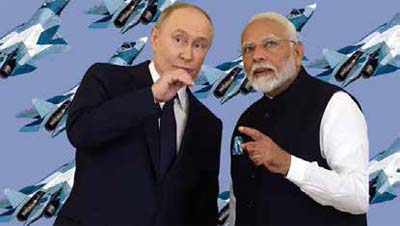
India’s relationship with Russia endured one of its most testing phases in 2025, but it endured, nonetheless. President Vladimir Putin’s state visit reaffirmed the “special and privileged strategic partnership,” spanning defence, energy and science. The subsequent trilateral moment involving Modi, Putin and Xi was also a signal to Washington- both of continuity and of India’s multi-alignment.
Even weakened by war and sanctions, Russia remains a consequential power. India’s ability to engage Moscow without alienating the West underscores a diplomatic skill few countries possess. In 2026, this continuity reassures India on defence supplies, energy security and diplomatic relevance—freeing bandwidth for economic and regional priorities.
Japan and the Architecture of Asia
 India’s partnership with Japan deepened further with an annual summit meeting in August 2025, anchored in a shared vision of Indo-Pacific security and prosperity. Cooperation now spans defence, infrastructure, critical technologies and supply chains. Japan’s role is structural, not transactional: it anchors India’s eastward strategy and supports manufacturing resilience. As supply chains reconfigure, the India–Japan axis could become one of Asia’s most consequential partnerships in 2026.
Neighbourhood First, Extended
Closer to home, India’s regional diplomacy showed renewed intent amid persistent volatility. Engagements with Sri Lanka and Nepal continued despite political churn. In Bangladesh, India watched violence with concern, hoping violence or refugees don’t spill over borders, and that elections in early 2026 would restore stability. Outreach to Afghanistan’s Taliban reflected India’s desire to shape, rather than abandon, its extended neighbourhood.
South Asia remains a source of friction—but also opportunity. If India can consolidate its role as a development and security partner, 2026 could see greater regional stability, particularly after elections in Myanmar and Bangladesh.
The Economic Undercurrent
Geopolitics alone cannot make a sweet spot. India’s economic trajectory will ultimately determine whether 2026 delivers. Early indicators suggest resilient growth trends; many forecasts continue to project India growing at around 7% annually, making it one of the fastest-expanding major economies. This growth is undergirded by structural reforms aimed at enhancing business climate, export competitiveness, and diversification of trade partners. Free trade agreements in 2025, with the EFTA, United Kingdom, Oman and New Zealand, exemplify this approach. The agreements grant zero-duty access for most Indian exports, and expand India’s footprint in regional markets, apart from opening new avenues for trade and investment. Continued negotiations with other major markets, including the EU and the US, signal an expanding portfolio of economic partnerships in 2026.
BRICS, the Global South—and Peace
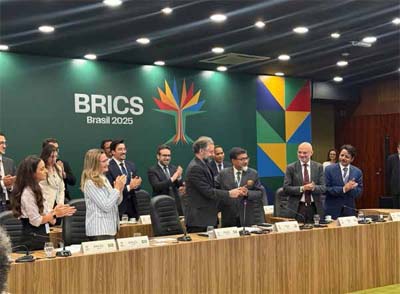 India’s assumption of the BRICS presidency on January 1, 2026 is more than ceremonial. With expanded membership and growing relevance, BRICS offers India a platform to shape debates on development finance, institutional reform and multipolar governance—especially as the G20 narrows and the G7 stands divided.
This platform also intersects with a larger responsibility. Four years after Russia invaded Ukraine, the war grinds on. Ukraine lies devastated, Russia weakened, Europe fragmented and the global economy poorer from second-order shocks. Trump’s blunt 20 point peace initiative—however ugly or unjust—remain the only serious pathway toward de-escalation, much as his intervention brought relative calm to West Asia.
This is where India could enter the frame. Few leaders today enjoy Prime Minister Modi’s credibility—able to speak to Washington and Moscow, Kyiv and Tel Aviv, Paris and Tehran. For India, peace diplomacy is not moral posturing; wars translate directly into energy shocks, inflation and development setbacks, particularly for the global south. India need not present a grand peace plan. Peace-making is incremental, patient and often a team sport. But supporting US efforts on dialogue—while engaging in reconstruction and humanitarian relief—aligns squarely with India’s interests and values.
A Sweet Spot, If Struck Well
2025 tested India’s resilience. 2026 offers opportunity. Diversified partnerships, economic momentum, regional leadership and a prominent multilateral platform converge as rarely before. If India consolidates its gains from the patient efforts of 2025—and couples strategic autonomy with proactive diplomacy—2026 could indeed be its sweet spot.
In a fragmented world desperate for stabilisers and ‘swing states’, India’s greatest strength may lie not just in managing power and strengthening its economy—but also in helping shape the peace in the emerging multipolar order.
ABOUT THE AUTHOR
 Ajay Bisaria, former diplomat and Distinguished Fellow, ORF is an alumni of St Stepehen’s College. He was India’s High Commissioner to Pakistan and Canada, and Ambassador to Poland. He is a regular writer in all the mainline newspapers.