Viewed holistically, the invasion of Venezuela appears less a demonstration of confidence than a confession of strategic anxiety. Rather than restoring US supremacy, such actions may accelerate the very decline they seek to arrest. Will India consider capability development to execute similar operations with far greater legitimacy against UN designated terrorists in the neighbourhood is for the strategic community to ponder.
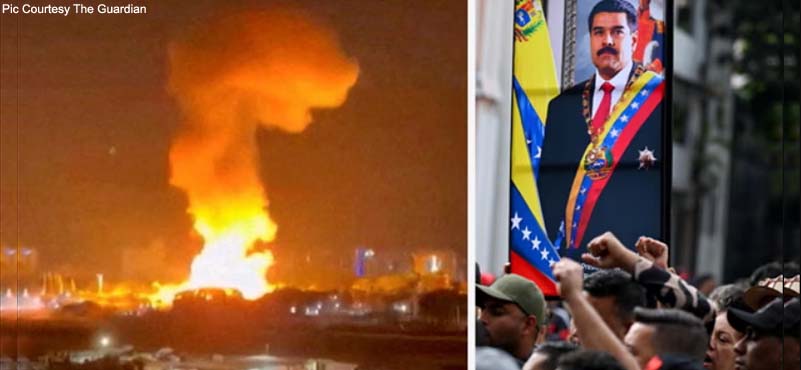
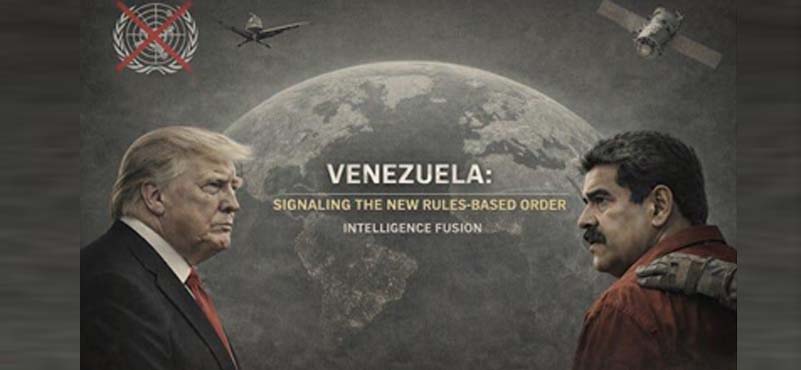
On 3 January 2026, the President and First Lady of Venezuela were seized and extracted from Caracas in a midnight military operation. The operation, executed with remarkable precision and speed, elicited muted international condemnation, with most states choosing political correctness over moral clarity. The bewildering lack of resistance by Venezuelan security forces—despite months of visible military preparations—raises fundamental questions about sovereignty, deterrence, and the true nature of the so-called “rules-based international order.”
The intervention itself was hardly a surprise. A naval blockade, unprecedented force deployments since October 2025, and the killing of over 100 individuals in alleged drug-running vessels in the Caribbean had clearly signalled impending action. What remains astonishing, however, is the absence of meaningful obstruction, suggesting deep penetration of Venezuela’s security architecture well before the operation commenced.
 Power, Not Rules, Governs Geopolitics
The episode reinforces an enduring truth: might has always defined geopolitics. Military and economic power—not international law—shapes outcomes. The idea of a universally applied “rules-based order” remains largely illusory, as rules are often crafted and selectively violated by the same powerful states that champion them.
Historically, justifications for such interventions have ranged from fabricated claims of weapons of mass destruction, to the war on terror, to narco-terrorism, or simply the unwillingness of a foreign leader to align with Washington’s strategic preferences. Venezuela fits neatly into this pattern.
The Trump Doctrine and Domestic Compulsions
The December 2025 U.S. National Security Strategy marks a decisive shift toward a revived Monroe Doctrine, emphasizing America First, hemispheric dominance, and the exclusion of rival powers—particularly China—from the Western Hemisphere. The strategy prioritises action over process, force over consensus, domination over dialogue and recklessness over deliberation.
Yet ideology alone does not explain the timing. President Trump enters 2026 weakened domestically, with declining approval ratings and mounting political pressures ahead of the November midterm elections. Key foreign and domestic challenges persist:
- The Gaza peace process remains stalled amid Israeli bombardment, aid restrictions, and unresolved disagreements over Hamas and Israeli withdrawal. The Board of Peace and International Stabilisation Force are still to be operationalised.
- Despite Trump intervention, the Cambodia–Thailand conflict remains fragile despite multiple ceasefires.
- The Ukraine war shows no sign of resolution, compounded by alleged assassination attempts on Putin, hypersonic missile use, and seizure of a Russian oil tanker in the North Atlantic.
- The release of Epstein files revealed more redactions than disclosures.
- The US public continues to suffer from a cost-of-living crisis, despite moderating inflation.
- Over 200 lawsuits challenge more than 90 executive orders, with legal experts pessimistic about favourable Supreme Court outcomes.
Against this backdrop, externalising domestic stress through decisive military action offered political utility. Control over Venezuelan oil, especially amid threats to the petrodollar system, provided both strategic and economic incentives—without risking a peer confrontation. Neither China nor Russia currently possesses the bandwidth to militarily contest U.S. dominance in the Western Hemisphere.
 Who Could Be Next?
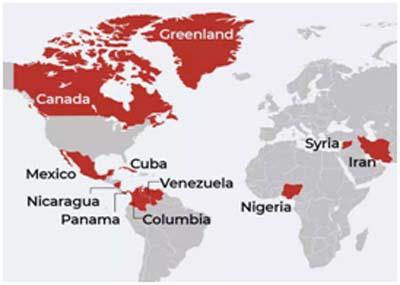
Speculation now turns to potential future targets—Cuba, Colombia, Iran, or even Greenland. However, Venezuela’s case reveals specific enabling conditions:
- Deep CIA penetration of Maduro’s security apparatus, including real-time intelligence on movements and locations, coordinated since mid-2025.
- Severe domestic alienation, driven by corruption, political repression, an 80% GDP contraction, hyperinflation, and a 74% decline in living standards over a decade.
- Absence of a credible external deterrent, despite energy ties with China and a strategic partnership with Russia.
These conditions do not uniformly apply elsewhere. While Greenland may appear militarily simple, it risks a catastrophic rupture within NATO. Iran, despite internal unrest, represents a far more complex and dangerous proposition.
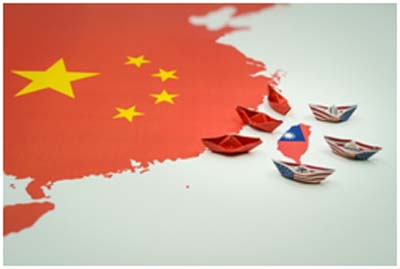 Implications for China and Taiwan
Does Venezuela strengthen China’s case on Taiwan? Superficially, unilateral action weakens normative constraints. However, the US–Venezuela analogy collapses under scrutiny.
- Over 50% of Taiwanese support formal independence, while only about 14% favour unification.
- Taiwan possesses a highly advanced economy, producing around 60% of global semiconductors, and enjoys robust public support for President Lai Ching-te.
- Taiwan’s military is far stronger, with layered air, naval, missile, and ISR defences, making amphibious operations extraordinarily costly.
- The Taiwan Relations Act (1979) obligates the U.S. to provide defensive support; in December 2025, Washington announced an $11.1 billion arms package.
- China’s PLA continues to suffer from leadership purges—approximately 78 senior officers including two defence ministers since 2013—limited combat experience, and untested large-scale joint warfare capabilities.
- Japan’s declaration of potential military involvement further complicates Beijing’s calculus.
`While China can highlight US hypocrisy—questioning extraterritorial application of American laws—it is unlikely to view Venezuela as a green light for Taiwan.
What It Means for Russia
The Venezuela operation strengthens Moscow’s narrative that great powers enforce security through force, reinforcing its justification for actions in Ukraine. With peace prospects dim, Russia is focused on consolidating control over Donbas, deterring NATO, and restoring its privileged sphere of influence across Eastern Europe and the Caucasus. Russia lacks both the economic leverage and military reach to challenge US actions in Latin America. A fractured NATO further weakened by possible annexation of Greenland will only embolden Russia in Eastern Europe.
India’s Calculated Pragmatism
India’s response has been measured and pragmatic, reflecting strategic realism rather than ideological reflexes. Despite renewed US tariff threats, India is neither Venezuela nor Cuba.
- India has resisted US pressure on agriculture and diversified exports toward Europe, with increases exceeding 50% in some markets.
- FTAs and CEPAs were concluded with the UK, Oman, and New Zealand in 2025; negotiations continue with the EU, ASEAN, Australia, and others.
- Dependence on Venezuelan oil has fallen from 6–7% in 2018 to about 0.3% in 2025, with diversification toward Russia, the Middle East, and Africa.
- Strategic self-reliance (Atmanirbharta) has gained urgency as trade, energy, and technology are increasingly weaponized.
India’s indigenous defence production has risen from ₹46,426 crore (2014–15) to ₹1.51 lakh crore (2024–25), with defence exports increasing 34-fold. Advances in semiconductors, nuclear energy(SHANTI), AI, space, and rare-earth processing are reducing long-term vulnerabilities.
Simultaneously, India has preserved strategic autonomy—engaging with SCO and BRICS, while remaining active in QUAD and I2U2—and deepened defence cooperation with the US through joint exercises and a renewed 10-year Defence Partnership Framework.
 Prognosis: Order in Decline
The US action in Venezuela is not merely a tactical victory over a weak state; it marks a serious erosion of international norms. Replication elsewhere will generate unintended consequences. Unlike Venezuela, Iran and other potential targets possess deeper institutional resilience and deterrent capabilities.
The average American remains more concerned with inflation, employment, immigration, and democratic values than foreign interventions. Reports—though unconfirmed—of Canada contemplating suspension of crude and uranium exports, Europe exploring alternative payment mechanisms, and global central banks shifting toward gold reflect deeper systemic shifts. In 2025 alone, over 1,000 metric tonnes of gold reportedly replaced dollar reserves globally.
Viewed holistically, the invasion of Venezuela appears less a demonstration of confidence than a confession of strategic anxiety. Rather than restoring US supremacy, such actions may accelerate the very decline they seek to arrest. Will India consider capability development to execute similar operations with far greater legitimacy against UN designated terrorists in the neighbourhood is for the strategic community to ponder.
ABOUT THE AUTHOR
 Major General SC Mohanty, AVSM (Retd), was commissioned in June 1983. The officer commanded a Mechanised Infantry Battalion, a Mechanised Brigade and an Infantry Division (RAPID Strike) in the Western Sector. As a Brigade Major, he took active part in the Kargil Operations while located at Drass. As part of Military Operations Directorate, he headed the Information Warfare, Cyber and Electronic Warfare branches. Post retirement, he was the Security Advisor to Government of Arunachal Pradesh from July 2020 to May 2023.