
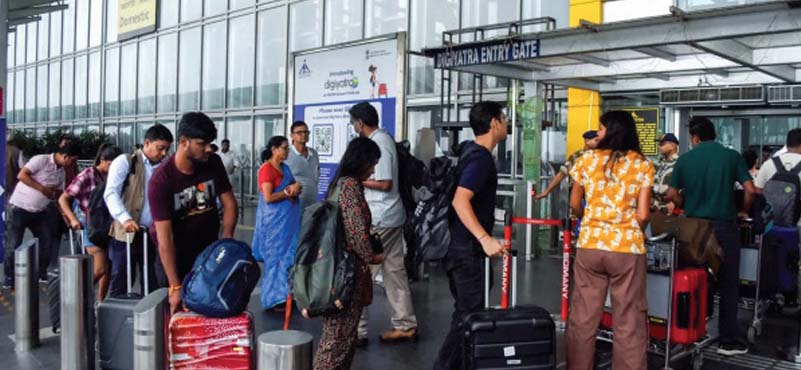
What has happened in the last few months, two incidents, with somewhat of a similar message. That public services are best run by the private sector, as these bring better efficiencies, economies of scale, the best of talent and opportunities to hire and fire; conversely, these require to be run at a higher maturity quotient, where public trust must be paramount which is best gained through transparency, information sharing, sustainability, profit making but with restraint with an eye on rising national aspirations.
When Essential Services Behave Like Optional Luxuries
The first was the meltdown at Indigo last December, when flights were cancelled in hundreds, affection thousands of passengers, leaving behind distraught travellers across the country. Here, the vulnerability of the air transport system became woefully apparent, being in so-called private hands, with a market share of 65% of the vital transport that every economy demands and needs. Equally, it is not the government that can run such enterprises, as governments lack the ability to be efficient in providing public services; so, private it must be, and remain so, but with transparency, ensuring safety and equally sustainability in terms of balance sheets. Airlines can ill afford to run on losses, as profits are central to their survival. The last two decades have witnessed the fall of just about every one of them. Indigo has survived, grown, become the pride of the nation amidst the global aviation industry.
The other incident is the hue and cry around hotel rates as Delhi got ready to host the global AI summit this month. A national event, of international importance, critical for India in its role for not only itself but also as a voice of the Global South. There are differences in opinion as to what is fair and reasonable and what is the right price. What is predatory pricing, profit booking, for private gains versus national image and profiteering. The jury may be still out, but balancing a public perspective is well called for, worthy of discussion and debate. What is the nature of travel and hospitality, how much is it public service and how much a private narrative?
The two incidents showed that India has outgrown its old narrative about travel and hospitality — yet we continue to treat these sectors as though they were discretionary luxuries rather than essential infrastructure.
And that misalignment has begun to show.

Aviation Is Not Glamour. It Is Plumbing.
For decades, we spoke of “civil aviation” with a certain flourish. It carried the aura of elite mobility. That perception is obsolete.
Air transport today is not glamour. It is plumbing — as fundamental to the economy as roads, railways or ports. Business executives, doctors, entrepreneurs, government officials, students, and small traders depend on predictable air connectivity. Day trips across states are routine. Supply chains rely on speed. Investment decisions factor in flight networks.
When IndiGo — which today carries a dominant share of domestic traffic — experiences disruption, the ripple effects extend far beyond stranded passengers. Meetings are postponed. Transactions are delayed. Productivity is dented.
This is not a criticism but a statement of fact. On the contrary, IndiGo’s consistency over two decades stands in contrast to the many carriers that have come and gone. It is precisely because of its scale and stability that the episode was instructive.
When a private airline becomes the backbone of national connectivity, it ceases to be merely a corporate enterprise. It becomes systemic infrastructure.
And systemic infrastructure carries responsibilities that go beyond quarterly performance.
India has learned, sometimes painfully, that running airlines is not the natural business of governments. The rebuilding of Air India under the stewardship of the Tata Group, supported by Singapore Airlines, reinforces the view that professional private capital is better suited to operate complex service systems.
But privatization does not mean abdication of public service.
An airline may not be government-owned. Yet it is unquestionably in public service.
That distinction must move from rhetoric to philosophy — embedded from boardroom to baggage handler.
Hotels Are Not Luxury. They Are Urban Infrastructure.
The second episode is even more revealing.
As Delhi hosted a large international AI summit — a gathering positioned not as entertainment but as a signal of India’s role in the future of artificial intelligence — hotel tariffs surged dramatically. Rates reportedly multiplied several times over prevailing norms.
The defence from sections of the hospitality industry was straightforward: we are private enterprises; pricing is market-driven; when demand peaks, rates rise. Economically, that is correct. But economically correct behaviour is not always institutionally mature behaviour.
Accommodation in a modern city is not an indulgence. It is infrastructure. Just as critical as office space or transport connectivity. Visitors do not descend on a city for leisure alone. They arrive to invest, negotiate, collaborate and build.
When a city hosts a summit of national importance, the experience extends beyond conference halls. It encompasses airports, taxis, restaurants and hotels. Excessive opportunism in any one component reflects on the ecosystem as a whole.
Delhi aspires to stand alongside Tokyo, Paris, London or New York. Such stature is not conferred by event scale alone. It is earned through predictability, moderation and institutional discipline.
During a sporting event, price spikes may be tolerated. Attendance is discretionary. But when a summit positions India at the crossroads of technological transformation, participants do not attend for spectacle. They attend because the stakes are strategic.
At such moments, restraint is not charity. It is long-term investment in credibility.
Profit Is Essential — But So Is Perspective
Let us be clear: neither aviation nor hospitality can function without profitability. These are capital-intensive sectors with high fixed costs and long gestation periods. Investors require returns. Expansion depends on retained earnings.
But the argument here is not about suppressing profit. It is about recognizing that certain sectors, by virtue of their systemic importance, operate under a broader social contract.
When industries become essential infrastructure, pure market logic is insufficient.
They must balance yield maximization with access sustainability, competitive behaviour with ecosystem stability and shareholder returns with national positioning.
India is experiencing explosive demand for air travel and accommodation. Supply has not kept pace. The result is volatility — operational stress in aviation, pricing spikes in hospitality. The temptation in such conditions is to extract maximum short-term gain.
The wiser path is to accelerate long-term capacity and institutionalize codes of conduct that prevent reputational damage.

The Risk to Further Growth
Why does this matter now? Because India’s next phase of growth depends less on incremental consumption and more on integration into global networks — technology, manufacturing, services, diplomacy.
Investors and partners assess not just policy frameworks but functional ecosystems. Can executives travel reliably between cities? Can international delegations attend conferences without encountering distortions? Can essential services be counted on during stress?
If aviation disruptions become frequent or pricing volatility becomes habitual, the cumulative effect is subtle but corrosive. Confidence erodes not through dramatic collapse, but through repeated friction. And once a reputation forms — that India’s essential services behave opportunistically under pressure — it is difficult to reverse.
From Fast-Growing to Mature
India often compares itself to advanced economies in scale and ambition. But maturity is not measured in skyline height or stock market capitalization. It is measured in institutional conduct.
Mature markets display restraint when leverage is greatest, transparency during disruption, coordination during national events and long-term thinking over short-term windfall.
This is not about imposing price controls or inviting bureaucratic micromanagement. On the contrary, heavy-handed regulation would harm precisely the private dynamism that has driven growth.
The solution lies in recognition.
Recognition that airlines are essential national connective tissue, hotels are foundational urban infrastructure, market leadership brings systemic responsibility, short-term opportunism can undermine long-term aspiration, industry bodies can establish voluntary codes during nationally significant events. Airlines can strengthen contingency planning and public communication. Policymakers can formally recognize aviation and hospitality as strategic infrastructure, encouraging capacity expansion while reinforcing accountability.
Most importantly, leadership across these sectors must embrace a philosophical shift: Private enterprise in essential services operates in public trust.
The Choice Before Us
India’s economic journey has been remarkable. But the next stage — from rapid growth to durable maturity — will depend on whether our institutions internalize their expanded roles.
Travel and hospitality are no longer peripheral industries serving aspirational consumers. They are instruments of national capability.
When essential services behave like optional luxuries, growth eventually slows under its own contradictions. When essential services understand themselves as infrastructure, growth compounds. The choice is not between profit and patriotism. It is between short-term gain and long-term stature. At a time when India is positioning itself as a global hub for technology, manufacturing and diplomacy, the world is watching — not only our ambition, but our conduct.
It is time we reposition travel, aviation and hospitality for what they truly are: pillars of a maturing nation.
If the diagnosis is that aviation and hospitality are now strategic infrastructure in a maturing economy, then the industry response cannot be defensive. It must be forward-looking. Here is what industry — not government first, but industry itself — should do now.
What Industry Should Do Now
Publicly Acknowledge the Shift
The first step is philosophical, not regulatory. Industry leaders in aviation and hospitality must openly recognize we are no longer discretionary service providers, we are essential infrastructure operators, and market leadership carries systemic responsibility.
A simple shift in language matters. When CEOs describe their businesses as “public service delivered through private enterprise,” it sets the tone for culture and conduct.
Mature sectors define their own responsibility before regulators define it for them.
Establish Voluntary Codes for National Events
Before government intervenes, industry bodies should act. Hospitality associations can define what constitutes a “nationally significant event”, agree on transparent surge multipliers, create aggregated pricing bands during such events, publish guidelines in advance.
This is not price control. It is reputational insurance. If the industry self-regulates, it retains credibility. If it does not, regulation will eventually follow — and likely in a cruder form.

Build System Resilience, Not Just Market Share
For aviation especially, resilience must become a board-level priority. Airlines should strengthen contingency planning, invest in crew pipeline depth, improve passenger communication systems, conduct public post-incident transparency briefings.
Dominant market share means dominant systemic responsibility. The larger the airline, the more it must think like infrastructure. The same applies to large hotel chains in major metros.
Accelerate Capacity Expansion
India’s core problem is structural shortage insufficient hotel rooms across price categories, airport congestion in major cities and limited trained workforce depth. High pricing and operational strain are symptoms of under-capacity.
Industry must push aggressively for faster approvals, partner in airport expansion, invest in mid-market accommodation, not only luxury segments and expand skill development pipelines.
Supply growth is the most sustainable way to moderate volatility.
Separate Opportunism from Strategy
There is a difference between dynamic pricing and extreme opportunism. Short-term windfalls during AI summits, G20 meetings, or global conferences may boost quarterly revenues. But the reputational cost may exceed the gain.
Industry boards must begin asking a different question: Does this pricing decision strengthen long-term ecosystem credibility?
If the answer is no, restraint may be strategically superior to extraction.
Embed Public Service Ethos in Organizational Culture
This is subtle but critical. Frontline airline and hotel staff must understand they are custodians of national experience, every interaction reflects on the country and safety, transparency and fairness are non-negotiable. This cultural embedding cannot be outsourced to compliance manuals. It must be articulated from leadership consistently.
In mature economies, infrastructure operators feel pride in stability — not just profitability.
Create a Joint Aviation–Hospitality Council
India’s aviation and hospitality ecosystems are interdependent but often siloed.
Industry should consider forming a high-level joint council to coordinate during major events, anticipate demand spikes, share data and align communication strategies.
When sectors behave as a coordinated ecosystem, systemic shocks reduce.
Signal Long-Term Capital Discipline
Investors are watching closely. If aviation and hospitality demonstrate predictable governance, balanced pricing behaviour, resilience planning, and responsible communication, long-term capital will flow more confidently. If volatility becomes endemic, capital becomes cautious.
The industry must understand: maturity lowers cost of capital.
The Strategic Opportunity
This moment is not merely a challenge. It is an opportunity. India is transitioning from high-growth emerging market to structural global player. Aviation and hospitality are the interface between India and the world. They are the first and last impression for investors, technologists, diplomats, entrepreneurs. If industry acts now — voluntarily, intelligently, and cohesively — it can define the standards of a mature market. If it waits, standards will be imposed.
The Bottom Line
Industry should not ask, “Why are we being criticized?” It should ask what role are we now playing in the national system? And, what behaviour aligns with long-term stature and how do we protect profitability without eroding credibility?
Growth created scale. Scale created responsibility. Responsibility now demands maturity.
ABOUT THE AUTHOR
 Navin Berry, Editor, CS Conversations, over five decades has edited publications like CityScan, India Debates and Travel Trends Today. He is the founder of SATTE, India’s first inbound tourism mart, biggest in Asia.
Blogs at: https://www.csconversations.in/nb-blogs