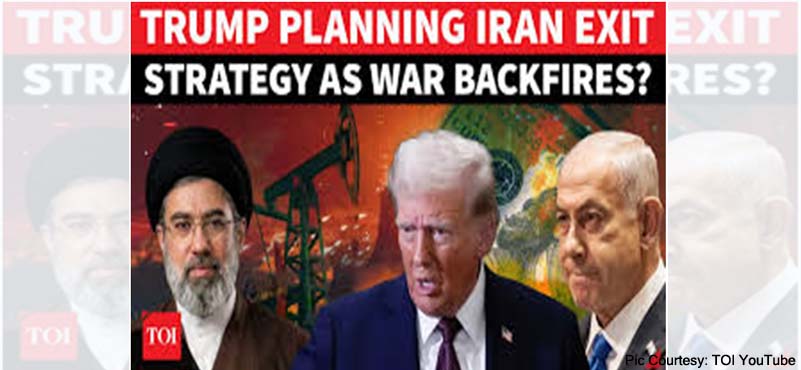
The United States is considering stepping back from confrontation with Iran, but the language of success is arriving faster than the reality of strategy. President Donald Trump’s recent message does not read like closure. It reads like compression under pressure. It signals a system that has reached its limit and is now looking for a way out without saying so directly.
The language appears confident on the surface. Missile systems are degraded, infrastructure is hit, and naval capabilities have been reduced. It resembles a script for an honourable exit. However, the focus on allies securing the Strait of Hormuz tells a different story.
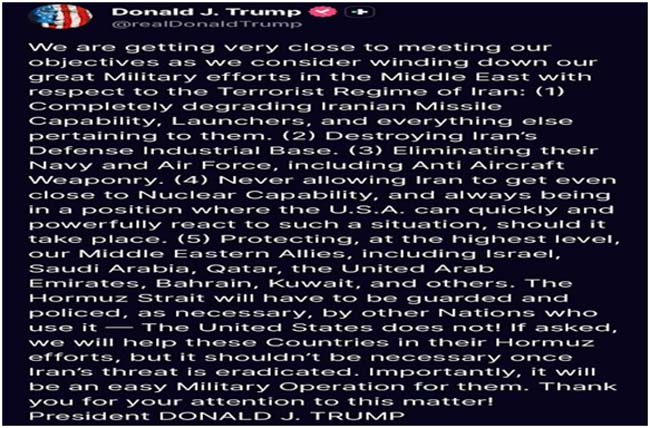
This turn did not happen unexpectedly. Just days earlier, the rhetoric was much more ambitious. There was talk of decisive results, even transformation. Now, it has shifted to something more modest and practical. The gap between aspiration and feasibility has shrunk quickly. The outcome must now be presented as success.
At home, the mood has shifted. Prolonged engagements tend to erode support, especially when objectives keep shifting. Within the system, there is increasing recognition that attention and resources are limited. You cannot prepare for one contest while remaining committed to another. This realisation, more than anything else, is accelerating the pace of disengagement.
Allies have not stepped in to fill the gap. European governments have kept their distance, wary of energy shocks and wider escalation. For them, this is a conflict with more downside than gain. Gulf states, despite their reliance on American security, have also begun to hedge more openly. Repeated strikes on their territory have exposed the limits of external protection. Quietly, they are widening their options. Not dramatically, but enough to matter. The shift is incremental, but strategically decisive.
The strain with Israel has been harder to mask. Israel is not looking for partial outcomes. It seeks decisive neutralisation of threats, not their management. That requires time, escalation, and persistence. Washington is no longer willing to underwrite that trajectory.
From the ground, air, and sea, the results have been mixed. There has been damage, but it is not final. Systems adapt. Launchers move. Networks absorb losses and reemerge. It becomes a cycle of action and response, not a path to closure. Meanwhile, resources are limited. Stockpiles diminish, deployments extend, and costs build up in ways that are hard to justify indefinitely.
There is also a harsher reality that no amount of messaging can avoid. Iran is not an easy theatre to dominate over the long term. Geography matters. Depth matters. Decentralised structures matter. These are not conditions that favour quick, clean outcomes. They favour endurance. And in long contests, the side that needs to disengage usually does. In such environments, time becomes a weapon.
So the United States is choosing its moment, not at a point of decisive victory, but at the point where persistence becomes strategically untenable. That distinction will not be lost on others.
What follows will not be collapse, but recalibration. The region is accustomed to such shifts. Iran will rebuild with added vigour, not in obvious ways, but through networks and proxies that are harder to target directly. Gulf states will invest more heavily in their own defensive layers, relying less on guarantees and more on capacity. Israel will continue to act where it believes it must, regardless of broader alignment. Defence spending is likely to rise, and external powers, particularly China, will look to expand their strategic space in the resulting uncertainty.
The result is not disorder, but a more contested equilibrium. No single power will shape it. Instead, it will be managed through overlapping interests and occasional friction. That tends to be less stable, but also more realistic in the current environment.
For India, this shift creates space but also introduces risks. A less tightly controlled region offers more flexibility for engagement. Energy access, connectivity projects, and strategic partnerships can be pursued with fewer restrictions. India’s capacity to engage across divides without rigid alignment becomes a strategic advantage.
But there is a flip side. Instability rarely remains contained. Energy markets react rapidly. Proxy networks grow quietly. Disruptions spread farther than expected. Managing these risks will require as much strategic discipline as seizing opportunities.
The larger point is about limits. Power projection depends on more than capability. It depends on the clarity of the end mission and end state, staying power, alignment with allies, and domestic tolerance for costs. When these begin to weaken, the strategy adjusts, whether acknowledged or not.
What makes this moment notable is not the withdrawal, but its speed and presentation. When exits are framed as completion, they leave strategic ambiguity behind and invite testing by adversaries. Allies plan differently. Adversaries become more willing to test boundaries.
The United States is not leaving the region. But it is stepping back enough to alter its strategic grammar. In that shift, allies will hedge, adversaries will probe, and the illusion of control will give way to the reality of limits. The operation may ultimately be judged less by its intent than by the limits it exposed.
ABOUT THE AUTHOR
 Lieutenant General A B Shivane, is the former Strike Corps Commander and Director General of Mechanised Forces. As a scholar warrior, he has authored over 200 publications on national security and matters defence, besides four books and is an internationally renowned keynote speaker. The General was a Consultant to the Ministry of Defence (Ordnance Factory Board) post-superannuation. He was the Distinguished Fellow and held COAS Chair of Excellence at the Centre for Land Warfare Studies 2021 2022. He is also the Senior Advisor Board Member to several organisations and Think Tanks.