
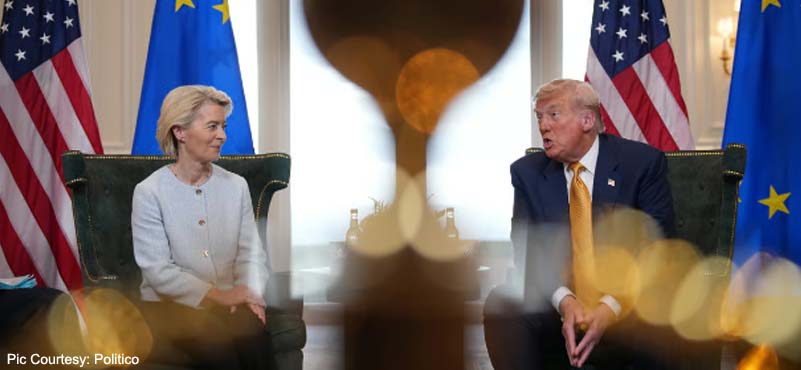
The latest confrontation between the US and Europe over Greenland marks more than a trade dispute or another episode of transatlantic friction. It may represent the point at which accumulated grievances finally outweigh European restraint. When President Trump threatened tariffs unless Europe acquiesced to the “complete and total purchase” of Greenland, the gloves came off. For the first time since Trump’s return to office, Europe is openly contemplating pushback—not merely rhetorical, but economic and political.
European leaders have responded sharply. Britain’s Prime Minister has called the ultimatum unacceptable. France’s President has gone further, suggesting that the European Union consider activating its so-called “anti-coercion instrument”, a powerful trade mechanism designed to retaliate against economic bullying. The European Parliament has spoken of freezing trade agreements. Protests have erupted in Greenland itself, and in Denmark, where the issue cuts directly into questions of sovereignty.
What makes this episode different is not just Trump’s language, but the object of his pressure. Greenland is an autonomous territory under Danish sovereignty, and Denmark is both a NATO ally and an EU member. This is not a dispute over tariffs or burden-sharing; it is a challenge to the territorial integrity of a European state. For Europe, that changes the political calculus.
Until now, European leaders have absorbed a long series of indignities in the name of strategic necessity. They accepted higher US tariffs. They moderated criticism when Trump appeared to tilt towards Russia on Ukraine. They remained largely silent on Venezuela and other issues where American positions clashed with European preferences. The reason was simple: Europe remains deeply dependent on the United States for security through NATO and for sustaining Ukraine’s war effort against Russia.
Greenland, however, touches a different nerve. It forces Europe to confront a deeper question; how far can accommodation go before it erodes self-respect, credibility, and ultimately sovereignty? For many European leaders, this appears to be the last straw.
Europe does, in fact, possess leverage. The EU is the world’s largest single market, and American companies—particularly in technology and services—are heavily dependent on access to European consumers. The “trade bazooka”, as the anti-coercion instrument is informally known, could target US technology firms or restrict market access in ways that would be felt quickly in Washington. Europe also has a prepared list of retaliatory tariffs worth nearly €100 billion.
Yet this leverage comes at a cost. Restricting American technology platforms would inconvenience European consumers and businesses. A trade war would further weaken European economies already under strain. More importantly, escalation risks deepening a rift with a security partner on whom Europe still relies.
This is where Europe’s dilemma sharpens. Trump has three years of stewardship left. Europe must ask whether riding out this period through continued deference is sustainable, or whether a calibrated pushback now would establish boundaries for future engagement. It is not a zero-sum choice, but it is a consequential one.
The shadow of Russia looms large over every European calculation. Europe’s vulnerability to Russian pressure—military, energy, and political—has not disappeared. The war in Ukraine remains unresolved, and US military, intelligence, and financial support remains critical. Any serious rupture with Washington could complicate Europe’s ability to defend its interests on the eastern flank.
At the same time, the Greenland episode underscores a troubling reality; if Europe cannot defend the sovereignty of one of its own members against pressure from an ally, what signal does that send to adversaries? Strategic credibility, once eroded, is hard to restore.
Trump justifies his Greenland gambit in strategic terms, citing Chinese and Russian ambitions in the Arctic. There is substance to those concerns. But the United States already enjoys extensive military rights in Greenland under a 1951 agreement with Denmark. The issue, therefore, is less about security access and more about power, signaling, and coercion.
For Ukraine, the implications are complex. A distracted or divided transatlantic alliance weakens Kyiv’s position. Conversely, a Europe that asserts itself more firmly could eventually contribute to a more balanced partnership with the US, reducing over-dependence. But that is a long-term aspiration, not a short-term reality.
Europe now stands at a crossroads. It can continue to absorb pressure in the hope that stability will return after Trump’s tenure. Or it can push back selectively, accepting short-term costs to preserve long-term autonomy and dignity. Neither path is risk-free.
Greenland may thus come to be remembered not for its ice or minerals, but as the moment Europe was forced to decide how much bullying it could endure—and what kind of strategic actor it wished to be in a world where even allies test the limits of power.
ABOUT THE AUTHOR
 The author is a product of Sherwood College, Nainital and St Stephen’s College Delhi. He is the former Commander of the Chinar Corps Srinagar and is currently the Chancellor of the Central University of Kashmir and Member of the National Disaster Management Authority.