Why World War III Has Not Begun?
When War and Peace are Chasing Each other in circles, will they catch up? And, when? Fear overrides our passion for power. And fear has built a world where peace is indistinguishable from pressure, deterrence from provocation, and safety from escalation. If World War III comes, it may not be chosen. It may simply happen — the final tangle in a web of fears we mistook for peace.
The modern world seems to teeter on the edge of disaster with unsettling regularity. Every few weeks, headlines suggest that global order is about to collapse. It is a nervous time for most. And it isn’t irrational to think it could. Nuclear powers clash, old rivalries reignite, and entire regions convulse with violence.
In just four years, the world has seen the first direct clash between nuclear powers since 1969, Europe’s largest land war since 1945, and a Middle East so volatile that it has endured as many as thirty conflicts in fifteen years. Even conservative counts put the death toll since 2011 near two million. Yet despite this constant turbulence, the world never quite tips into full-scale catastrophe.
Are we as a society grown insensitive to violence over the past few years? It’s not just the common folk who bear the stress of a world almost imploding every few days. It is also equally clear that the politicians of the world are also becoming numb to the warnings and stakes of war, thereby creating that in-between space that the world is right now in, between normalcy and nuclear Armageddon.
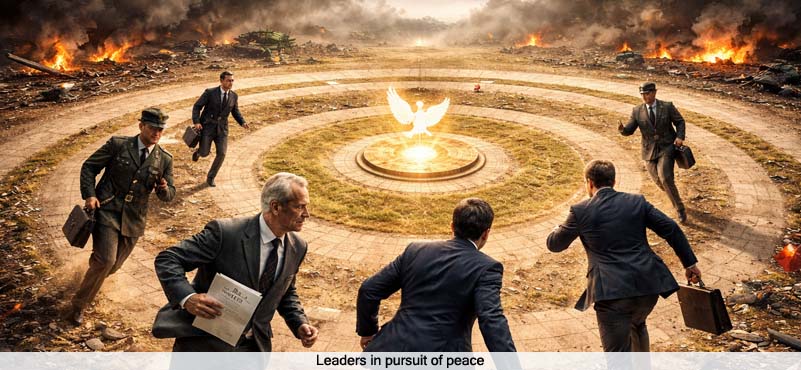
Succinctly put, the world is not drifting towards World War lll; rather, is being pulled there by desensitized leaders trying to pursue peace through strategies that increasingly seem to resemble war, all driven by a fear. A fear that has moulded a security net around the world in which every attempt to avoid catastrophe brings us only closer towards it.
Is there is legacy that has brought this about? Looking at some of the frontline countries actively engaged in this circus, the average of a country leader is 62, meaning that the average world politician was born in the peak of the cold war. Quite literally from their birth onwards, they’ve had to live through the Cuban missile crisis, the second Indo-China war, the Bangladesh genocide, the Yom Kippur war and the Iranian revolution, among others, all before their 18th birthday. Only now, children again are living in such a turbulent time. Inevitably, when these men became world leaders in a post-cold war year, one can imagine the fear of their childhood, living through the most turbulent times in history, which would have coerced them onto a path of peace. They were raised in an environment which, hopefully, the leaders of tomorrow will not be made to face. One where annihilation was not a hypothetical, dark fantasy but scheduled and only delayed perpetually.
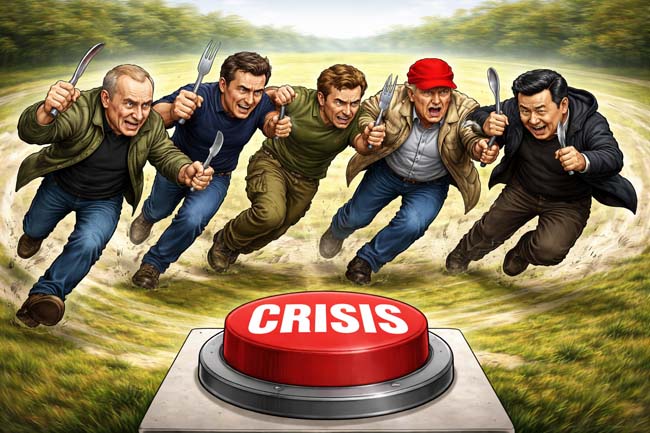
A sense of security, created from a threat to go to war
In hindsight, we can deduce that the pathological fear of the cold war, regardless of its impact on them, would have led them to be obsessed with their own idea of peace, to the point where it infringes on the sanctity of other human life. Each world leader, who may commit heinous acts, all ultimately want to create a sense of security; but the collective subtle trauma of the cold war has made them so selfish in their understanding of peace, that more harm is being done than good. Look at some shining recent examples:
- Putin’s invasion of Ukraine to keep NATO away from her doorstep, was committed to serve through an egotistic lens, being that to keep Russia safe and far away from her enemies.
- The brutal radical policies of The Islamic Republic of Iran were enunciated to seemingly implement social norms advocated by the radicalized Khomeinist regime, the idea being to stop moral decay.
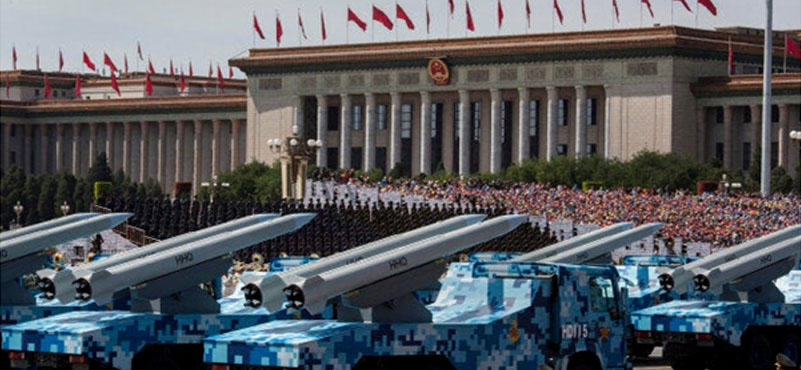
- Take China. Constantly dragged as some form of player in every recent war, they have been involved in supplying Iran with weapons and being an eager trade partner with Venezuela. Their technological projects such as the BeiDou satellite programme were used by Iran to strike United States’ assets throughout the summer of last year. Its PLA has been putting more intense tension around its contentious borders with India and Afghanistan, to ensure the safety of its ‘assumed’ legitimate borders. It can be argued that the mantle of the new “ruler of the waves” belongs firmly among so much else, in Chinese hands.
With such influence in recent conflicts and the accentuation of the global sense of tension, without any retaliatory strikes to counter, these efforts of Chinese brinkmanship are helping it thrive in a world only itching to be war-torn. But seldom showing its own hands, preferring to work through proxies, behind the scenes.
- We have the privilege to look away from this and be grateful one’s own country doesn’t compel war in a quest for peace, but the truth is rather more depressive. India is militarized to near nuclear war with Pakistan in our effort to thwart repeated attempt by the neighbour to create unrest in Kashmir.
- Additionally, when it comes to direct confrontation, we still at least keep the twisted common sense to never fight by ourselves but outsourcing traditional violence to weaker neighbours or associates. Ironically, this is another safety measure, with perhaps the most obvious consequence, directly being contradictory to the values and ideals of peace.
Why the wars do not happen? Reach the tipping point?
But why do these bubbling conflicts of interest never tip over a boiling point? Why have they not set off a ballistic reaction like World War II did, even though tension has been building up for 81 years with nearly 200 countries involved? While of course the shadow of nuclear deterrence casts a watchful vigil over the bickering forces of the world, are we still fundamentally scared of something else? Something, that makes us almost at the last-minute pull back? Instinctively, inevitably, almost an overactive subconsciousness that strikes peril in our innermost being!
After all, America would surely never nuke Copenhagen over Greenland. Major powers may posture, threaten, or escalate, but they stop short of actions that would guarantee mutual destruction. Even alliances resemble a diluted version of the Cold War.
NATO and the UN were born from the shock of World War II, but today’s geopolitical blocs are hesitant, fragmented, and unwilling to fully defend their partners. A global multipolar civilisation, we are scared for very selfish reasons. We realise wars just don’t kill the enemy, we get killed, too; eventually, the reason that has saved our world from being charred under the weight of thousands of missiles and drones. While these may be good at individual levels, these are not efforts towards the larger good?
After World War II, the shock that still has never been replicated to this day, resulted in the formation of NATO, which despite destroying middle eastern nation states every few years does view themselves (and were created to be) an alliance for peace and to keep it. So was the UN.
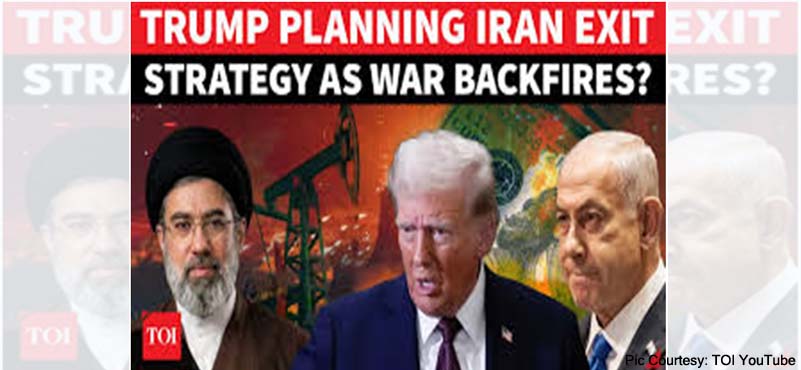
The tussle between war and peace continues. NATO allies have left Trump disappointed for refusing to join the war on Iran. France, Germany and UK, among them, have said it is not their war, they were not consulted and that their support has been at best only tactical, like the UK giving the US the use of Diego Garcia base. Trump calls it their foolish mistake. But the truth is the opposite. Not joining the war has ensured the number of countries at war do not increase, the chances of another World War recede.
War and Peace Tracing a Circular Path
We are going around in a circle, hoping to have influence. Donald Trump does what he does for “peace”. Afterall, Mr Trump claims a Nobel peace prize for stopping 6 wars in 2025.
While this may be the case that we are always on the cusp of World War III, but never quite make it the full way, it is still invariably on the cusp, and one which might be closer than we think, but not in the way we think. If anything, it seems likely war will start when the superpowers trying to stay safe, puppeteering weaker allies, tangle up the strings they use to pull the world, throwing it into disarray, exacerbated by the policy of massive retaliation. One noted geo-political expert, Iqbal Malhotra, insists we might be closer to a nuclear war than we think – only a wild moment away, so to speak.
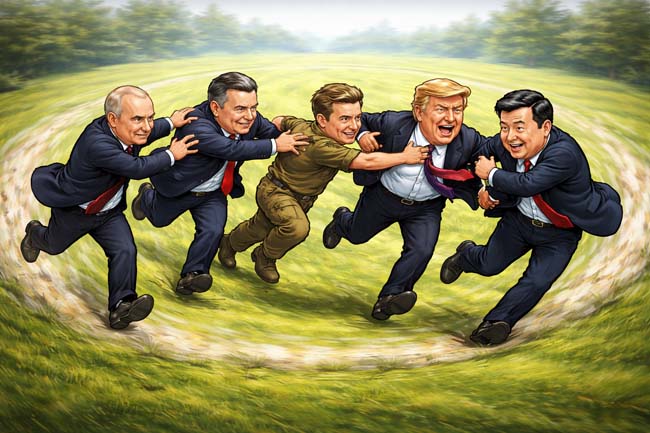
Evidently so, we have already almost seen World War III numerous times in the past 6 years alone, and therefore it can be seen that we all seem to expect an apocalypse at every gunshot fired in the middle east. Leaning back onto the circular analogy, we are closer than ever, as if we are going around in circles, harbouring wars and threatening the worst, in our mission to cleanse the world from it, as the east and west try to move apart from conflict with each other, looking for peace they only will end up walking back to each other.
But this logic chain has grimmer consequences. As for the famous quote, “I don’t know what weapons World War III will be fought with but world war 4 will be fought with sticks and stones.”, it must be brought to light that one thinks in our inevitable journey to meet our enemies at the other end of the circle in a hypothetical World War III, it is then that we would be fighting with sticks and stones as we would have destroyed ourselves from the fear and violence we dub as “peace” along the way, the ultimate form of brinkmanship policy.
The memory of war may persist in our leaders’ minds, but equally so, it can fade away. Systems and policies of fear are some of the strongest, and will not break easily. Instead, their fear leads to a deadly misjudgement they will never truly recover from. If a larger war does occur, no one would have truly started it; it would be one final culmination of all events, finally defeating us all in the end.
This is the state we find as war and peace seem like they are about catch up to each other in this circle. We have not destroyed ourselves because we remain afraid. Fear overrides our passion for power. And fear has built a world where peace is indistinguishable from pressure, deterrence from provocation, and safety from escalation. If World War III comes, it may not be chosen. It may simply happen — the final tangle in a web of fears we mistook for peace.
ABOUT THE AUTHOR
 Aditya Shankar Berry is a young 14 year old, studying in a private school in London, a keen observer of the Geo-political unfolding dynamics.. He is looking forward to a career in diplomacy and international relations. This is his first published article with many more to follow.