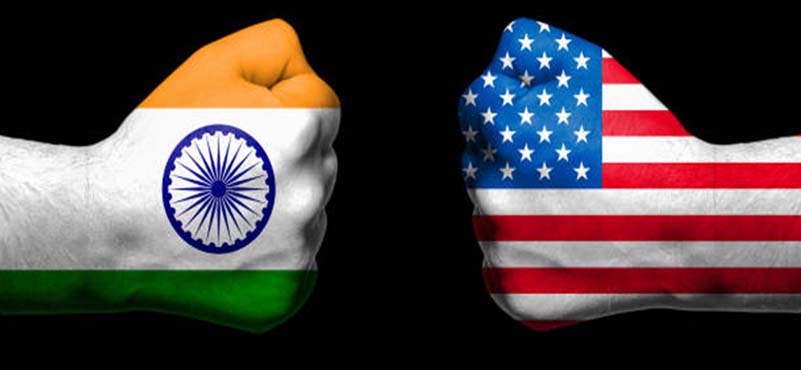
On November 25, 2026, the Office of the United States Trade Representative (USTR) dropped a trade proposal that immediately upended the commercial math between Washington and New Delhi. Wrapping up a slate of investigations launched in March 2026 under Section 301 of the Trade Act of 1974, the USTR threatened tariffs of up to 25% on Indian goods. That figure is virtually identical to the 26% levy President Trump floated during his “Liberation Day” reciprocal tariff rollout back in April 2025; a measure he paused a week later to cut deals elsewhere.
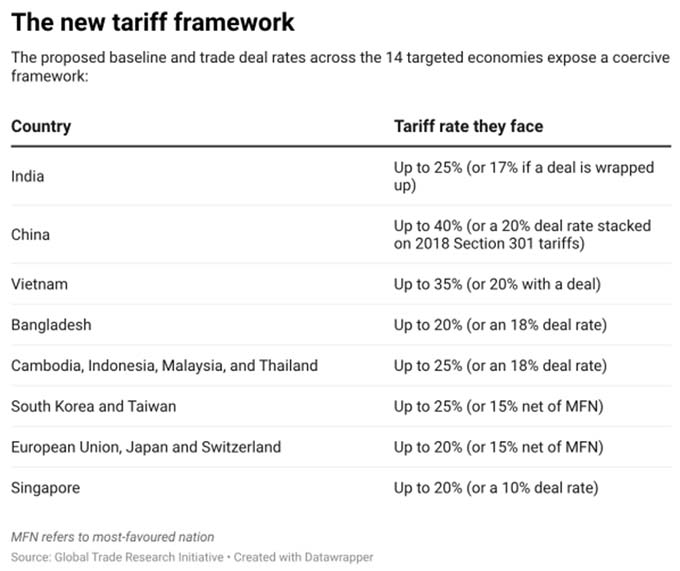
This time, however, the offer comes with a carefully engineered hook. If India signs a Bilateral Trade Agreement—rebranded by Washington as an Agreement on Reciprocal Trade—and satisfies the investigation’s findings, that 25% ceiling drops to 17%. On paper, an eight-percentage-point reduction looks like a generous diplomatic olive branch. Calling 17% a “discount,” though, completely misreads the mechanics of the offer. In practice, that 17% rate is a floor designed to rush New Delhi into sweeping concessions at the negotiating table, while the looming 25% threat freezes pricing and rattles supply chains months before a single dollar of duty is collected.
How the USTR Built the Trap
The November proposal stems from USTR determinations across 14 economies—out of 16 originally probed—accused of fostering “structural excess capacity and production in manufacturing sectors.” Washington argues that these countries rely on unfair domestic policies that distort global markets and undercut American industry. For now, Mexico and Norway have been spared from the proposed tariff list.
To justify targeting India, the USTR built its case around five pillars of domestic economic policy:
- Industrial Subsidies and Capacity Expansion: Washington took direct aim at state-backed industrial planning, with Indian policy analysts noting sharp scrutiny of flagship programs like the Production-Linked Incentive (PLI) scheme and Make in India.
- Market-Access Barriers: Persistent tariff and regulatory hurdles that keep American exporters from competing on an even playing field inside India.
- Labour Protections: Claims that lax labour standards artificially hold down Indian manufacturing costs.
- Financial Repression: Domestic credit and capital allocation policies that Washington views as cheap, state-engineered financing for local firms.
- Spillovers from Non-Market Economies: A perceived failure by New Delhi to wall off its supply chains from global overcapacity, particularly imports and foreign direct investment tied to non-market economies.
None of these duties takes effect immediately. Written public comments remain open until January 5, 2027, with formal USTR hearings set to begin on January 25, 2027. Crucially, the new tariffs are structured to apply net of existing Section 301 duties—such as the 10% levy slapped on goods tied to forced-labour inputs in June 2026, rather than piling indiscriminately onto every sector-specific charge. Major export engines like pharmaceuticals, electronics, and energy products are also expected to escape the net largely unscathed, softening the headline shock. Even so, among the 14 targeted economies, India faces one of the steepest baseline threats, trailing only China and Vietnam. For India, the Section 301 probe singled out seven sectors for alleged excess capacity or export surpluses: solar modules, petrochemicals, steel, textiles, health-related goods, construction materials, and automotive products.
To see whether a 17% tariff is genuinely a win for New Delhi, you cannot compare it to the 25% threat but to compare it to the rates offered by Washington to India’s direct competitors across Asia. Here we go:
| Economy / Bloc | Proposed Deal Tariff Rate | India’s Relative Tariff Advantage (at 17%) |
| India | 17% | Baseline |
| Bangladesh, Cambodia, Indonesia, Malaysia, Thailand | 18% | +1 percentage point |
| Vietnam, China | 20% | +3 percentage points |
When the broader tariff landscape is stripped down to hard numbers, India’s much-touted edge shrinks to a rounding error. Signing a bilateral pact buys New Delhi just a one-percentage-point advantage over Bangladesh, Cambodia, Indonesia, Malaysia, and Thailand, and a slim three-point buffer against Vietnam and China.
Walk away from the table, however, and the math turns brutal. At 25%, Indian goods would immediately become seven percentage points costlier than compliant Southeast Asian rivals, and five points more expensive than compliant Vietnam. Seen through that lens, Washington’s two-tier tariff structure isn’t a reward for strategic partnership—it is an extortionate insurance policy designed to keep Indian exporters from being priced out of the American market altogether.
The Myth of India’s Non-Tariff Wall
Much of Washington’s rhetoric relies on painting India as an outlier in protectionism, particularly when it comes to Non-Tariff Measures (NTMs) and Non-Tariff Barriers (NTBs). While policy tools like sanitary standards or environmental rules serve legitimate public goals, restrictive NTBs—such as arbitrary import quotas, opaque licensing, customs valuation hurdles, pre-shipment inspections, and red-tape delays—can quietly choke off trade just as effectively as a customs duty.
Yet the empirical record tells a very different story than the one coming out of Washington. It needs no clairvoyance to perceive that India uses fewer NTBs than most major economies, including the United States itself, as repeatedly held by me and strikingly shown in the UNCTAD data below:
Non-tariff measures in India vis-à-vis other Major Economies
| Indicator | India | US | China | UK | Japan | Brazil | Germany |
| Frequency Ratio (% of imported products subject to non-tariff measures) | 47 | 77 | 90 | 92 | 61 | 75 | 92 |
| Coverage Ratio (% of import value subject to non-tariff measures) | 69 | 83 | 92 | 89 | 76 | 84 | 89 |
With less than half of its imported product lines subject to NTMs—compared to 77% in the United States and over 90% in China, the UK, and Germany—India is hardly the fortress economy its critics describe. A serious trade conversation requires a sharper focus on NTBs “to strike the delicate balance between the reduction of trade costs and the preservation of public objectives,” rather than weaponising selective narratives.
Why Washington’s Tariff Floor Won’t Budge
What makes the November 2026 proposal truly rigid has less to do with trade ideology and everything to do with American budget math. Earlier in 2026, the U.S. Supreme Court struck down the administration’s sweeping “reciprocal tariffs” issued under the International Emergency Economic Powers Act (IEEPA). According to the nonpartisan Committee for a Responsible Federal Budget (CRFB), that judicial rebuke blew a $1.7 trillion hole in projected federal revenue through FY 2036.
Pivoting to Section 301 is a calculated move to rebuild that lost revenue stream on sturdier legal ground. Preliminary CRFB estimates suggest that the proposed Section 301 duties across all 14 economies will pull in roughly $375 billion through FY 2036. Stacked alongside existing Section 301, Section 338, and temporary Section 122 tariffs, these levies recover nearly 80% of the cash wiped out by the IEEPA ruling. For policymakers in New Delhi, that fiscal reality clearly means that Washington cannot afford to negotiate tariffs back down to zero. Because customs duties have become a structural pillar of U.S. federal revenue rather than a temporary negotiating lever, even a completed bilateral trade deal will leave Indian exporters staring at a permanent 17% wall.
 Free Trade, Fair Trade, and WTO Rules
Harvard economist Dani Rodrik famously observed that “no trade is free,” a reminder that universal templates rarely fit economies at vastly different stages of development. Unlike Washington’s unilateral tariff blitz, India’s higher bound tariffs are entirely legal under World Trade Organisation (WTO) rules. When the 166-member body was created in 1995, wealthy nations explicitly agreed to let developing countries maintain higher tariff ceilings as a quid pro quo for signing onto strict intellectual property rules under TRIPS, opening services, and accepting new agricultural trade disciplines. Rewriting that grand bargain at gunpoint undermines the very rules-based order Washington spent decades building.
Macro Strength vs. Micro Pain
On the surface, India enters this storm with strong macroeconomic health. Real GDP expanded by 7.8% in Q1 FY27—matching the 7.7% to 7.8% pace set in FY26—powered by resilient domestic consumption, heavy public capital expenditure, and a 9.2% jump in manufacturing output. Exports have looked equally buoyant, with combined goods and services shipments climbing 16.66% year-on-year to $568.84 billion between April and October FY27, capped by a near-30% surge in October alone. Exports to the U.S. have averaged roughly $8.4 billion a month in FY27, fuelled largely by American importers frontloading orders to beat incoming duties. That frontloading, however, is a classic double-edged sword. Pulling orders forward inflates late-2026 trade numbers, setting the stage for an inevitable demand slump once new tariffs bite after January 2027. Because India’s economy runs primarily on domestic demand rather than export dependence, headline GDP growth won’t derail—which explains why domestic economists and Dalal Street barely flinched at the USTR announcement.
Zoom in past the macro averages, though, and the picture turns grim. With pharmaceuticals, electronics, and energy carved out of the tariff net, India’s highest-value export engines are largely shielded. As I have demonstrated in about a dozen articles on Trump’s tariffs, the burden of this uneasy equilibrium falls disproportionately on labour-intensive, razor-thin-margin industries: textiles and apparel, gems and jewellery, marine products, leather, chemicals, and capital goods.
In apparel and home textiles, where operating margins routinely hover between 5% and 8%, even a 17% duty upends buyer math; a 25% tariff prices Indian factories out of the market overnight against Bangladesh and Vietnam. Trade lobbies have already sounded the alarm. The Chamber of Trading Industry (CTI) warned that $48 billion in exports and roughly five lakh (500,000) jobs hang in the balance, urging New Delhi to slap a retaliatory 25% duty on American farm and industrial goods. While CTI’s numbers reflect an industry lobby’s worst-case scenario rather than an official government estimate, the pain among Micro, Small, and Medium Enterprises (MSMEs) is real. Unlike pharma or tech giants, small textile and engineering firms lack the balance-sheet cushion to absorb tariff shocks or reroute supply chains overnight. Even so, hitting back with a 25% retaliatory tariff would be self-sabotage—raising domestic input costs and inviting escalation from a partner with whom India enjoys a massive trade surplus.
The Trap at the Negotiating Table
So far, New Delhi has tried to walk a tightrope. The Department of Commerce flatly rejected Washington’s core accusation—insisting that India “does not have structural excess capacity in any sector”, while simultaneously reaffirming its eagerness to wrap up an early Bilateral Trade Agreement. Those two positions are on a collision course. The USTR notice makes clear that unlocking the 17% ceiling requires a deal that actively “addresses the findings” of the Section 301 investigation.
Evidently, Washington wants far more than token duty cuts on bourbon, almonds, or Harley-Davidsons. U.S. negotiators are gearing up to demand curbs on PLI manufacturing subsidies, changes to public procurement preferences, stricter labour compliance mandates, and access to politically sensitive farm and dairy markets—where Commerce Minister Piyush Goyal has already drawn hard red lines over genetically modified crops and certain dairy imports. That is the real strategic trap: trading away the sovereign industrial policy space India needs to build manufacturing scale, all in exchange for a 17% tariff that merely buys parity with regional rivals.
Ajay Srivastava, Founder of the Global Trade Research Initiative, cuts straight to the heart of the ploy. These new Section 301 “excess-capacity” probes, he notes, “recreate the reciprocal-tariff regime under a new name, engineered to bait trading partners into signing one-sided, expensive trade deals rather than genuinely addressing structural industrial overproduction.” By pairing a punitive baseline tariff with a slightly lower “deal” rate, Washington reclaims the leverage to extract unilateral concessions even when the underlying industrial capacity never changes. What the American economy needs is genuine competitiveness, not higher tariff walls—a reality driven by domestic pressures ranging from asset monetisation and lower crude prices to interest rate cuts, a softer dollar, and the push to revive U.S. manufacturing.
 Four Hard Truths for New Delhi
Stepping back from the daily headlines, four strategic realities define India’s predicament:
- Paying Concessions for Parity, Not Preference: Two years ago, a 17% U.S. tariff would have been condemned as punitive; today, it is packaged as a diplomatic victory. India is being asked to surrender permanent policy space on subsidies and market access not to win preferential entry into America, but merely to avoid heavier penalties than Vietnam or Bangladesh.
- The Hidden Tax of Uncertainty: Between November 2026 and the close of USTR hearings in late January 2027, Indian exporters must price contracts across an eight-percentage-point fog (17% to 25%). That limbo freezes capital expenditure and forces small suppliers into painful margin-sharing compromises with U.S. buyers.
- The Fragility of Washington’s Word: Even though Section 301 stands on firmer legal ground than the struck-down IEEPA tariffs, a signed pact offers zero guarantee of permanence. If U.S. fiscal deficits widen or political winds shift, Washington retains unilateral tools to tear up or reopen tariff schedules.
- Rethinking the “China-Plus-One” Pitch: For years, India sold itself to global manufacturers on tariff arbitrage against China. With China sitting at a 20% deal rate (plus select product duties) and India at 17%, tariff gaps alone will no longer drive factory relocations. Global capital will judge India strictly on domestic fundamentals: logistics speed, industrial power costs, port turnaround times, and regulatory predictability.
What to Watch Before January
As the January 5, 2027, comment deadline and January 25 hearings approach, three signals will reveal the true cost of this standoff:
- The Fate of Carve-Outs: Whether Washington keeps pharmaceuticals, electronics, and energy products exempt in its final notice—or narrows those carve-outs to squeeze New Delhi harder.
- Holding the Red Lines: Whether Indian negotiators can appease Washington with targeted tariff cuts and trade facilitation without gutting PLI incentives or exposing farmers and dairy cooperatives.
- The Q4 Hangover: Export numbers for January–March 2027, which will strip away the frontloading distortion and show how much real U.S. demand survives behind the new tariff wall.
In these tempestuous Trump times, the haunting cadence of W. B. Yeats’s The Second Coming (1919) captures the unease rippling through global commerce:
“Turning and turning in the widening gyre
The falcon cannot hear the falconer;
Things fall apart; the center cannot hold;
Mere anarchy is loosed upon the world,
The blood-dimmed tide is loosed, and everywhere
The ceremony of innocence is drowned;
The best lack all conviction, while the worst
Are full of passionate intensity.”
Yet watching a high-stakes drama unfold is no excuse for fatalism. As Lord Alfred Tennyson urged in Ulysses, the mandate is “To strive, to seek, to find, and not to yield.” Overcoming this transition requires an uncompromising focus on deepening domestic value chains, driving innovation, executing business process reengineering (BPR), and shifting away from low-margin commodity exports toward differentiated, high-value products.
To pull that off, New Delhi must anchor itself to the critical success factors Dr. C. Rangarajan laid out in Economic & Political Weekly (“Some Issues in External Sector Management,” May 26, 2018): “We need to increase the competitiveness of our exports, which requires among other things an efficient and well-knit infrastructure. We should not underestimate the importance of domestic price stability as a contributing factor to prevent a rise in the REER. The surpluses on the services sector will also need nurturing. Hard work is needed to maintain our leadership in information technology. A significant part of the invisibles comes from transfers, which will also depend upon the state of the world economy. We have so far managed our BOP well. However, we need to be conscious of our vulnerabilities in relation to imports and exports and this will require advanced action. There is no doubt that a well-managed external sector can be an important driving force of economic growth.”
ABOUT THE AUTHOR
 Dr. Manoranjan Sharma has been the Chief Economist for 25 years with Canara Bank and Infomerics Ratings.
Globally recognised as an expert in global economy, Indian economy, banking, finance, MSMEs, sustainable development and financial inclusion, he has chaired sessions at national and international conferences and is recognised as one of the 30 global experts by the UN Virtual University (UNVU) for SDGs.
He has been on over a dozen Advisory Councils in seven states, viz. Member, Rajasthan Governor’s Advisory Council; Governor’s Senate Nominee on Rajasthan University; Governor’s Senate Nominee on SNDT University, Mumbai; and Expert on selection panels for IIMs, Vijay Patil School of Management, SAIL, IDBI Bank, Canara Bank, Bank of India, Union Bank of India.
He has been published widely and quoted extensively in major Indian and international media and publications.