“The real source of wealth and capital in this new era is not material things… it is the human mind, the human spirit, the human imagination and our faith in the future.” Steve Forbes
India and Russia share a mature, time-tested partnership built assiduously over decades on converging geopolitical interests, deep mutual trust, and a tradition of reliable diplomacy. The durability of this relationship, memorably demonstrated during the Indo-Pak conflict of 1971, underscores that Russia has never been a “fair-weather friend.” As global power balances shift and the world becomes increasingly multipolar, the multilayered India–Russia partnership is undergoing a paradigm shift, requiring both countries to work strategically to modernise, diversify, and elevate their engagement in sync with their national priorities.
A Transformational Economic Agenda
A key thrust of the renewed partnership is the ambitious goal of diversifying bilateral trade and investment linkages, with a target of $100 billion by 2030. This vision is anchored in strengthening Indian exports, particularly agriculture, food processing, pharmaceuticals, minerals, and engineered goods. Russia’s willingness to ease non-tariff and regulatory barriers is an important enabler, as it can significantly enhance market access for Indian products and reduce transaction costs for exporters. This kind of development, as I have repeatedly demonstrated in my writings and interviews, helps reduce the element of skew in India’s external economic relationship, reduces concentration risk and makes India’s relations more broad-based in the comity of nations. For, as quoted in Washington Post (12 Aug. 1973), “It doesn’t matter whether a cat is black or white as long as it catches mice”.
Beyond Energy and Defence: Expanding the Strategic Canvas
India–Russia cooperation is steadily moving beyond its traditional pillars of hydrocarbons and defence procurement. New and emerging domains, such as fertilisers and critical minerals, maritime transport and shipbuilding, nuclear and space technologies, food processing, health, and fisheries, hold considerable promise. They also align closely with India’s “Make in India,” industrial upgrade, and export diversification objectives.
Collaboration in critical minerals, for example, can propel India’s entry into high-technology value chains like batteries, electronics, and renewable energy. Similarly, expanded work in civil nuclear energy strengthens India’s long-term energy security while contributing to a cleaner and more resilient power mix.
Transforming financial architecture: accelerating de-dollarisation, strengthening ruble–rupee settlement, and an EAEU FTA.
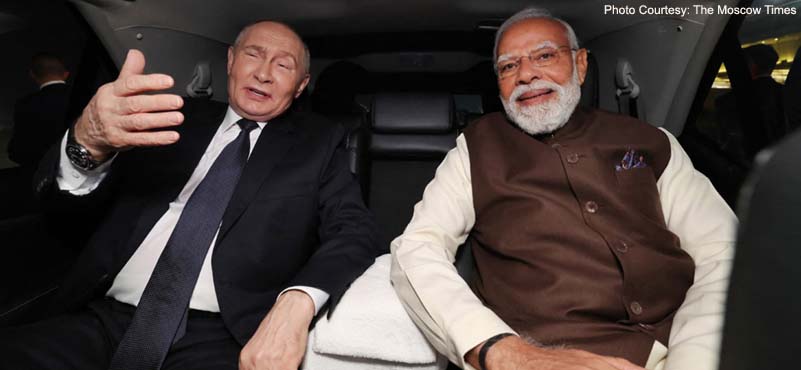
India-Russia relations received an impetus with the signing of the Reciprocal Exchange of Logistics (RELOS) Agreement and other key pacts during Russian President Vladimir Putin’s visit to India in December 2025. This landmark agreement is set to transform the defence partnership between the two nations, providing unprecedented access to military facilities, ports, and logistics infrastructure.
Key Highlights of the RELOS Agreement:
- Enhanced Military Cooperation: Allows India and Russia to support each other’s naval, air, and ground deployments across vast geographies.
- Access to Strategic Locations: India gains access to Russian naval facilities in the Arctic and northern Pacific, while Russia gets access to Indian bases in the Indian Ocean.
- Geopolitical Significance: Strengthens India-Russia ties amidst changing global geopolitics and sanctions imposed on Russia.
New Vistas of Development
The 23rd India-Russia Annual Summit also saw the signing of several other agreements, including:
- Healthcare and Medical Sciences: Collaboration on medical education, pharmaceuticals, and disease research.
- Food Safety and Standards Cooperation: Aligns food-quality standards and safety protocols between the two countries.
- Migration and Labour Mobility: Facilitates legal movement of workers, professionals, and students between India and Russia.
Progress on rupee–ruble trade settlements and the ongoing negotiations for a Free Trade Agreement (FTA) with the Eurasian Economic Union (EAEU) enhance the strategic depth of the partnership. These initiatives could reduce dependence on dollar-denominated transactions, reduce exposure to currency volatility, and streamline payment benefits, especially critical given the heightened uncertainties of the current global financial environment. Maritime cooperation modernizes port infrastructure and enhances shipping routes.
These agreements underscore the growing strategic partnership between India and Russia, with a focus on economic cooperation, defence, and energy security. As global geopolitics continues to evolve, this partnership is expected to play a significant role in shaping the future of international relations. If concluded, an EAEU FTA may offer Indian exporters preferential access to a broader regional market, potentially boosting exports in sectors like agriculture, textiles, leather goods, pharmaceuticals, and small and medium-scale manufacturing.
Energy and Fuel Security: Strategic Convergence
Russia’s assurance of uninterrupted supplies of crude oil, coal, and nuclear fuel, despite geopolitical pressures, has become vital for India’s economic stability. Affordable and predictable energy supplies help moderate inflation, stabilise industrial costs, and reduce fluctuations in the burgeoning import bill.
Enhanced nuclear cooperation, especially in fuel supply and reactor technology, can further strengthen India’s long-term transition to a diversified low-carbon energy portfolio.
Defence–Industrial Cooperation: From Buyer–Seller to Co-Development
Defence remains a major pillar of the partnership, but its character is evolving in conformity with the needs and requirements of the two major powers. Emphasis is gradually shifting from a transactional vendor–buyer approach to co-production, joint R&D, and technology transfer under the “Make in India” framework. This strategic transition can help India deepen indigenous manufacturing, create jobs, reduce import dependence, and ultimately improve the trade and current-account balance.
Can This Cushion India Against US Tariffs? A Nuanced Picture
Stronger India–Russia engagement can partially soften the blow from external trade shocks such as potential US tariffs. Benefits include diversification of export destinations, smoother payment mechanisms, reduced non-tariff hurdles, and lower input costs due to Russian energy supplies. However, these gains have certain inherent limitations. The US remains India’s largest and most lucrative export market, especially for labour-intensive and largely export-inelastic sectors like textiles, IT services, engineering goods, and pharmaceuticals, and we must, therefore, maintain a sense of balance and proportion in an objective assessment of the evolving situation.
Russian demand cannot easily substitute for all categories of Indian exports, particularly in high-value or consumer-driven segments. Sanctions-related uncertainties in shipping, insurance, and banking may continue to constrain full-scale trade expansion with Russia.
Structural asymmetries—India largely exporting consumer goods while importing energy and defence inputs—limit complete trade rebalancing. Moreover, global forces and factors, such as supply-chain reorientation, competitive pressure from Southeast Asia, and shifting consumption patterns, will continue to influence India’s export trajectory.
Long-Term Strategic Payoffs- The Form and Substance
Despite short-term constraints, the long-term potential of a deeper India–Russia relationship is substantial. If nurtured carefully, it can enhance resilience against geopolitical and economic shocks, reduce dependence on a narrow set of export markets, provide a more diversified and secure energy base, industrial upgrading through technology partnerships, and strengthen strategic autonomy in an increasingly polarised global landscape.
The Road Ahead- Undivided Attention and Forceful Direction
Transforming the development spectrum on these lines is a tall order. Accordingly, realising these benefits will require India to scale up competitive manufacturing, capture new Russian and EAEU market segments, diversify export capabilities, and adapt swiftly to emerging global supply chains.
India and Russia are clearly poised to lift their partnership to a higher orbit. With sustained commitment, institutional coordination, and strategic foresight, this set of agreements could lead to a “win-win situation” for both nations, similar to Shakespeare’s famous “quality of mercy”, from The Merchant of Venice (Act 4, Scene 1), a speech delivered by Portia. With sincerity of purpose, a renewed thrust on mutual benefits and mid-course correction, as and when necessary, the task ahead may be difficult, but by no means undoable. Given our successful decades-old track record of friendship and cooperation, and faith and mutual trust on both sides of the aisle, we will succeed- “hum honge kamyaab”!
ABOUT THE AUTHOR
 Dr. Manoranjan Sharma is Chief Economist, Infomerics, India. With a brilliant academic record, he has over 250 publications and six books. His views have been cited in the Associated Press, New York; Dow Jones, New York; International Herald Tribune, New York; Wall Street Journal, New York.