The Indian market is here to stay. Growth is not the issue, but certain. The more pertinent point is how, with what diligence and with what result. Competition is inevitable, not only among brands, but also with competing businesses in the real estate field. Ensuring ROI in the most responsible way.
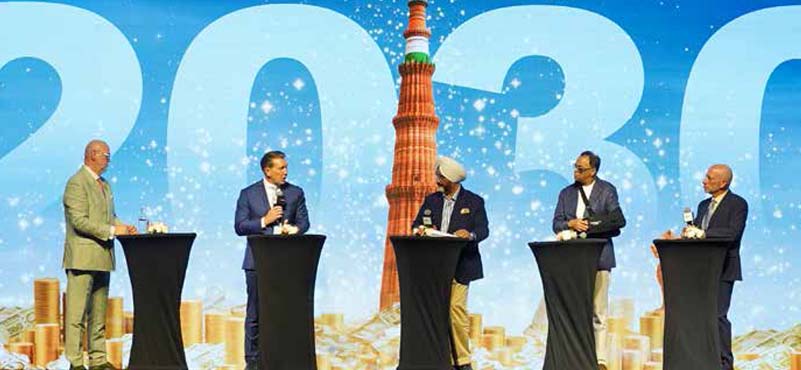
Presenting a panel at HVS ANAROCK HOPE 2026, featuring Alan Watts, President, Asia Pacific, Hilton; Dimitris Manikis, President for Europe, Middle East, Eurasia and Africa (EMEA), Wyndham Hotels & Resorts; Rajeev Menon, President, Asia Pacific (excluding China), Marriott International and Ron Pohl, President, WorldHotels & President, International Operations, BWH Hotels. The panel was moderated by Mandeep Lamba, President & CEO (South Asia).
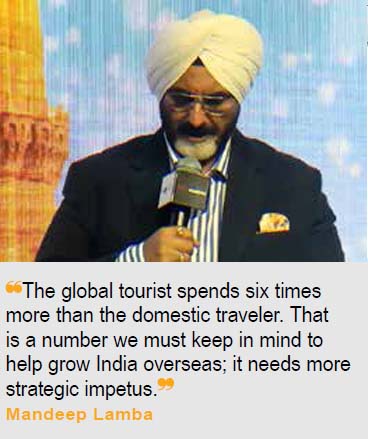 Mandeep Lamba: If we strip away the global noise, how would you describe India hotel demand today? Are we still in a catch-up cycle or have we entered a structurally higher demand phase?
Rajeev Menon: So, in India’s case at least, what we are witnessing across the board, is what I call as a 75% structural shift and a 25% cyclical play. And the tourism secretary aptly put it and since then a number of other speakers have addressed this as well. Over the last 25 years that I’ve been with Marriott, I have had the opportunity to sit in the boardroom in Hong Kong, which used to be our regional headquarters, and watch how China grew.
And when you looked at the amount of infrastructure investment that was going in, how the government was pushing to make just ease of doing business, people were acquiring wealth, they were starting to move freely, and you could see the hotel industry thriving. That is exactly to some extent what’s starting to play out here for the last few years now. And I think for that reason, I continue to say, I see India as decades-long growth story.
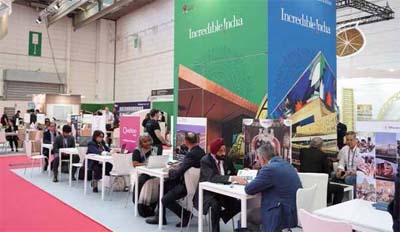 And I’ve been saying for the last year or so, India is shining. There is incredible opportunity. Just think about Japan, forget China for a minute, 130 million people, just over 40 million inbound, you’ve got 1.8 million hotel rooms. We all know how many hotel rooms there are in India.
So, as the government continues to invest in infrastructure, as people are continuing to acquire wealth, they continue to become aspirational, you’re going to see more and more of the country on the move. And as a result, you would need hotel rooms. Gone are the days when we were growing up, and I’m sure we did the same. There were two options. Either you had real five-star hotels that most of us couldn’t afford. I’m from a middle-class family. Or we all stayed in guest houses. And my dad was a senior railway executive and we stayed in the railway guest house growing up. So, but that has shifted now. It’s a demand for mid-scale to select to premium to luxury. You’re seeing every segment thrive and I think that’s gonna continue for a long period of time.
Mandeep Lamba: I couldn’t agree more. But is there something Raj that has sort of surprised you about demand in India over the last, let’s say, 12 months?
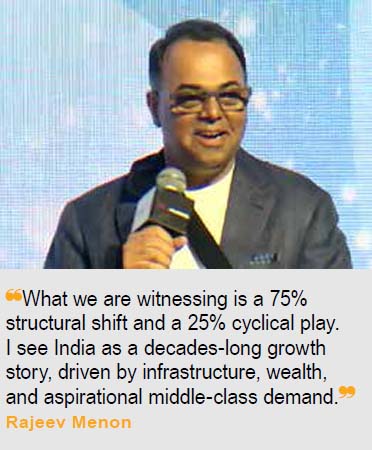 Rajeev Menon: I’ll tell you, it really is not a surprise. But when you think about in the past cycles, you would get a lot of supply coming in. The demand would struggle to keep up. This was really the first year when you saw considerable supply come in, and then demand growth was almost on par, if not a bit higher.
And again, it’s all coming from exactly what I said earlier. It’s because of the economic growth. What you’re seeing is really in the growth numbers in secondary tertiary markets. That’s where the opportunity sits beyond. So today, we have about 50% of our hotels in the primary cities. The rest are all in the secondary and tertiary markets. And that’s where, to me, the opportunity is for future years as well.
Mandeep Lamba: Alan, from an APAC perspective, where is India sort of genuinely outperforming the region today? Is it rate strength? Is it the depth of demand? Or is it just resilience?
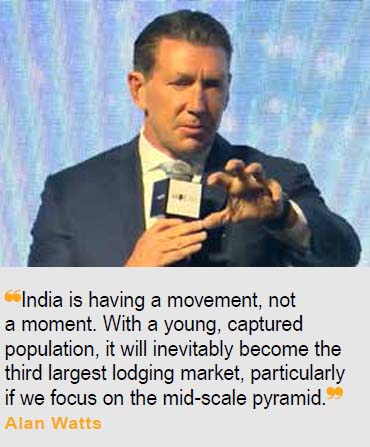
Alan Watts: I would say if it wasn’t for the geopolitical issues last year, India would be the top performing market at the top of its cycle. It’s only India and Japan, sort of the darlings of the industry today. But as Raj quite rightly puts it, you need three things for the hotel industry to survive. Strong GDP growth, a demand and supply characteristic that’s in your favor, and strong infrastructure. And so, the sustainable India piece, particularly for this room, we shouldn’t be on this stage trying to convince each other that the time for India is now. Your comments about India having a movement, not a moment, ring true. This room should be focused at an industry level and I thought the Secretary did a wonderful job talking about this on how do we work better as an industry for structural reform, ease of doing business to facilitate what’s clearly coming.
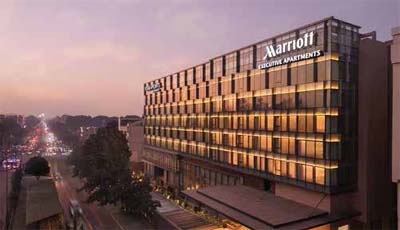 And that means as AI gets more efficient, what role do we play in employment opportunities? From my perspective, there’s no debate that India becomes the third largest lodging market in the world. But if you look at the demographics of the population, and it has the advantage of a captured and young population, the demographics of the population are like an aircraft. There’s very few in first class. There’s a more significant but still smaller portion of business. But the majority of the market sits in economy and mid-scale. And if we look at our hotel supply today, particularly in the branded sector, there is an enormous base of the pyramid where not only can we deploy our brands for great owner returns, that we can lift the entire segment and rebrand hospitality as an employer of choice for the next generation coming through those hotel skills.
And it’s that conversation that we need to ensure that in great forums like this, that we get together and have. So, in a pointed answer to your question, it has today’s performance of Japan, but it has a massive competitive advantage of a captured market and population base. That means while Japan is doing well today, it will inevitably be cyclic in a way that I don’t think India will in the near term.
Mandeep Lamba: Absolutely. Dmitry, from an EMEA perspective, and if you look at India, what looks familiar and what doesn’t look familiar to you, and what feels completely different?
Dimitris Manikis: Both of my colleagues spoke about Japan. The difference with what you see in other markets, for example, in Japan, you sell more adult diapers than baby diapers. That is a fact of life. Here, what did the secretary said, 60% of the population is below the age of 35? That’s the main difference. That’s where I see the enormous opportunity. So, talking about mid-scale and economy, so now I’m going the reverse. I’m actually going into luxury. I’m opening up Wyndham Gardens, Wyndham Grands. I’m opening up the Dolce’s. I’m actually contemplating looking at management opportunities because these guys are going to fill my space, so I need to do something else. So, I cannot believe that this is actually happening. So I’m extremely excited.
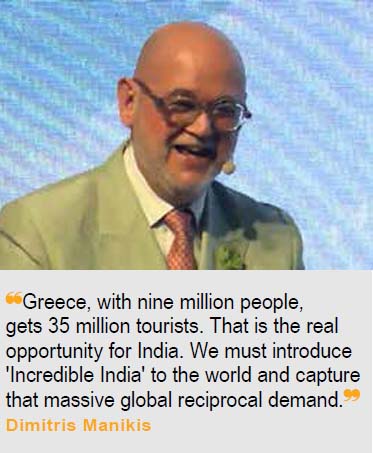
You can start from a 50-room economy over to a JW Marriott or a Waldorf Astoria, it’s an amazing market. And it’s room for everybody. The only thing, and I have to say to all of you here, India has been great to us, right? You have been so amazing to us. We have 100 hotels, we’ve got another 55 in the pipeline, but it’s not about the numbers. We need to do something about India as well. Just to give you an idea. I come from a country with 9 million people. I mean, this is like a fourth-tier city in your country. Greece is nine million people. We have 35 million tourists every year in 9 months of the year.
 So, Mr. Secretary, that is your real opportunity. Greece, with 9 million people, in 9 months of the year, gets 35 million tourists. Between Turkey, Greece, we get 80 million tourists per year in that little part of the Aegean Sea in the Mediterranean. That’s where the real opportunity for India exists.
So for us, if you look at these guys, right? 200 million members, now I’m gonna do your job. 220 million members, 180 million members, 120 million members. Can we get more people to India? That’s what I think is the huge opportunity for all of us. We need to introduce incredible India to the world. That’s where I think the real opportunity stands. Because if we do that, then we will capture the 150 million Indian consumers that are going to travel around the world, because it’s reciprocal. So, for me, for Wyndham, that’s where the real opportunity lies.
Mandeep Lamba: And I think while domestic demand keeps on growing, and all of us know about that, but the Honorable Secretary said in the morning today that the global tourist spends 6x of the domestic. That’s a number we need to keep in our mind and help grow India overseas, which is something that needs more impetus.
Ron, I’m going to ask you from a global boardroom perspective, how visible is India today compared to, let’s say, five years ago?
 Ron Pohl: Well, I would tell you that India has been in our sights for many years, and there’s a couple reasons behind that. Number one is, as a private hotel company, over 50% of our hoteliers in the States are Indian owners. We’re very proud of that. We work very closely with them. Of our seven board directors, four of them are Indian and visit this country frequently. I go back to 2017 and I brought the entire board of directors here to tour India so we could understand what we needed to do to be successful here. And then two years ago, I brought them back again and said, we need to really see how we can be more successful. And ten years ago, we partnered with a local hotel company because we knew it wasn’t in our bandwidth to be extremely successful by trying to do it that way. And we teamed up with Sorrel Hospitality, Ranjan Bhattacharya, and their team to grow here.
So, we saw this day coming. We didn’t know exactly when, but the Best Western brands especially are very good at developing in secondary, tertiary, leisure type markets. So, we’ve got 35 hotels operating today, we’ve got 26 in the pipeline, and more coming, but it’s because of the way our organization is structured and committed to India, that’s made us successful. And again, we’ve been waiting for this day to come, we knew it would, and we’re excited to be here.
Mandeep Lamba: So would you say, Ron, that conversations today are around core growth, India showing core growth? Are we still saying it’s an emerging sort of country or destination?
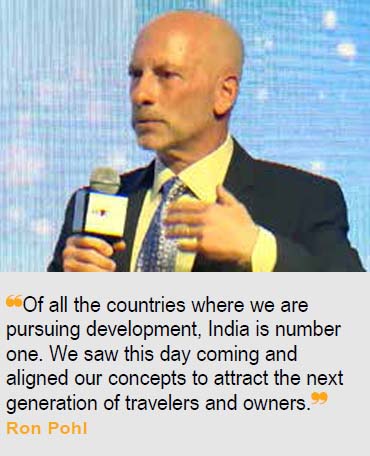
Ron Pohl: Of all the countries where we are pursuing development, India is number one.
 Mandeep Lamba: Alan, let’s talk a little bit about, the business of hotels. India demand is strong, we all know that, but margins matter. Where are India hotel economics genuinely improving and where are operators still feeling the pain?
Alan Watts: Look, this is a perennial subject, right, and so if you think of RevPar growth in India in the cycle that we’re currently in, margins are increasing, they have been steadily for the last, sort of since COVID, and that because RevPar is outstripping cost increase. And so, I think at the moment, if you’re in the industry and you’re talking to owners, broadly speaking, everybody’s happy. We can debate who gives best in class owner returns, but everybody’s winning. A rising tide lifts all ships. And to the point of my colleagues, boards are excited about India. Everybody’s investing money. We’re certainly investing more above-property money than we ever have in any other market with the exception of China here.
But the storm clouds on the horizon, I don’t feel, are demand-side, something the Secretary said that I think rings true to us. We are going to have to, as years go on, address what will become a biggest issue for our hotels, and that’s rising wage costs. As RevPAR stabilizes, which invariably it will, we are going to have to address core talent, training of talent, and productivity, so margins don’t come under pressure.
 And I know we don’t feel it today, and as much as I would love double-digit RevPAR growth to continue forever, if you look at manning ratios across everybody on stage and everybody in the room, this versus almost every other market in Asia, and I include China in that, after having, a decade now of legislated minimum wage increases in China, even the once unproductive China hotels are now lean and mean because they are forced to be.
So, if we want to continue to maintain the margins that we’re maintaining today, it’s never too early to look at the quality of training, the quality of hotel schools, and the productivity that’s going to ensure our margins and therefore our industry continues to be strong.
Mandeep Lamba: Raj, owners in this room are asking, is this the best profitability cycle that India has ever seen, or is it just the best so far?
Rajeev Menon: I think it’s the best so far, right, because I’ve been closely associated with India in the world of Marriott 25 years next month. I opened the second hotel, and as of last night, we are at 213 hotels. I’ve seen the highs and the lows. We are definitely at a high point. When you think about 25, and we have a large base of hotels, just comparable hotels for us were double-digit RevPar growth, profitability was pretty damn close to 50%. Now that is around global numbers, you would say it’s right up there. There are not many countries that are at that level. But is there opportunity? Our best hotel is probably at about 64, 65%.
But I would say Alan is right in the sense that we’ve got to continue to watch labor. We’ve got to continue to watch other elements. Now I genuinely also believe we need to pay people well. Entry-level salaries must go up. We have to lift the broader lifestyle of the communities where we operate. There is no denying on any of that, but the opportunity still is on both sides. In our case, we have programs where, in the old days, when I started my career in this country, you could work 18 hours, 20 hours, and nobody blinked an eye. Now we are saying, please go home after your shift. And we want to have minimum wages. But one of the things that we did coming out of COVID as a learning was to shift gears a little bit and make sure what we learned during COVID we didn’t lose out coming in this hysteria that we are in now. And that’s kind of paying a little benefit.
So, as I look around the world, and I just did this analysis because I happened to present it to Marriott board a couple of weeks ago, Asia’s in broad cases, we’re still better off. Our payroll margins are about 150 basis points lower today than they were in 2019. It’s because the teams have done a better job on productivity overall. So, can we continue to stay focused? AI is a huge opportunity in front of us. We can continue to grow profit and give people much better lifestyle and pay and still be sustainable.
Mandeep Lamba: Which is something I think the industry must seriously look at. It’s an element that gets discussed every time we talk about our sector. Entry-level salaries must, must improve. We have taken our management card and the senior management salaries to really market, but we still are struggling at the entry level. Dmitry, in Europe, cost pressures sort of feel structural. In India, are we underestimating long-term cost pressures?
Dimitris Manikis: Yeah, I mean, it’s like I always said, right? I live in London, and the only thing when you do in London, when you see a sunny day, you carry an umbrella, because you know that eventually, at some point in the day it’s gonna rain. So, it’s the same with everything in life, right?
I mean, I was so impressed by all the numbers that I heard, but you always have to remember you need to carry that umbrella because something, somewhere, at some point might go wrong. And I think it is our job, all of us, as leaders, to make sure, you know, I heard the duty of care, just to do the right thing for our teams. What if something goes wrong? And what is that? That could be energy, it could be cost. I don’t care, control the controllables. I don’t know about geopolitical, what can I do?
You know, you wake up in the morning and something happened in Mexico and the whole Mexican tourism industry goes into dire straits. Who expected that, right? So that’s something we cannot control, but we can control costs, we can control how technology can actually help us bounce back if something happens. And I don’t think, the whole story about all Europe is different than India, whatever. I don’t think it is. Because when I grew up in the hospitality, and that was a long time ago, you couldn’t be a GM if you were not Swiss, German, French, or English. Now, 50% are Indians. So that means that what happens in Europe is not Europe’s fault, because you guys are running most of our hotels.
So, I don’t think that the whole thing, oh, you know, Europe is different than India or China. Actually, it’s not. The hospitality industry, it’s exactly the same everywhere in the world. Look at the consumers, what do they want? Exactly the same thing. They want security, they want health, safety, a decent bed, a great shower. They want somebody to smile at them. It doesn’t matter if you are in Shanghai or if you are in downtown Athens, people want exactly the same. So, all that comparison, Europe, Asia, yes, there are differences. But I wouldn’t put it to the extent that it’s actually changing the perspective of hospitality. Hospitality is global. Tourism or travel is a human right. The moment we realize that, we’re all on the same page. So that’s my view.
Mandeep Lamba: Ron, given your background and Best Western, India is one of the largest unbranded hotel universes. What makes India fertile ground for conversions? And what mistakes do owners usually make?
 Ron Pohl: Well, I think that the first thing you need to look at as an owner is where do you want to position your hotel? And is it an opportunity that if you’re going to brand it, to reposition it in the market? We often look at it and have created brands to bring in a mid-scale property and with some smart renovation, move it up market to upper mid-scale. And then have the brands that are aligned with, is your target demographic more of the baby boomers, which you don’t have many of here, so that wouldn’t make sense. So what brands are going to attract Gen Z? And so, we aligned that product and concept with what would work in that market.
And we look at each hotel specifically with our design team to say, this is where you can generate the greatest ROI on your investment money. And we saw similar in Europe, because there’s so many unbranded hotels, 70% are unbranded in Europe, you see similar statistics here. Okay, well, coming into a market and talking about a brand can be difficult just at the start, but if you can show the value in what that brand offers and what repositioning within that brand provides, the story is much simpler.
 Mandeep Lamba: Raj, are Indian owners today more aligned with brands or should I say more assertive?
Rajeev Menon: I think Indian owners are aligned. Full stop. I mean, again, I’ve had the luxury of being here for so many years. And I’ve seen the highs and lows. I’ve seen lows where we’ve gotten into the room and gone at each other and walked out and hugged each other. And today, we are having very productive conversations about what steps to take to get the best out of the asset. How are we growing our people? What are we doing from a long-term perspective? So, I think COVID was a huge time of self realization. But also, was also an incredible time when there was more alignment, between the owner community and the operators, because we actually spend time talking, getting to understand each other’s problems and working our way through.
So again, really today I’m sitting in a boardroom having a discussion where it is about assertiveness, it is about clear point of view, and on broad terms you tend to agree on issues. And you want, from a long-term perspective, how are we going to win collectively?
 Mandeep Lamba: Alan, what single shift will most change how hotels in India are built or operated over the next three to five years?
Alan Watts: I really think, I mean we started to touch on AI and efficiency and rising labour costs and our duty of care to ensure that there is perhaps less people in our hotels at a higher pay bracket and we are fulfilling that duty of care to make sure that people progress. The upside in doing that and driving efficiency and utilizing AI for the powers of good is the amount of GFA in a hotel that’s revenue generating. You’re going to see smaller back of house, you’re going to see smaller kitchen, you’re going to see owners continuing to do what they should be doing, which is looking for best-in-class owner returns. Best-in-class owner returns starts with best-in-class use of GFA.
I don’t think you’re going to see a kitchen that you need to take a golf cart to get from one side to another, and when you do see it, shame on us. The technology is moving fast, and that is technology in build, that’s technology in efficiency, that’s us being great stewards for environmental builds, but ultimately, it’s some of the facilities planning in our hotel, in our hotels, are no longer modern.
And it is a traditional approach where size is everything, is not always right. So, if we start to take a look—every metre of real estate that is not revenue-generating and questioning whether that’s a metre of real estate that is needed. Every team member in your manning guide, how do we do less with more and ensure those people are compensated? It will ultimately see our offers evolve in the way that they have through necessity. We have an advantage at the moment. Supply and demand is in our favour. We should take that advantage to continue pushing barriers on behalf of our business. Ultimately, we as an industry need to be mindful that we’re in the real estate business. And as much as great team member experiences, great guest experiences equal top line profits and bottom-line profits, we shouldn’t be competing with each other. We’re competing with residential real estate, we’re competing with retail, and we’re competing with retail, and we’re competing with commercial. And the true size of the prize for our industry is to offer an equivalent, if not better, return for a long-hold asset to attract people to the sector. And that means being mindful that you are as much a real estate steward as you are a hotelier. That means our general managers understand asset value and asset and value creation beyond the GOP. And as hoteliers, we make sure we partner with our owners and asset managers beyond the GOP. And that will see an evolution of latest quality build.
Mandeep Lamba: Dimitri, what’s the most over-designed trend creeping into Indian hospitality, if there is any?
Dimitris Manikis: Look, I think that you guys have taken luxury to the next level. The question is how sustainable is that? In a world where everybody’s looking for efficiencies, everybody’s looking for new ways of doing things, energy consumption, sustainability is a big conversation.
Raj said it very nicely; we need to pay better. How do you sustain that level of luxury? How do you sustain three employees per guest in some cases? That is going be the biggest challenge in the industry in India. What I’ve seen the last seven years, you’re exporting talent so much that you don’t have enough talent in India. There are more Indian people serving or professional serving hospitality outside of India.
And suddenly, you’re going be missing your own people serving hospitality, your own country. That’s why education is very important, as the minister said, and so forth. So, you gotta be very careful on that luxury over kind of overspent. And both Alan and Raj, I think Ron said it very nicely, that mid-scale space with a tweak, it’s the future of India. And one thing that I wanna say, premium experience doesn’t mean premium price. That’s something that the Indian hospitality needs to learn how to adapt.
Mandeep Lamba: The only trouble here that I always have is who defines what is expensive? I get a lot of people telling me today that Indian hotels are becoming unaffordable, but if you look at it on a global stage, we’re still really at the beginning of that climb up.
Dimitris Manikis: I was in Rome three months ago and a guy said, oh, we’re the number one in luxury in the world, we charge $1,000 a night. I said, okay, in five years, tell me how many people can actually afford $1,000 a night. My kids can’t. They still live with me, because they cannot afford to have a decent place, because cost of life is so expensive in big cities. So, we’ve got to be mindful of this.
Ron Pohl: Coming out of COVID, we saw a pretty significant shift in demographics of financial capabilities of the luxury traveler. And this was a study done by McKinsey and Company that today 30% of luxury travelers have a net worth under a million dollars. So, think about that.
They are not going use all of your facilities all of the time. They will be selective in what they’re going to use while they’re at a luxury or upper upscale hotel and they’re going to visit the local areas for other experiences. So, as we look at hotels to join, our world hotels, our luxury brand, it’s how do we create the experience that is important, but isn’t necessarily $1,000 a night, because they’re not going to, not the entire population is going to spend that.