Introduction: Strategic Autonomy Under Unprecedented Strain
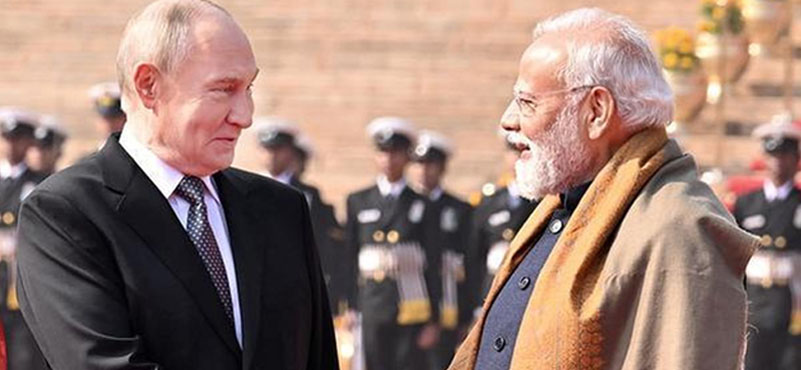
The evolving geopolitical environment has placed India’s long-cherished doctrine of strategic autonomy under extraordinary pressure. The recent India-US framework agreement while softening debilitating tariffs, restoring supply chain integration and market access in advance economies has also triggered a serious debate regarding sovereignty, strategic autonomy, economic vulnerability, technology dependence and long term national interests. These emanate from agricultural market access, digital trade, over $500bn imports in the ensuing five years, uneven tariff reduction and elimination of cheap Russian oil imports; raising an uncomfortable question. Has India compromised its strategic autonomy and by extension diluted its historically special and privileged partnership with Russia, most recently reaffirmed during President Vladimir Putin’s December 2025 visit to New Delhi?
Simultaneously, India’s expanding trade and investment agreements with the United Kingdom, the European Union, Oman, EFTA block (including Switzerland, Norway, Iceland and Liechtenstein) and New Zealand, deepening engagements with Germany, and a forthcoming diplomatic reset with Canada collectively reflect a deliberate strategy of economic diversification, technological access, and risk mitigation. These initiatives must be understood not as a departure from strategic autonomy but as a recalibration driven by compelling structural realities. Foremost among these are the relentless pace of technological transformation, the militarisation of artificial intelligence and space, the imperative of rapid defence modernisation, and above all, the strategic pressure exerted by China along the Line of Actual Control (LAC) and across India’s immediate neighbourhood.
India’s trade diversification efforts had begun well before the re-emergence of protectionist tendencies in the United States, anticipating volatility in tariff regimes and seeking insulation from unilateral economic coercion. In an increasingly fractured trade environment, India must navigate a delicate balance: securing market access, preserving domestic industrial growth, and retaining sovereign control over strategic sectors. The return of Donald Trump to the White House and his overtly transactional worldview has further intensified uncertainty. Despite formal agreements, Trump’s strategic unpredictability reinforces the reality that alliances today are provisional, contingent, and interest-driven. In such a setting, the maintenance of strategic autonomy becomes not merely difficult but existential.
India’s diplomatic posture in recent conflicts underscores this nuanced balancing act. During the Russia–Ukraine war, India maintained principled neutrality, safeguarding energy security and strategic partnerships. In the Israel–Gaza conflict, New Delhi carefully balanced humanitarian concerns with strategic alignment. On Venezuela, calibrated silence prevailed. This nuanced diplomacy highlights India’s determination to preserve flexibility, autonomy, and manoeuvring space in a deeply polarised global system.
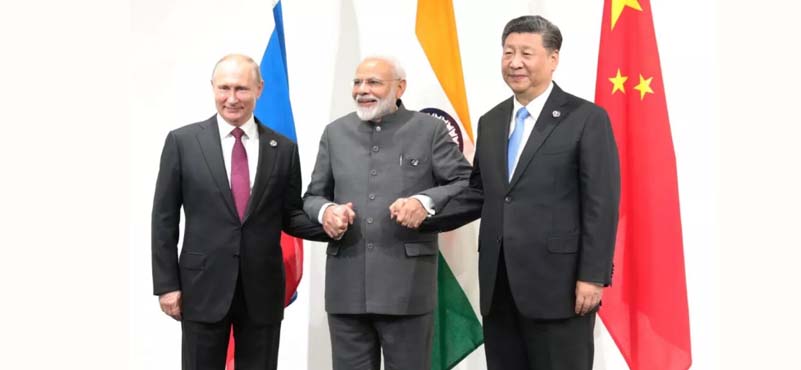
Against this turbulent background, the Russia–India–China (RIC) triangle emerges as a potential stabilising framework, yet also as a theatre of profound contradictions. As the global order transitions from unipolarity to contested multipolarity, the central question remains: can RIC evolve into a credible geopolitical counterweight to Western dominance or will its internal fault lines prevent it from becoming anything more than a tactical convergence of convenience? More crucially, what role can and should India play within this triangular dynamic to protect its national interests while shaping the contours of the emerging world order?
Relevance of RIC: Between Strategic Promise and Structural Paradox
The revival of RIC has gained renewed prominence amid intensifying geopolitical polarisation. The Shanghai Cooperation Organisation (SCO) summit at Tianjin and the BRICS summit at Kazan both signalled a growing Eurasian consolidation that unsettled Western capitals. President Trump’s reported lament that “we have lost India and Russia to deep dark China” reveals the apprehension within Washington regarding the gradual erosion of Western geopolitical primacy and the emergence of alternative power centres.
At a structural level, RIC embodies extraordinary geopolitical potential. Collectively, the three states account for nearly a third of humanity, command vast energy, mineral, industrial and technological resources and dominate the Eurasian landmass. Their combined economic output in purchasing power parity terms rivals that of the G7. Their political weight across the United Nations, global financial institutions, and regional groupings grants them unparalleled capacity to influence emerging global governance norms. RIC thus appears, at least conceptually, as a formidable platform for reshaping the international system toward greater multipolarity.
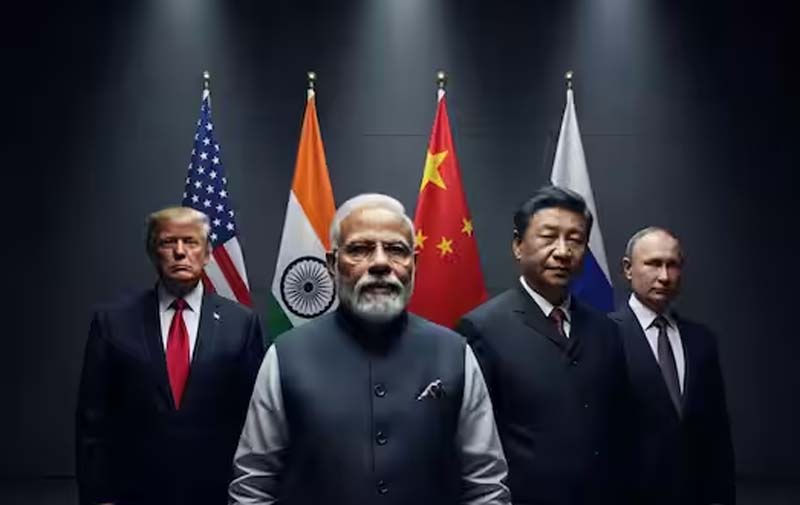
Yet, this promise is fundamentally constrained by internal contradictions. India and China remain locked in unresolved territorial disputes, strategic rivalry, and deep-seated mistrust. Russia and China, despite tactical convergence, are bound by an asymmetrical partnership increasingly tilted in Beijing’s favour. India and Russia maintain deep strategic trust, but Moscow’s growing dependence on China complicates its capacity to act as a reliable balancer. Moreover, each member of the triangle simultaneously maintains extensive transactional engagements with the West, often in ways that undercut collective strategic coherence.
Thus, RIC is best understood not as an alliance but as a fluid strategic consultative mechanism, offering tactical convergence without binding commitments. It functions as a diplomatic hedge, enabling each actor to expand its strategic options, mitigate vulnerability, and retain leverage across multiple power centres. The relevance of RIC therefore lies less in its ability to replace Western alliances and more in its potential to moderate geopolitical polarisation, prevent rigid bloc formation, and preserve strategic flexibility.
Russia–China Relations: Strategic Convergence Underwritten by Mutual Suspicion
The Russia–China relationship today represents one of the most consequential axes in global geopolitics. Western sanctions following the Ukraine war have dramatically deepened Russia’s economic and diplomatic reliance on China. Beijing has emerged as Moscow’s principal trading partner, technology supplier, financial conduit, and diplomatic shield at multilateral forums, particularly within the United Nations Security Council. The rapid expansion of Yuan–Ruble trade settlements, the bypassing of SWIFT mechanisms and the surge in Chinese exports of dual-use items to Russia collectively illustrate this growing dependency.
However, beneath this tactical alignment lies profound strategic mistrust. Russia is acutely conscious of the asymmetry in its partnership with China and resists being reduced to a subordinate role. Historically unresolved border tensions, demographic anxieties in Siberia, Chinese ambitions in Central Asia and emerging competition in the Arctic compound Moscow’s unease. Chinese strategic literature, which anticipates six major wars over the next half-century culminating in a confrontation with Russia, further reinforces mutual suspicion. China’s expanding footprint across Kazakhstan, Uzbekistan, Kyrgyzstan, and Tajikistan erodes Russia’s traditional sphere of influence in Eurasia, while Beijing’s Arctic aspirations directly challenge Russian geopolitical dominance in the High North.
 Yet, this relationship is sustained by reciprocal dependencies. China benefits enormously from discounted Russian energy supplies, access to advanced missiles, engines, aerospace technologies, submarine propulsion systems, and hypersonic research. Russia, in turn, relies on China’s manufacturing depth, technology backfilling, financial channels, and strategic diplomatic cover. This convergence, therefore, constitutes a marriage of necessity rather than trust, one driven by external pressure rather than organic strategic alignment.
For India, this axis introduces profound strategic complexity. Russia’s increasing entanglement with China dilutes its capacity to serve as a neutral balancer, even as Moscow seeks to preserve strategic autonomy. This evolving dynamic fundamentally reshapes the geometry of the RIC triangle, rendering its internal equilibrium increasingly fragile.
India–China Relations: The Structural Fault Line of RIC
India–China relations remain the central fault line within the RIC construct. The unresolved boundary dispute, persistent PLA deployments along the LAC, militarisation of Tibet, repeated transgressions, and the memory of violent confrontations such as Galwan have institutionalised mistrust. China’s territorial claims over Arunachal Pradesh, aggressive diplomatic signalling and strategic encirclement through the Belt and Road Initiative exacerbate Indian threat perceptions. Simultaneously, China’s deep strategic partnership with Pakistan, including military modernisation and nuclear collaboration further compounds India’s security anxieties.
At the strategic level, India and China represent competing visions for Asia. India advocates a genuinely multipolar World and Asia anchored in sovereign equality and strategic pluralism. China, in contrast, envisions a multipolar World underpinned by a hierarchically structured Asia, with Beijing occupying the central pole. This divergence makes strategic accommodation inherently difficult.
Economic interdependence, paradoxically, intensifies vulnerability rather than trust. India’s massive trade deficit with China spans critical sectors including rare earths, pharmaceutical APIs, fertilisers, electronics, telecom equipment, solar components, tunnel-boring machines and industrial machinery. Such asymmetry constrains India’s strategic space, forcing New Delhi to accelerate diversification, domestic manufacturing, and technology substitution. The fact that both countries have litigated against each other at the World Trade Organization underscores the erosion of economic confidence.
Yet, civilisational antagonism does not define India–China relations. As Prime Minister Modi has repeatedly emphasised, the two ancient civilisations possess the capacity for coexistence, cooperation, and mutual respect. However, strategic realism dictates that India must be prepared to defend its sovereignty independently. Along the LAC, no external power will intervene militarily on India’s behalf. Intelligence sharing, diplomatic backing and technological assistance may materialise, but the burden of deterrence rests squarely on India’s shoulders.
Within this equation, India retains latent leverage through the Tibetan issue, the Dalai Lama institution, strategic engagement with Taiwan and its capacity to shape global discourse on Xinjiang and human rights. While these levers remain calibrated and restrained, they constitute powerful instruments of strategic signalling, reinforcing India’s bargaining position.
India–Russia Relations: Strategic Trust Amid Geopolitical Flux
India–Russia relations constitute the most stable axis within the RIC framework, underpinned by decades of strategic trust, technological cooperation, and diplomatic convergence. From Moscow’s decisive support during the 1971 Bangladesh liberation war to sustained defence, nuclear, aerospace, and missile collaboration, this partnership has profoundly shaped India’s strategic capabilities. Russian assistance enabled India’s entry into advanced domains such as nuclear submarine operations, cryogenic engine development, and integrated missile systems, establishing a foundation of trust unmatched by any other partner.
President Putin’s December 2025 visit reaffirmed this partnership through major defence contracts, expanded nuclear reactor cooperation including modular technologies, long-term energy supply agreements and deepening collaboration in Arctic exploration. Russia remains India’s most reliable source of advanced military technology, offering unparalleled transfer of know-how and joint development models. The S-400 air defence system, which proved operationally decisive during Operation Sindoor and the prospective acquisition of the S-500, underscore this dimension. Russian readiness to support BrahMos missile exports to the Philippines, Armenia, Indonesia, Vietnam, Saudi Arabia and UAE alongside possible co-production of SU-57 stealth fighters, if and when; highlights a level of strategic trust rarely extended by major powers.
However, this partnership is not immune to structural strain. The Ukraine war has delayed deliveries, constrained Russian industrial capacity and intensified Moscow’s reliance on Beijing. Russia’s growing entanglement with China complicates its ability to function as a neutral mediator between New Delhi and Beijing. While Moscow continues to advocate dialogue and stability, its leverage over China remains limited. While it can act as a stabiliser, it is not a guarantor of India’s security interests.
Consequently, India cannot afford strategic complacency. While Russia remains indispensable for defence technology, energy security, and diplomatic backing, overdependence would expose India’s vulnerability. The evolving Russia–China axis therefore necessitates a more diversified strategic calculus.
Prognosis: India’s Strategic Role and the Future of RIC
The Russia–India–China triangle reflects both the aspirations and contradictions of emerging multipolarity. While it offers a platform to moderate Western dominance, its internal fault lines constrain its capacity to evolve into a cohesive geopolitical bloc. RIC’s future relevance will depend not on its rhetorical coherence but on its ability to reconcile divergent strategic trajectories.
For India, this demands a doctrine of strategic pragmatism grounded in active rebalancing. National security, technological sovereignty, economic growth, and diplomatic autonomy must remain guiding principles. India’s engagement with SCO and BRICS must coexist with its participation in QUAD, I2U2, and the India–Middle East–Europe Economic Corridor, reflecting an issue-based alignment strategy rather than ideological commitment.
The Asian century, so frequently invoked, cannot materialise without a stable India–China relationship. Competitive coexistence, crisis management mechanisms, and confidence-building measures are indispensable to preventing escalation. Without such accommodation, Asia risks becoming the principal theatre of global instability.
India must also ensure that extra-regional interventions do not undermine its core interests in South Asia and the Indian Ocean region. Managing US influence in Pakistan, Bangladesh, Afghanistan and Myanmar requires diplomatic dexterity, economic engagement, and security partnerships calibrated to preserve regional equilibrium. Its trade engagement with the US must remain transactional, not structural; diversified not concentrated and interest based not alliance driven.
India’s growing leverage through deepening partnerships with the Gulf Cooperation Council, technology giants, global capital flows and its unmatched demographic and market scale positions it uniquely within the RIC framework. By combining strategic autonomy with adaptive alignment, India can serve as the pivotal balancer, preventing Eurasian consolidation from hardening into antagonistic blocs.
Ultimately, RIC’s full strategic potential can only be realised if India and China move beyond rivalry toward structured coexistence and mutual accommodation. Without this, RIC will remain constrained, episodic, and tactical — a platform for consultation rather than a vehicle for global transformation.
ABOUT THE AUTHOR
 Major General SC Mohanty, AVSM (Retd), was commissioned in June 1983. The officer commanded a Mechanised Infantry Battalion, a Mechanised Brigade and an Infantry Division (RAPID Strike) in the Western Sector. As a Brigade Major, he took active part in the Kargil Operations while located at Drass. As part of Military Operations Directorate, he headed the Information Warfare, Cyber and Electronic Warfare branches. Post retirement, he was the Security Advisor to Government of Arunachal Pradesh from July 2020 to May 2023.