In the ninth piece of our Indian economy series, a sharp disconnect stands out: markets are riding a wave of renewed optimism, even as households feel the squeeze of higher prices and policymakers face tougher trade-offs. Over the past month, firmer core-sector output, returning foreign capital, and a steadier rupee have done plenty to lift the mood.
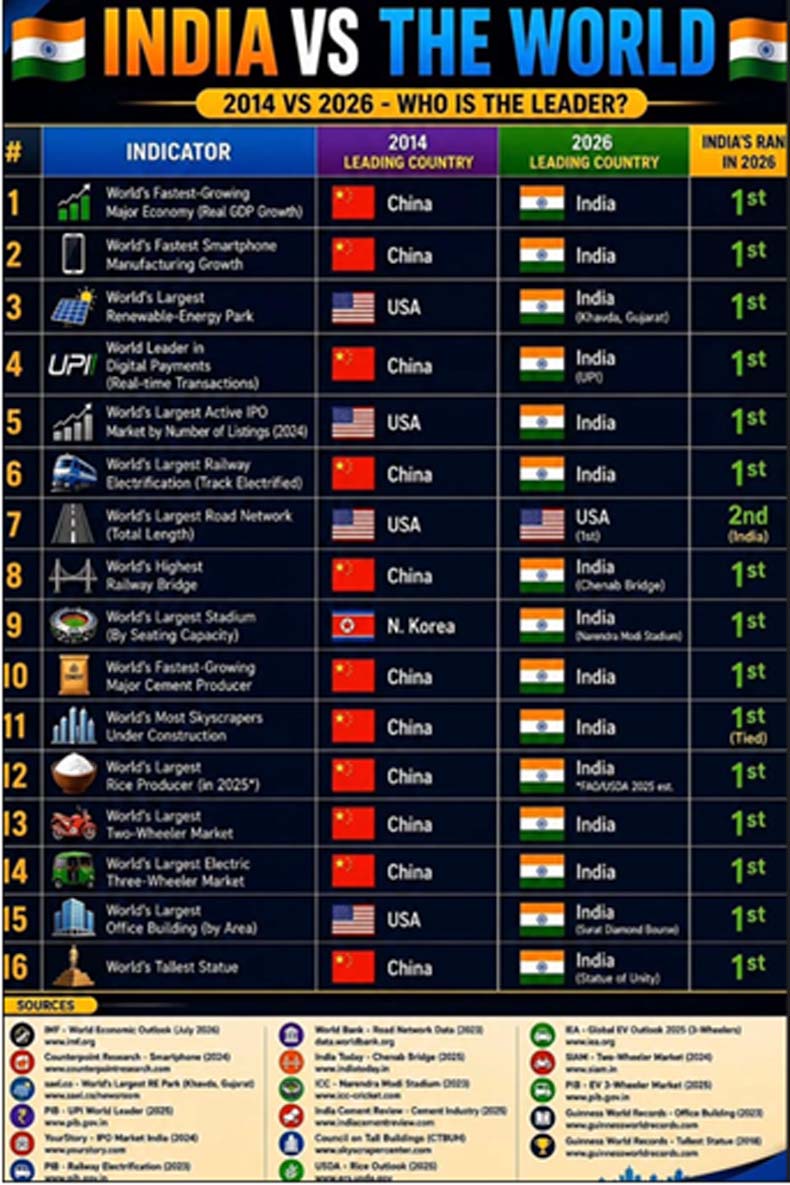
Somya Kant Ghosh, in his incisive article, “Less Unequal than Anyone Else,” published in The Economic Times on 21 November 2026, aptly highlights the World Bank’s recognition of India’s significant progress in poverty reduction. Extreme poverty, measured against the international poverty line of $3 per person per day (2021 PPP), declined sharply from 27.1% in 2011–12 to 2.6% in 2023–24, lifting millions of people out of extreme deprivation. More significantly, India has secured the top position in the World Bank’s latest Poverty and Inequality Platform (PIP) database. Certainly welcome, but much more needs to be done.
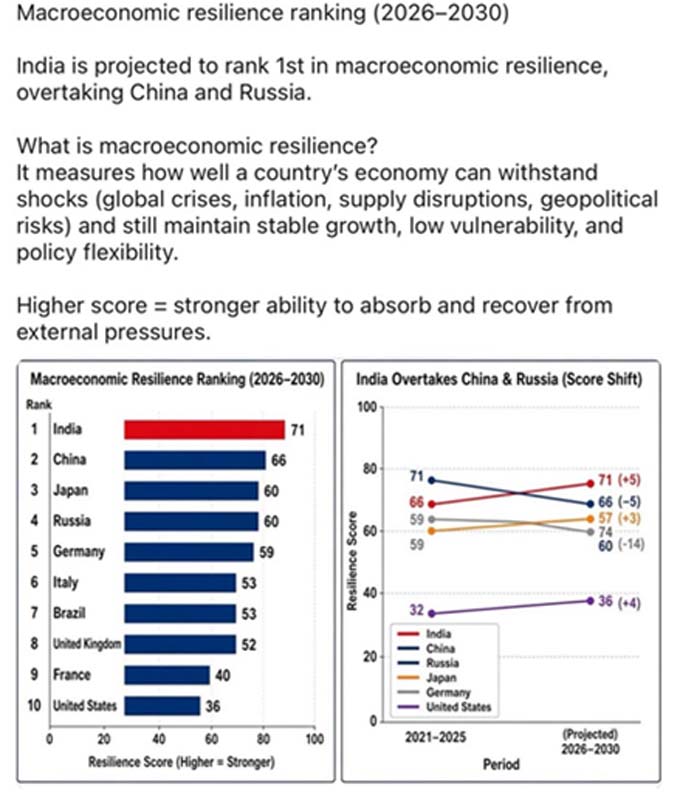
However, inflation above the Reserve Bank of India’s tolerance ceiling, a widening external deficit and mounting expenditure pressures cause concern. India’s growth momentum remains impressive, but the central question is whether it can become more employment-intensive, internationally competitive and resilient to energy shocks.
Strong GDP growth but cautious forecasts
A Reuters poll published on 18 November estimated July–September GDP growth at 7.6%, with individual forecasts ranging from 6.6% to 8.2%. The lexicon of change suggests considerable resilience despite expensive energy and pressure on household budgets. Against this backdrop, the GDP release on 30 November evokes wide interest. We expect growth to moderate later in the financial year as earlier tax-cut benefits fade and borrowing costs weigh on spending. This distinction is important because strong headline growth does not automatically mean that prosperity is broad-based. Indeed, Goldman Sachs describes the private investment revival as concentrated in energy, materials and strategic manufacturing.
I strongly argued in my PhD thesis, series of articles in The Hindu Business Line, The Indian Banker, Bank Quest, The IMC Journal, speeches and press interviews that India’s revival must spread across smaller enterprises and labour-intensive industries, rather than relying disproportionately on public infrastructure and a few capital-heavy sectors.
Industrial growth: encouraging, but skewed
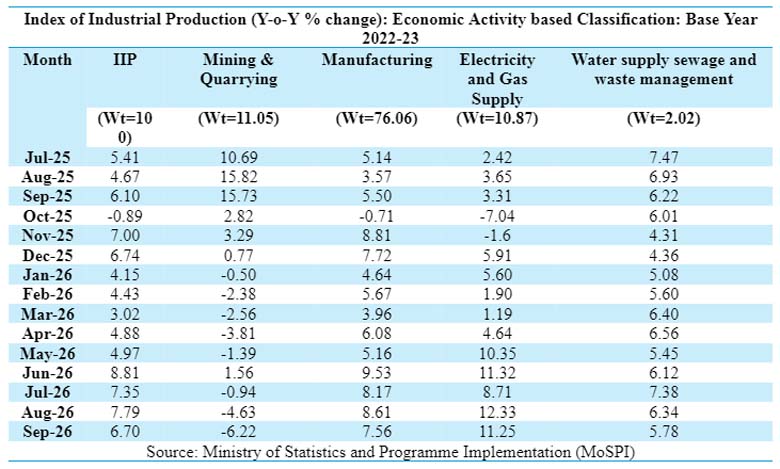
Industrial production grew 6.7% year-on-year in September, slowing from 8.0% in August. Manufacturing expanded 7.6%, while electricity and gas supply increased 11.2%; mining and quarrying contracted 6.2%. These figures are symptomatic of an industrial economy with substantial momentum and significant sectoral skew. More encouragingly, data released on 20 November showed that the nine core industries expanded 10.9% in October, against a final September growth rate of 8.2%. The index also rose 3.8% sequentially, showing that infrastructure-linked activity is gathering pace, although core-sector growth should not be confused with growth across the entire industrial economy. October’s broader industrial-production figures remain due on 30 November. The policy challenge, therefore, transcends higher output to deepen domestic supply chains, improve productivity and translate industrial expansion into sustained employment.
 Fiscal deficit: expenditure quality critical
The Union government’s fiscal deficit reached ₹7.14 lakh crore during April–September 2026, equivalent to 42.1% of the annual budget estimate, compared with 36.5% at the corresponding point last year. The full-year budgeted deficit is approximately ₹16.96 lakh crore. Importantly, 42.1% refers to the share of the annual borrowing-gap target already used—not the deficit as a percentage of GDP. But capital expenditure reached ₹6.55 lakh crore, or 53.6% of its annual allocation. Nevertheless, interest payments absorbed ₹6.46 lakh crore, illustrating how past borrowing restricts present choices. Food and fertiliser subsidy expenditure also increased compared with the corresponding period last year.
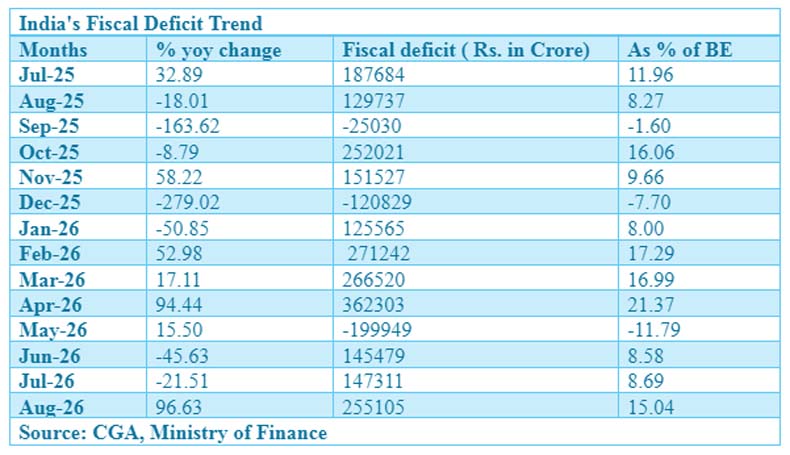
Contrary to popular perception, a burgeoning fiscal deficit does not require indiscriminate austerity but selective consolidation. As I have repeatedly demonstrated- far too numerous to list here- productive infrastructure and essential social expenditure should be protected, while poorly targeted support and inefficient projects face scrutiny. Half-year figures alone do not establish annual slippage; the Controller General of Accounts (CGA) rightly cautions that receipt and expenditure timing can distort interim comparisons.
Widening current account deficit (CAD) despite improving sentiment
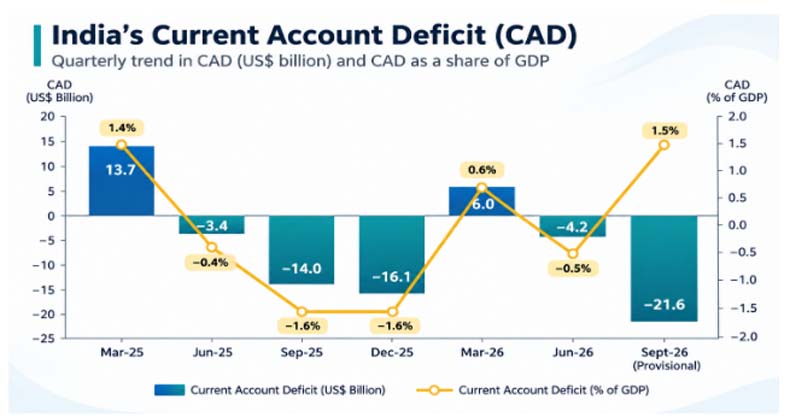
Balance-of-payments figures showed the CAD widening to $25.8 billion during April–September, from $18 billion a year earlier. The merchandise trade deficit rose to $176.1 billion, while stronger services earnings and transfers, including remittances, provided partial offsets. A deteriorating trade deficit is often seen as economic weakness. Expanding domestic activity can, however, increase imports. Nevertheless, the uncertain external situation exposes India to external financing conditions. There is a substantial overall balance-of-payments surplus, supported heavily by banking capital inflows. We shouldn’t confuse easy access to capital with genuine trade competitiveness. The real goal isn’t just pulling in enough foreign money to pay for a growing import bill; it is building a durable export engine that can stand on its own.
BSE, rupee and oil: a welcome financial reprieve
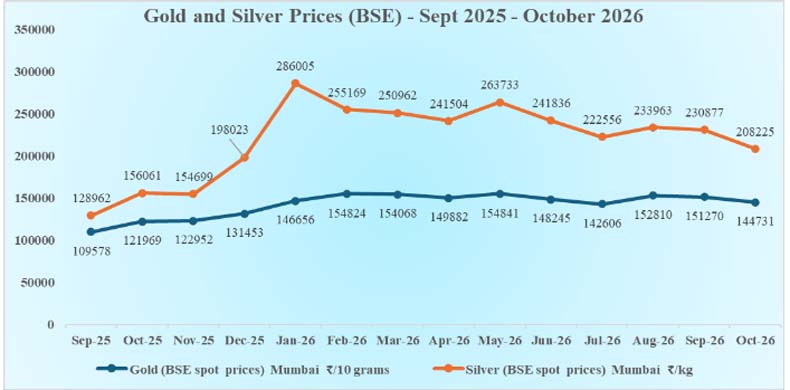
The BSE Sensex closed on 20 November at 83,919.71, gaining 2.85% over the week. The market report recorded four consecutive weekly advances, with domestic equities rising around 14% across that period. Foreign investors invested ₹1.01 trillion in Indian equities during the first fortnight of November, with financial services attracting more than half. While this is encouraging, the rally’s composition is uneven. Banks accounted for nearly 90% of the increase in the market value of NSE-listed companies during the latest week.
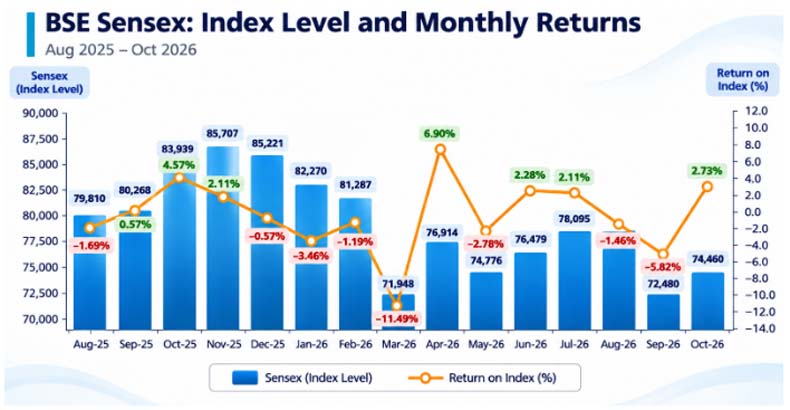
A banking-led, liquidity-supported rally cannot by itself demonstrate an economy-wide improvement in earnings or living standards. Gurumurthy’s article, “It’s Time for India to Outperform” (The Hindu Business Line, November 14, 2026), argues that technical and ratio analysis point to a potential bullish breakout in the Nifty above 26,500 next year. Having traded largely within the 22,000–26,500 range, the index needs a sustained breach of the upper threshold to establish a stronger upward trajectory. Ratio charts also suggest that US equity outperformance may be losing momentum, creating an opportunity for Indian equities to outperform the Dow Jones and S&P 500 over the next year.
However, this assessment rests exclusively on technical indicators rather than fundamental or macroeconomic modelling. Chart breakouts indicate probabilities, not certainties, and failed attempts to cross major resistance levels can trigger sharp corrections. While domestic economic stability and foreign capital inflows offer support, geopolitical tensions in West Asia remain a source of near-term volatility. The analysis should therefore be viewed as an encouraging technical perspective, not a definitive market forecast or standalone investment signal. Risk management and evolving global capital flows remain critical.
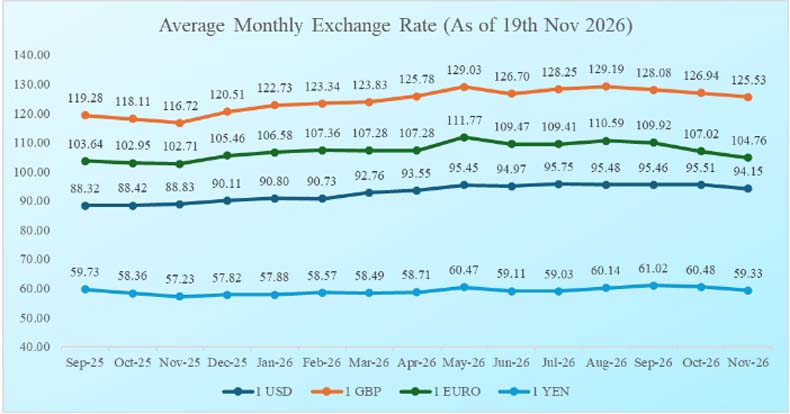
The rupee strengthened to approximately ₹92.675 per US dollar on 20 November, appreciating 0.67% that day.
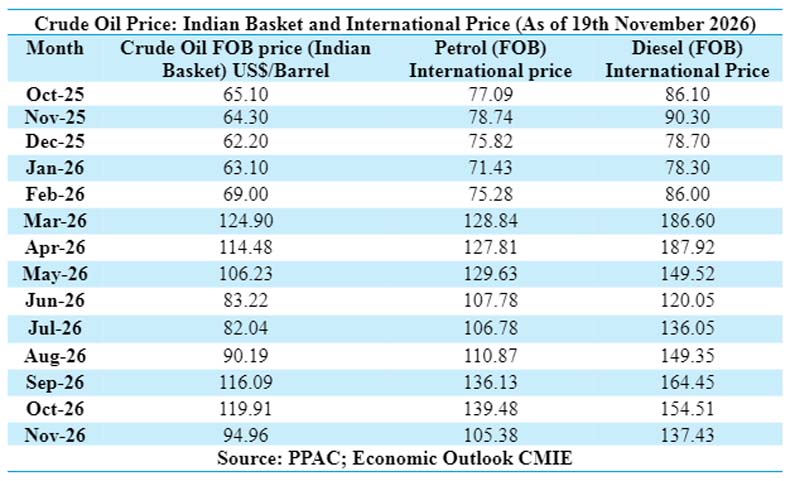
Brent crude traded around $91–92 a barrel during the session. Foreign inflows and easing commodity prices supported the improved financial mood.
 Testing times and the roadmap ahead
The inflationary spiral is causing concern and consternation. October retail inflation reached 6.09%, exceeding the RBI’s 6% upper tolerance limit and exacerbating economic pain. Food and transport costs were key drivers, with high oil prices and weather-related food pressures also contributing. An analytical article published in The Hindu on November 19, 2026, titled “The Average Cost of a Thali Has Jumped Up by 16% in 10 Months”, highlights how rising food inflation has increased the cost of meals, compelling households to allocate a larger share of their wages to food expenses. This squeezes household purchasing power and limits room for growth-supporting monetary easing, as long discussed in the theory and practice of Economics. With retail inflation breaching the 6% threshold and global headwinds persisting, the RBI may raise rates in its upcoming December 2026 Policy.
Grammar of Development
A credible roadmap has four priorities.
First, tackle supply constraints through food logistics, storage, irrigation and energy efficiency. Monetary policy must preserve credibility, but interest rates alone cannot resolve food shortages or imported energy costs.
Second, make manufacturing more productive and export-oriented. Research reported on 18 November (Foundation for Economic Development (FED) report on industrial tariff policy) found Indian import duties nearly three times those in China and Vietnam, underlining the tension between protecting domestic producers (no longer “infant industry” argument!) and giving exporters competitively priced inputs. Tariff rationalisation should accompany simpler compliance and more reliable logistics for exports to steadily rise.
Third, preserve fiscal credibility without sacrificing productive investment. Better project selection and transparent expenditure management offer a stronger route than abrupt capital-spending cuts.
Finally, judge success through employment, real household incomes and private investment—not GDP and share indices alone.
The past month has certainly brightened India’s growth story, yet lasting progress depends on translating market optimism into stronger businesses, affordable everyday essentials, and better jobs. In this Chakravyuh (maze) of global uncertainty, unfamiliar problems, geoeconomic fragmentation, deluge of information and rapidly evolving AI, the syntax of transformation requires synchronised and concerted action by all stakeholders with a sense of urgency to discernibly alter the ground realities and create meaning and value in the lives of the poor, the marginalised and the vulnerable sections of society- what Mahatma called, “the teeming millions” of India. The task is difficult but by no means insurmountable. As Berton Braley (1882 – 1966) wrote in his famous poem Opportunity,
“With doubt and dismay you are smitten
You think there’s no chance for you, son?
Why, the best books haven’t been written
The best race hasn’t been run,
The best score hasn’t been made yet,
The best song hasn’t been sung,
The best tune hasn’t been played yet,
Cheer up, for the world is young!”
ABOUT THE AUTHOR
 Dr. Manoranjan Sharma has been the Chief Economist for 25 years with Canara Bank and Infomerics Ratings.
Globally recognised as an expert in global economy, Indian economy, banking, finance, MSMEs, sustainable development and financial inclusion, he has chaired sessions at national and international conferences and is recognised as one of the 30 global experts by the UN Virtual University (UNVU) for SDGs.
He has been on over a dozen Advisory Councils in seven states, viz. Member, Rajasthan Governor’s Advisory Council; Governor’s Senate Nominee on Rajasthan University; Governor’s Senate Nominee on SNDT University, Mumbai; and Expert on selection panels for IIMs, Vijay Patil School of Management, SAIL, IDBI Bank, Canara Bank, Bank of India, Union Bank of India.
He has been published widely and quoted extensively in major Indian and international media and publications.