India’s Global Oil Diplomacy and the Quest for Strategic Autonomy
Energy: The New Currency of National Power
The security of a nation is no longer measured exclusively by the strength of its armed forces, the sophistication of its weapons or the size of its economy. Increasingly, it is also determined by its ability to secure uninterrupted access to energy. Oil fuels military logistics, moves commercial transportation, sustains industries, supports agriculture and keeps the wheels of a modern economy turning. A disruption in energy supply can therefore become an economic crisis, a national security challenge and, ultimately, a strategic vulnerability.
For India, this challenge is particularly consequential. With a population exceeding 1.4 billion, an expanding manufacturing base, rapidly growing mobility requirements and ambitions of becoming a developed economy by 2047, its appetite for energy will continue to rise. India is already the world’s third-largest consumer of oil and imports more than 90 per cent of its crude oil requirements according to a 2026 assessment by EY. The country consumed approximately five million barrels of oil per day in recent years, with demand expected to grow further.
This dependence is not merely an economic statistic. It is a strategic exposure. Every barrel imported carry with it questions of price, availability, shipping, insurance, political stability and the reliability of the supplying country. The ability to secure energy at affordable prices, through dependable routes and from multiple sources is therefore integral to India’s strategic autonomy.
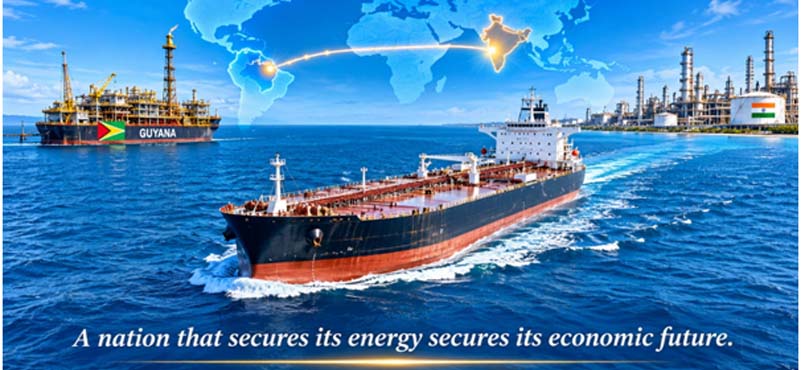
The recent emergence of Guyana as a potential long-term energy partner offers an interesting window into how India is approaching this challenge. It is not simply another oil purchase. It is a signal of a larger strategic reorientation.
India’s Energy Vulnerability: The Cost of Dependence
India’s energy vulnerability is rooted in a structural imbalance between domestic production and consumption. Domestic crude oil production has been declining, falling from 34.2 million metric tonnes in 2018–19 to 28.4 million tonnes in 2024–25. Meanwhile, consumption of petroleum products grew at approximately four per cent annually over the 2014–24 period.
The consequences extend well beyond the oil industry. A sustained rise of $10 per barrel in crude prices can add billions of dollars to India’s annual import expenditure, depending on the volume imported and the exchange rate. It can increase inflationary pressures, widen the current account deficit, weaken the rupee and raise transportation and manufacturing costs. Energy shocks are ultimately transmitted to the ordinary household.
Geography compounds this vulnerability. A substantial proportion of India’s crude imports has traditionally originated in West Asia, with shipments exposed to the Strait of Hormuz and the wider Indian Ocean maritime environment. The Centre for Energy, Environment and Water has estimated that approximately 50–60 per cent of India’s crude oil imports pass through the Strait of Hormuz.
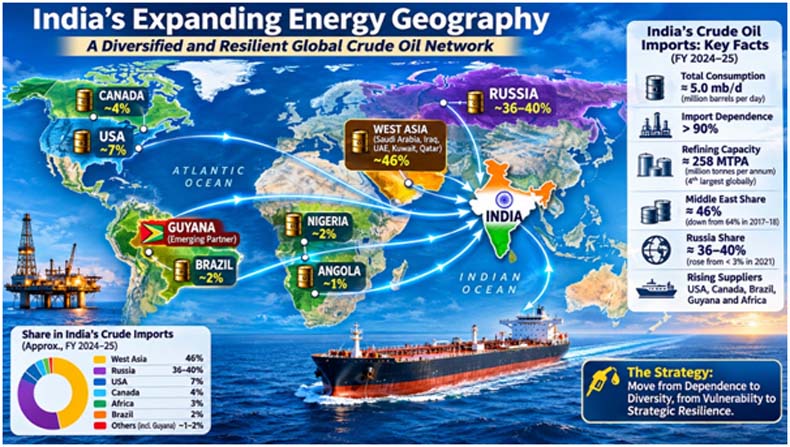
The Russia–Ukraine conflict demonstrated how rapidly the international oil market can be rearranged by geopolitics. Russia’s share in India’s crude imports rose from less than three per cent in 2021 to nearly 40 per cent in 2023. More recently, India’s sourcing geography has expanded further. The share of the Middle East in India’s crude imports declined from 64 per cent in 2017–18 to 46 per cent in 2024–25, while Eurasia emerged as a major supplier region.
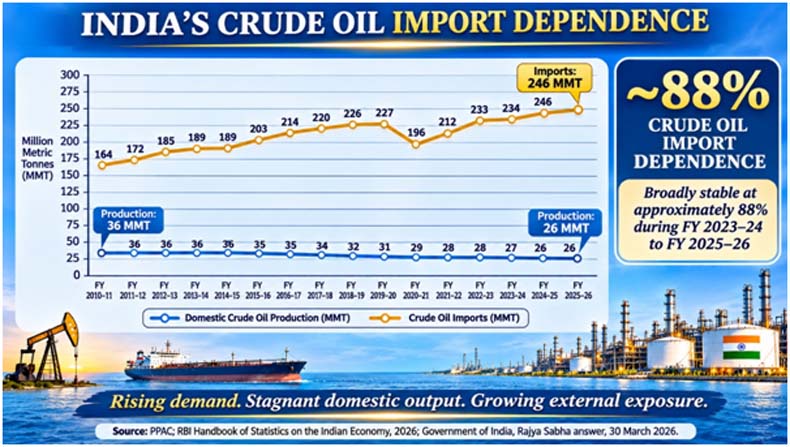
The lesson is unmistakable. Dependence on a single region, supplier or maritime corridor can constrain national choices. Diversification is not merely a commercial preference; it is strategic insurance.
Guyana: A New Atlantic Opportunity
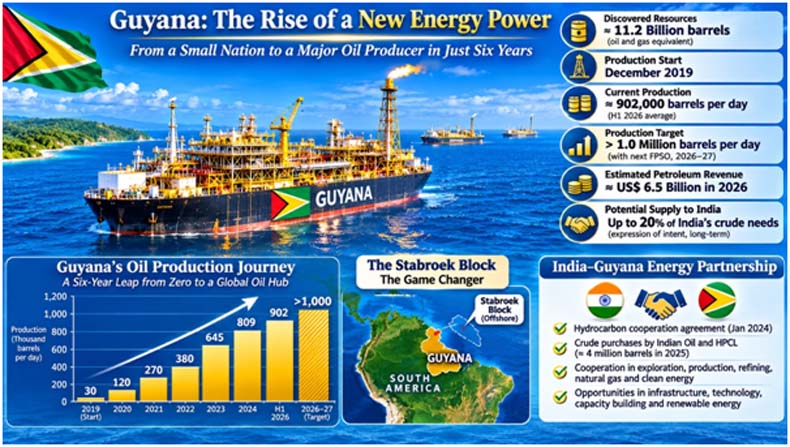
Guyana has emerged as one of the most consequential new oil-producing nations of the twenty-first century. A country on the northeastern coast of South America, with a population of less than one million, it has discovered approximately 11 billion barrels of oil and gas equivalent resources offshore, principally in the prolific Stabroek Block. Its transformation has been extraordinary.
Production began in December 2019. By August 2025, the commissioning of the fourth floating production, storage and offloading vessel, One Guyana, had taken installed national production capacity beyond 900,000 barrels per day. In the first half of 2026, average daily production reached approximately 902,000 barrels, with output expected to cross one million barrels per day following the arrival of the fifth FPSO.
The scale of this transformation is reflected in the country’s economic performance. Guyana’s crude exports generated approximately US$15.05 billion in the first six months of 2026 alone. Its government projected petroleum revenues of nearly US$6.5 billion for the full year.
For India, Guyana represents something more valuable than an additional source of crude. It opens an Atlantic dimension to India’s energy geography, providing access to a rapidly expanding production centre outside the traditional West Asian supply network.
India’s engagement is not new. A hydrocarbon cooperation memorandum was approved in January 2024, covering crude sourcing, exploration and production, refining, natural gas, capacity building and clean energy. During his November 2024 visit, Prime Minister Narendra Modi reinforced the strategic importance of this relationship. Indian Oil Corporation and HPCL subsequently purchased two million barrels each of Guyanese crude in 2025.
In November 2026, Guyana’s High Commissioner indicated that his country could potentially supply up to 20 per cent of India’s future crude requirements. This is an ambitious expression of intent, not a concluded long-term supply commitment. Nevertheless, it places the emerging relationship in a much larger strategic context.
From the Persian Gulf to the Americas
Guyana must not be viewed in isolation. It is part of a broader Indian effort to establish energy relationships across continents and geopolitical blocs. India’s energy diplomacy is gradually becoming global in character, involving traditional suppliers as well as emerging producers.
West Asia remains indispensable, with Saudi Arabia, Iraq, the UAE, Kuwait and Qatar occupying important positions in India’s energy architecture. Russia has become a major supplier since 2022, demonstrating the importance of maintaining commercial relationships across political divides. The United States has emerged as an important source of crude and liquefied natural gas. Africa offers opportunities through Nigeria, Angola and other producers, while Brazil, Guyana, Canada and potentially other Latin American economies provide additional options.
This geographical expansion has a strategic logic. Oil-producing countries are not necessarily located in politically stable neighbourhoods, and their export infrastructure is not immune to conflict. A diversified supplier base allows India to respond to disruptions, negotiate better commercial terms and avoid becoming captive to the political calculations of any single region.
The opportunity is considerable. India’s refining capacity reached approximately 258 million tonnes annually in 2024–25, making it the world’s fourth-largest refining nation. It also exports substantial quantities of refined petroleum products, including diesel, petrol and aviation turbine fuel. This gives India a significant commercial advantage: it can purchase crude from diverse geographical sources, process it domestically and supply finished products to international markets.
However, geographical diversification must be accompanied by technical diversification. Different crude grades have different sulphur content, density and processing characteristics. Not every refinery can economically process every variety of crude. India’s ability to diversify suppliers must therefore be matched by investments in refinery flexibility, storage, blending and logistics.
The objective should be to create an energy network in which India has choices, alternatives and negotiating strength.
From Crude Purchases to Global Energy Partnerships
There is a significant difference between buying oil and securing a stake in its production. India must gradually move from being predominantly a large energy consumer to becoming an influential participant in the global energy value chain.
The Guyana opportunity is particularly suitable for this transition. Its offshore petroleum sector is dominated by the ExxonMobil-led consortium, comprising ExxonMobil, Chevron through Hess and China’s CNOOC. The Stabroek Block alone has approximately 11 billion barrels of discovered recoverable resources. ExxonMobil operates the block with a 45 per cent interest, while Chevron and CNOOC hold 30 and 25 per cent respectively.
India should explore meaningful participation through ONGC Videsh, Indian Oil, Oil India and other capable public and private sector entities. Participation in exploration, production, offshore engineering, storage infrastructure and associated services could provide India with long-term commercial interests rather than dependence on spot-market purchases.
There is also an opportunity for a mutually beneficial partnership. Guyana needs infrastructure, skilled manpower, healthcare, technology, connectivity and institutional capacity to manage its rapidly expanding economy. India has considerable experience in these areas. Its strengths in engineering, digital public infrastructure, pharmaceuticals, construction and human resource development can complement Guyana’s natural wealth.
The proposed supply of 20 per cent of India’s crude requirements deserves scrutiny. At five million barrels per day of Indian consumption, this would translate into approximately one million barrels daily. That is almost equivalent to Guyana’s entire projected national production in 2026. It cannot realistically be treated as an immediately available export commitment. Production growth, domestic requirements, existing contracts, consortium entitlements, commercial arrangements and competing buyers will determine what can be supplied.
The opportunity, therefore, lies in building a phased, commercially viable partnership rather than pursuing an attractive but potentially unrealistic headline number.
India must become a partner in the energy business, not merely a customer at its receiving end.
The Geopolitics of Oil, Oceans and Strategic Autonomy
Energy diplomacy is inseparable from geopolitics. The location of oil reserves, the ownership of production infrastructure, the security of shipping lanes and the political relationships between producing and consuming nations collectively determine the reliability of energy supplies.
Guyana illustrates this complexity. Its oil wealth is concentrated offshore, in a region affected by the long-standing territorial dispute with Venezuela over the Essequibo region. The International Court of Justice has been hearing the dispute, and provisional measures have been issued to prevent actions that could alter the situation on the ground pending its final judgment. The oral hearings concluded in May 2026, with a final judgment awaited.
This is not a peripheral concern. Any escalation could affect investor confidence, offshore operations and regional maritime security. India’s engagement must therefore be grounded in international law, respect for sovereignty and a peaceful resolution of disputes.
There is another strategic dimension. Guyanese crude must travel across the Atlantic and Indian Ocean to reach Indian refineries. Longer shipping distances mean higher freight exposure, tanker availability requirements and potentially greater insurance costs. A new geographical source does not automatically create a more secure or economical supply chain.
India must accordingly strengthen its maritime logistics, strategic petroleum reserves, shipping capabilities and commercial relationships with tanker operators. Its energy security cannot end at the oilfield; it must extend all the way to the refinery gate.
The larger strategic objective is to ensure that no single geopolitical crisis can hold India’s economic functioning hostage.
The Energy Security without Mortgaging Future
A strategy built exclusively around acquiring more oil would be incomplete. The world is moving towards a different energy architecture, even as hydrocarbons remain essential to transportation, petrochemicals, aviation, defence and industrial production.
India must therefore pursue a dual-track approach: securing adequate conventional energy supplies while reducing the economy’s vulnerability to imported fossil fuels. Its commitments include reducing the emissions intensity of GDP by 45 per cent from 2005 levels by 2030 and achieving approximately 50 per cent of installed electricity capacity from non-fossil sources.
Renewable energy, nuclear power, green hydrogen, biofuels, ethanol blending, electric mobility and compressed biogas must all become integral components of the national energy strategy.
Guyana itself offers an interesting opportunity for cooperation beyond petroleum. The existing bilateral framework includes renewable energy and biofuels. India could contribute solar technology, capacity building, digital systems and expertise in energy infrastructure while Guyana develops its petroleum economy.
The objective is not to choose between oil and renewables. It is to ensure that India has sufficient energy today without compromising its ability to transition tomorrow.
A country that diversifies its energy sources but fails to reduce its overall energy vulnerability has only addressed half the challenge.
India’s Energy Doctrine: Dependence to Resilience
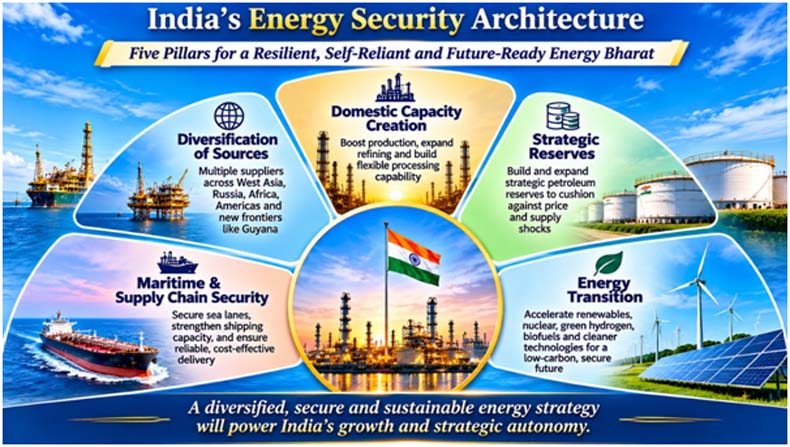
The Guyana engagement should prompt India to articulate a more comprehensive energy doctrine. Its foundation must rest on five priorities: diversification of suppliers, overseas investment in energy assets, resilient maritime supply chains, domestic production and accelerated transition to alternative energy.
India should pursue long-term supply arrangements wherever commercially viable, acquire stakes in strategically important overseas assets, expand storage capacity and make its refineries more adaptable to different crude grades. It should also strengthen partnerships with emerging producers across Africa, Latin America, North America and the Indo-Pacific.
Equally important is the institutional coordination of energy diplomacy. The ministries of petroleum, external affairs, finance, commerce and defence must approach energy security as an interconnected national priority. Commercial decisions must be supported by geopolitical assessments, maritime planning and strategic risk management.
India’s experience with Russia, the Gulf and now Guyana demonstrates that energy relationships cannot be reduced to ideological preferences or temporary diplomatic alignments. They must be guided by national interest, affordability, reliability and strategic flexibility.
The coming decades will witness intense competition for energy resources, infrastructure, technology and supply chains. India’s economic ambitions will require dependable access not only to oil but also to gas, critical minerals, electricity and emerging energy technologies. Its diplomatic outreach must anticipate these requirements rather than react to crises after they occur.
The Strategic Imperative
Guyana may be geographically distant from India, but its significance lies in the strategic possibilities it creates. It represents an emerging Atlantic connection in India’s expanding energy network and demonstrates how economic diplomacy can be converted into national strategic advantage.
India’s challenge is not simply to find enough oil. It is to ensure that its growth, industrial ambitions, military preparedness and economic stability are never compromised by the political instability of a producing region, the vulnerability of a shipping route or the commercial decisions of a handful of suppliers.
The next energy crisis may not announce itself in advance. India must prepare for it through partnerships, investments, infrastructure and strategic foresight.
A nation that cannot secure its energy cannot fully secure its destiny. India must not merely buy energy from the world; it must build the global relationships that secure its access to energy.
ABOUT THE AUTHOR

Lt Gen Rajeev Chaudhry (Retd) is a social observer and writes on contemporary national and international issues, strategic implications of infrastructure development towards national power, geo-moral dimension of international relations and leadership nuances in changing social construct.