The Quad brought substance to Manila and the G3 brought optics to Shenzhen. Together they point to an emerging multipolar world that India must navigate with skill.
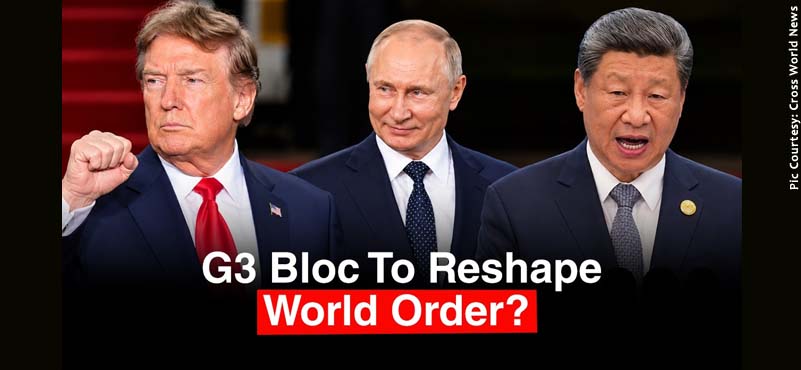
The season of summits is on. Donald Trump attended a Quad leaders’ summit in Manila on November 17, along with PM Modi and their Australian and Japanese counterparts. Two days later, he took part in a much-hyped, first-ever “G3” summit of the United States, China and Russia in Shenzhen. Next month, the G20 gathers in Florida. At one level, these meetings are competing scripts for governing a multipolar world. Read together, they also show shifting power dynamics and how Washington is balancing its commitments.
Manila: a Quad that did its homework
The Quad has been written off several times. It went dormant for a decade after 2007, was revived by officials in Manila in 2017, rose to leaders’ level in 2021, and then went more than two years without a summit. It was fitting that it returned to Manila, on the sidelines of the ASEAN summit, for its first leaders’ meeting since September 2024. The leaders marked nearly ten years since the Quad’s revival and a decade since the late Japanese Prime Minister Abe Shinzo set out his vision of a “free and open” Indo-Pacific.
For Washington, Manila was an act of balancing. Before sitting down with America’s two principal rivals, Trump renewed his commitment to the democracies at the four corners of the Indo-Pacific. What set Manila apart from Shenzhen was preparation. Five Quad foreign ministers’ meetings have been held in Trump’s second term: in Washington the day after his inauguration in January 2025 and again that July, then in New Delhi in May this year, in Manila in July and in Atlanta at the end of October. That ministerial groundwork showed in the results.
The agenda was constructive, and it now extends to commerce. The leaders announced the first Quad Business Leaders’ Forum, an Indian proposal, to meet in Mumbai in early 2027 and bring executives, officials and policy experts together to build private-sector ties and promote commercial deals. They endorsed the Super Intelligence Accelerator announced by their foreign ministers in Atlanta, which will coordinate and fund access to trusted AI across the region. Yet back at the White House on November 20, Trump talked down the plan, insisting that the US means to stay the front runner in the AI race, against China and within the Quad, and threatening a “tremendous tax” on American companies that build data centres abroad. They launched an Indo-Pacific Maritime Surveillance Collaboration, under which Quad P-8 and P-3C patrol aircraft will fly a joint exercise in 2027, the first of its kind in a Quad context. The cable partnership was expanded, with Australia adding electricity cables and new undersea projects planned in the Indian Ocean, and cybersecurity cooperation was stepped up.
The statement was clear on security. It opposed any attempt to change the status quo by force or coercion, voiced concern about arbitrary export restrictions, and condemned terrorism in all forms, including cross-border terrorism. The line on export restrictions was widely read as aimed at China’s grip on rare earths; the language on cross-border terrorism was New Delhi’s. Trump chose to stand with his Quad partners before flying to Shenzhen, and allies who had worried about a deal over their heads were reassured, at least for now.
Shenzhen: the symbolism of three
The G3 summit was unprecedented and heavy with history. Xi recalled the three countries fighting “shoulder to shoulder” as the key anti-fascist forces more than 80 years ago. Even before that, the summit invited talk of a Yalta 2.0, a replay of the 1945 conference where the wartime victors divided Europe into spheres of influence. It also let China present itself as a co-victor of that war, on the strength of its resistance to Japan: a pointed message, as Japan’s Prime Minister Sanae Takaichi left Shenzhen without a one-on-one meeting with Xi.
Still, the spheres-of-influence case is overstated. Some in the MAGA camp would welcome a world divided into hemispheres: the US retreating to the Western Hemisphere, Russia given more room in Europe, and China more room in the Indo-Pacific, including on Taiwan. Shenzhen did not deliver that. For all his warm words for Putin and Xi, Trump did not openly abandon core US positions on Taiwan or other partners that Moscow and Beijing regard as within their spheres.
The hurriedly assembled outcome document, the Declaration toward Peace, covered four areas. On UN reform, the three, as permanent members of the Security Council, committed to reforming the UN so it can better meet global challenges and its core mission of peace and security. On energy, they pledged to raise production and supply of refined petroleum products for all nations and stressed stable energy flows. On sovereignty, they warned the International Criminal Court and similar bodies against overreaching their jurisdiction. On nuclear risk, they reaffirmed that a nuclear war “cannot be won and must never be fought” and agreed to a dialogue on reducing nuclear risks and preventing proliferation.
Each point deserves a closer look. UN reform led by three permanent members could easily mean reform that protects their privileges instead of expanding the Council. The energy clause reflects disrupted Gulf supplies. The ICC clause marks a convergence among three powers that have never joined the court. The nuclear language repeats a 1985 Reagan–Gorbachev formula but sets up no framework. Even so, the meeting itself represented a trilateral détente of the kind Washington and Moscow attempted during the Cold War to reduce nuclear risks and manage their differences.
The bilaterals revealed the real dynamics
The separate meetings said more than the joint text. Putin noted that he had discussed Ukraine with Xi the day before, and with Trump in their own meeting of about 40 minutes just ahead of the trilateral. Moscow and Beijing came to the table having already compared notes.
The third Trump–Xi meeting of the year was about managing competition. The two agreed to draw up an action plan for a “constructive relationship of strategic stability”, and Xi reportedly urged Trump to avoid setbacks on Taiwan. There was little headway on trade, where the truce now expires on 10 January 2027.
You can’t climb summits without sherpas
Shenzhen was held with very little preparation, and it showed. Manila had five ministerial meetings behind it; Shenzhen had a few weeks of working out an agenda and protocol for an idea first floated in September. The declaration left out the hardest questions, including Ukraine and Iran, and there was little concrete progress on any of the world’s crises.
Yet the meeting mattered, as did the issues it touched. The first is arms control. New START lapsed in February, leaving no binding limits on US and Russian arsenals for the first time in over half a century, while China’s arsenal keeps growing. A promised “dialogue” on nuclear risk will mean something only if it becomes a structured process with negotiators, timelines and verification.
The second is the two wars in which G3 members are belligerents: Russia in Ukraine and the United States in Iran. The best case would be a grand bargain of sorts. Russia, with China, could help Washington wind down the Iran war, while the US presses its mediation to end the war in Ukraine. Moscow and Beijing have influence in Tehran; Washington has influence in Kyiv.
None of this will happen in an 80-minute meeting. If Shenzhen gives way to working groups, special envoys and follow-up meetings, the G3 could become a useful crisis-management channel. If not, it will be remembered as a photo opportunity on the APEC sidelines.
The view from New Delhi
From India’s point of view, the Quad is real while the G3 is mostly optics, well short of the new global concert some observers warn about. The Quad delivers tangible goods to the region: maritime awareness, undersea cables, trusted technology, and a commercial agenda India will help shape as host of the Business Leaders’ Forum. The G3 so far offers declarations without delivery mechanisms.
India’s relations with two of the three G3 members are positive. The United States and Russia are strategic partners. China, despite the recent thaw at the border and in trade, remains India’s strategic rival.
That mix brings both risks and opportunities. The risk is a great-power condominium that decides questions of Asian security, nuclear order or UN reform without Asia’s other major powers at the table. India, while a strong advocate of reformed multilateralism, should be wary of any “UN reform” defined by three permanent members. The opportunity is that lower tension among the big three is good for India. A US–Russia thaw could ease the pressure India has faced over its ties with Moscow, and a stable US–China relationship reduces the risk of a regional crisis.
The answer lies in engaging all three on their own merits: making the Quad deliver, deepening the partnership with Washington, maintaining ties with Moscow, and managing Beijing with a mix of engagement and deterrence. The next stop is the G20 in Florida on December 14–15, where these conversations can be furthered. Manila was built by sherpas; Shenzhen was built on spectacle. India should bank the gains from the first and watch the second closely.
ABOUT THE AUTHOR
 Ajay Bisaria, former diplomat and Distinguished Fellow, ORF is an alumni of St Stepehen’s College. He was India’s High Commissioner to Pakistan and Canada, and Ambassador to Poland. He is a regular writer in all the mainline newspapers.