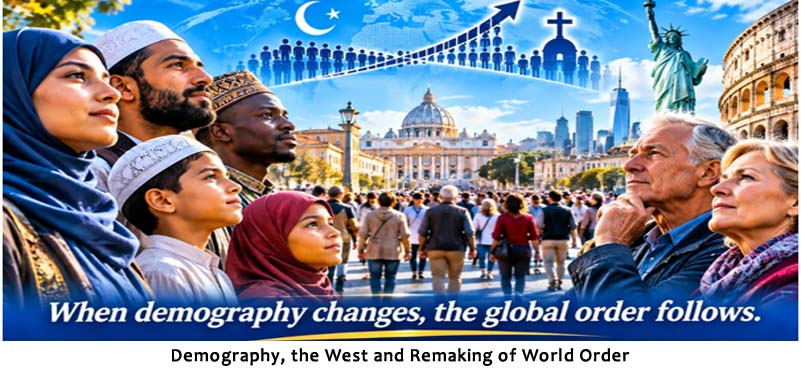
The rise of a religion may change population statistics. The response of societies to that rise may change politics. And the ability of nations to manage that transformation may ultimately determine the contours of the new world order.
The Great Demographic Reversal
History occasionally changes direction without the sound of a gunshot. Sometimes, the transformation begins in maternity wards, classrooms and migration corridors. The changing religious demography of the world may be one such transformation, with implications extending well beyond religion into politics, economics and international relations.
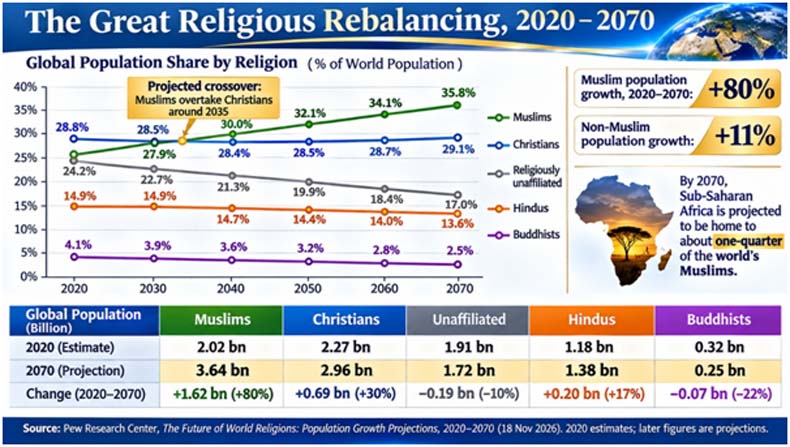
A new Pew Research Center study, released on 18 November 2026, projects that Muslims will overtake Christians as the world’s largest religious group by 2035. Between 2020 and 2070, the global Muslim population is expected to increase by approximately 80%, reaching 3.6 billion, or 36% of humanity. The Christian population will also grow, but at a considerably slower pace. The principal drivers are higher fertility, a younger age profile and geographical redistribution.
These figures represent a significant demographic transition, but they must be interpreted carefully. Population strength does not automatically translate into political influence, economic prosperity or military power. Nor does religious affiliation imply ideological uniformity. Nevertheless, when the world’s largest religious communities change in size and geographical distribution, the consequences inevitably extend into the international system.
The more consequential question, therefore, is not which religion will occupy the numerical first position, but how societies and political systems will respond to this transformation.
Europe’s Identity Crossroads
Europe presents perhaps the most consequential theatre of this demographic and cultural transition. For centuries, Christianity provided much of the continent’s cultural vocabulary, institutional foundations and civilisational identity. Yet Europe is changing, and the transformation is driven as much by secularisation as by immigration.
Pew projects that Christians will decline from 67.1% of Europe’s population in 2020 to 51.6% by 2070. Muslims are expected to increase from 6% to 12.7%, while the religiously unaffiliated will rise from 25.3% to 32.6%. The Christian decline is driven substantially by ageing, low fertility and people leaving religious affiliation. Migration contributes to Muslim population growth but cannot alone explain Europe’s changing religious composition.
This distinction is important because the debate is frequently reduced to immigration and Islam. The larger story is the gradual erosion of traditional religious identification alongside the emergence of more diverse societies.
France, Germany and the United Kingdom illustrate different aspects of this challenge. France’s assertive secularism, Germany’s integration debate and Britain’s multicultural experience reflect different approaches to accommodating religious diversity. Immigration, religious expression, national identity and social integration have increasingly become subjects of electoral politics. Populist movements have capitalised on anxieties about borders, cultural change and the perceived loss of national identity.
The danger lies in allowing legitimate concerns about integration, extremism and social cohesion to become generalisations about entire religious communities. Equally, governments cannot dismiss every concern as intolerance. Successful integration requires reciprocal responsibility: newcomers must respect constitutional values and civic obligations, while host societies must ensure equality, opportunity and freedom of worship.
Europe’s challenge is not simply demographic. It is whether a shared civic identity can remain stronger than competing cultural anxieties.
America: Assimilation or Accommodation?
America’s experience is different, although the underlying question is remarkably similar. Its national identity has historically been shaped by immigration, constitutional freedoms and the capacity to absorb diverse communities. The American experiment has never been free of racial, religious or cultural tensions, but its institutions have repeatedly demonstrated considerable adaptability.
The latest Pew projections suggest that Muslims could constitute nearly 5% of North America’s population by 2070, compared with 1.6% in 2020. In the United States, the Muslim share is projected to reach approximately 4%. More significantly, Christians are projected to fall below 50% of the population in both the United States and Canada. The religiously unaffiliated will account for a substantial part of this transformation.
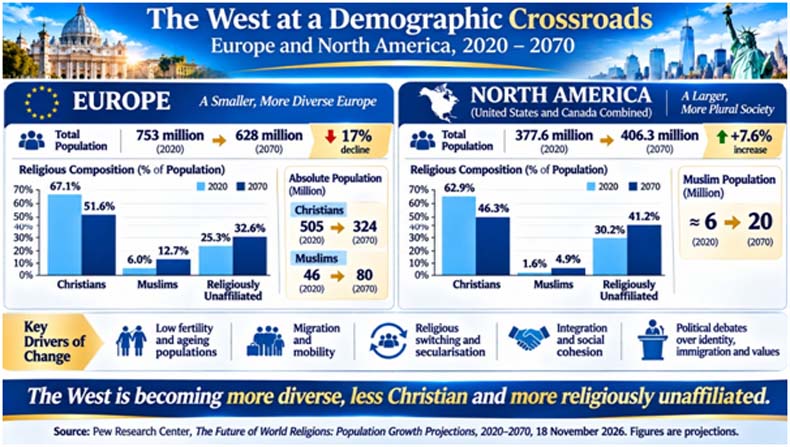
Thus, America’s religious transition is not an Islamisation story. It is a broader movement towards religious diversity and declining Christian identification.
Nevertheless, immigration, Islamophobia, religious freedom, national security and the politics of cultural identity will continue to influence American domestic debate. The challenge is to distinguish legitimate security concerns from religious profiling and to protect constitutional freedoms without compromising national security.
America’s institutional resilience will be tested not by the growth of any particular faith, but by its ability to accommodate changing identities without weakening the constitutional compact that binds its citizens.
Huntington Revisited: The Clash of Civilisations
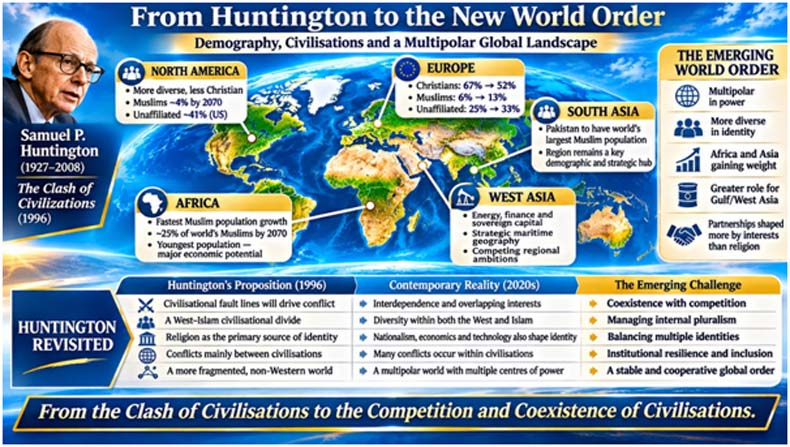
In 1993, American political scientist Samuel P. Huntington introduced an argument that would profoundly influence international strategic thinking. His essay, subsequently expanded into the 1996 book The Clash of Civilizations and the Remaking of World Order, proposed that the principal sources of conflict in the post-Cold War world would increasingly be cultural and civilisational rather than ideological. The fault lines between Western, Islamic, Sinic and other civilisations, he argued, would shape future international politics.
The disintegration of the Soviet Union had ended the bipolar ideological confrontation. Huntington suggested that culture, religion, history and collective identity would increasingly determine the alignment of nations. His identification of the Western-Islamic fault line attracted particular attention, especially after the September 11 attacks and subsequent conflicts in Afghanistan and Iraq.
Three decades later, his thesis deserves reconsideration.
There is evidence supporting his concerns. Religious identity has become an increasingly influential factor in domestic politics, migration debates and international relations. Cultural anxieties have contributed to political polarisation in Europe and America. Conflicts in West Asia have also demonstrated how religious narratives can become intertwined with territorial ambitions and geopolitical rivalries.
However, Huntington’s framework has significant limitations. Islam is not a unified political civilisation, just as the West is not a homogeneous ideological community. Sunni-Shia rivalries, competition between Muslim-majority states and divergent national interests expose the fragmentation within the Islamic world. Western disagreements over migration, trade, security and international intervention demonstrate similar divisions.
Empirical research has also questioned his proposition that conflicts between civilisations have become the dominant pattern of global conflict. Jonathan Fox’s quantitative study, published in the British Journal of Political Science in 2002, found that civilisational conflicts constituted a minority of ethnic conflicts and did not demonstrate the predicted increase in intensity.
Huntington was therefore perceptive in recognising the political significance of cultural identity, but less convincing in treating civilisational boundaries as the principal organising principle of international conflict.
Perhaps the more important development is that civilisations are increasingly interacting, competing and coexisting within the same national boundaries. The clash may not always occur between nations; it can also emerge within societies.
Beyond the West: The New Geopolitical Geography
The changing demography of Islam has another significant dimension: its geographical centre of gravity is gradually shifting.
Sub-Saharan Africa is expected to experience some of the fastest growth in Muslim populations. By 2070, approximately one-quarter of the world’s Muslims could live there. Pakistan is projected to replace Indonesia as the country with the largest Muslim population, while the Asia-Pacific region will continue to account for approximately half of the global Muslim population.
This redistribution has implications beyond religious statistics. Africa’s youthful population, expanding urban centres, natural resources and strategic maritime geography could increase its importance in global trade and diplomacy. Muslim-majority countries will become increasingly relevant as markets, investment destinations and partners in energy and infrastructure development.
West Asia will retain its strategic significance through energy resources, financial capital, maritime chokepoints and sovereign investments. Meanwhile, countries such as Türkiye, Saudi Arabia, Iran, Pakistan and Indonesia will continue to pursue distinct regional and international ambitions.
However, demographic expansion should not be mistaken for the emergence of a unified Islamic geopolitical bloc. National interests, competing ambitions and economic dependencies will continue to determine alignments.
China’s expanding engagement with the Gulf and Africa, Russia’s strategic outreach and the West’s continuing partnerships with Muslim-majority countries demonstrate that international relationships are increasingly determined by economic and security interests rather than religious affinity.
The changing geography of Islam could therefore strengthen the diplomatic importance of several emerging countries without necessarily producing a common political identity.
The Emerging World Order
The international system is already undergoing a transition from Western predominance towards a more distributed arrangement of power. The rise of China, India’s growing economic and strategic weight, the expanding influence of middle powers and the increasing importance of Africa are all contributing to this transformation.
Religious demography will form part of this larger transition, but it will not determine its outcome.
A youthful population can generate economic dividends through education, industrialisation, entrepreneurship and technological innovation. Conversely, without employment, institutional capacity and social stability, demographic expansion can create economic pressures, migration and political discontent.
The Muslim-majority world faces this strategic choice. Its demographic potential is considerable, but translating numbers into scientific achievement, technological capability, economic productivity and diplomatic influence requires sustained institutional development.
Europe and America face a different challenge. Their societies must manage demographic ageing, secularisation, immigration and changing cultural identities while preserving their economic competitiveness and political cohesion.
There is also a danger of self-fulfilling civilisational confrontation. If political establishments increasingly portray demographic change as an existential threat, they risk strengthening precisely those identity-based divisions they seek to contain.
The emerging world order will consequently be shaped by three simultaneous forces: the redistribution of economic and military power, the changing geography of populations, and the capacity of political institutions to manage cultural diversity.
India’s Strategic and Civilisational Response
For India, this transformation carries both strategic opportunity and domestic responsibility.
India has one of the world’s largest Muslim populations and a civilisational inheritance shaped by multiple religious and philosophical traditions. Its constitutional commitment to religious freedom and equality is central to its national identity and international credibility.
Externally, India’s engagement with the Islamic world must extend beyond traditional West Asian relationships. The Gulf remains indispensable for energy security, investment, trade and the welfare of millions of Indians. Indonesia and Bangladesh are important partners in India’s eastern strategic neighbourhood. Africa presents opportunities for connectivity, development partnerships, maritime cooperation and economic engagement.
India must also navigate the complexities of its relationship with Pakistan and the wider security implications of developments in Afghanistan and West Asia.
Its approach should be guided by strategic autonomy rather than religious alignment. India’s competitive advantage lies in its ability to engage diverse societies through economic partnerships, diplomacy and civilisational confidence.
A plural society that delivers prosperity, opportunity and social cohesion can become an important source of international influence. For India, the challenge is to ensure that internal diversity strengthens rather than complicates its external ambitions.
Beyond the Clash: A New Civilisational Compact
The changing religious demography of the world should not be viewed as a contest for civilisational supremacy. Christianity, Islam, Hinduism, Buddhism and other faith traditions have shaped humanity’s intellectual, cultural and ethical inheritance. Their demographic trajectories will change, but their collective contribution to civilisation cannot be measured through population rankings.
Huntington may have identified an important fault line in international relations, but humanity is not condemned to follow it. The greater test lies in reconciling identity with tolerance, faith with modernity and national interests with international responsibility.
The West must learn to accommodate changing societies without abandoning its democratic foundations. Muslim-majority nations must convert demographic potential into education, innovation and prosperity. Emerging powers must resist the temptation to turn cultural differences into instruments of geopolitical confrontation.
The future will not belong to the largest religion or the loudest civilisation. It will belong to societies that can transform diversity into strength and difference into cooperation.
Huntington predicted a clash of civilisations; the greater challenge before humanity is to prevent a changing world from becoming a divided one.
ABOUT THE AUTHOR
Lt Gen Rajeev Chaudhry (Retd) is a social observer and writes on contemporary national and international issues, strategic implications of infrastructure development towards national power, geo-moral dimension of international relations and leadership nuances in changing social construct.