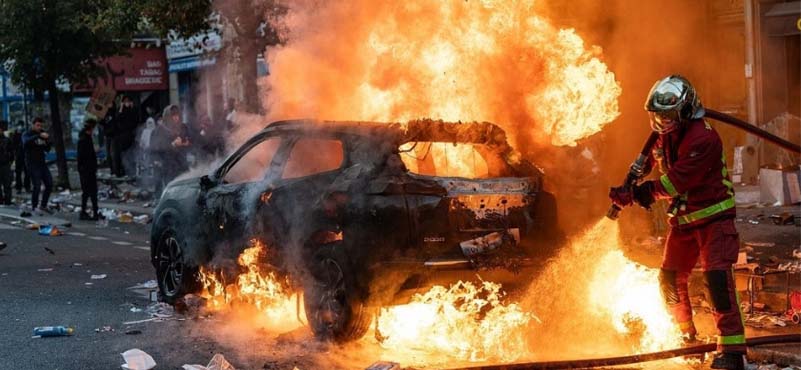
France is burning again, and the easy explanation is the wrong one. In the first week of October, student protests and school riots had disrupted over 700 secondary schools, with roughly 5,000 arrests reported. On Saturday 17 October, about 550,000 people marched nationwide, according to the Interior Ministry. Most were peaceful. A minority looted shops, attacked public buildings and fought the police. The historic town hall at Limoges was largely destroyed by fire.
The spark was small. The movement began last month in high schools in the working-class northern suburbs of Paris. The complaints were ordinary: too few teachers, poor buildings, exhausting timetables. No government falls over such things. But the protests landed in the same weeks as a nationwide public sector strike against the 2027 budget, which carries a 54 billion euro package of cuts and tax measures and, according to unions, a fourth consecutive freeze on civil service pay scales. Then the yellow vests joined, the movement that took to the streets in 2018 over living costs and inequality. Three separate angers became one. A historian of contemporary France called that the worst possible outcome for the government.
The students grasp the logic of their own tactics. One protester in Lille told CBC News that fire forces a government to listen. That should worry every capital. It means peaceful pressure is no longer believed to work, and that disorder has become the only language the state is thought to hear.
Why has the ordinary channel failed? Political paralysis since the 2024 parliamentary elections left no bloc with a majority. Scholars cited in the coverage argue that no party or movement can now carry social discontent into policy. Voters change governments and find that little else changes. A presidential election is due in April 2027, and some analysts expect Marine Le Pen to gain, though others warn against assuming it. When politics cannot absorb anger, the street takes over the job.
The official response has leaned heavily on order. President Macron promised that those responsible for violence would be prosecuted and punished. Human Rights Watch reports that a 15-year-old lost a hand to a police stun grenade and that a 14-year-old suffered a shattered jaw from a tear gas canister fired at close range. Whatever the justification, such images shift the moral ground. A rioter who burns a town hall is a criminal. A child maimed by the state becomes a symbol. A government that treats a grievance purely as a security problem ends up with both.
India is not France. Its scale, its federal design and its political culture differ. Yet six lessons travel well.
The differences cut both ways. A federal structure spreads risk, so no single capital carries the whole load. But India also has one of the youngest populations among large economies, a graduate workforce that expects more jobs than the market offers, and social fault lines that outsiders can read as easily as insiders. Complacency would be the costliest error. A state that assumes its institutions are immune stops listening to the signals those institutions send.
First, watch the small grievances. The French fire began in a classroom. Teacher vacancies, examination integrity, unfilled recruitment and rising prices are where legitimacy is quietly won or lost. Our own neighbourhood shows how fast the ladder is climbed. Bangladesh in 2024 began with protests over civil service quotas and ended with a fallen government. Nepal’s youth-led protests forced out a government last year. Sri Lanka’s crisis in 2022 followed the same arc, from the kitchen to the capital. A state should judge its standing by the school, the clinic and the job examination, not by national averages.
Second, prevent convergence. Governments survive isolated anger. They struggle against merged anger. When farmers, students, unemployed youth and contract workers share a street, every grievance borrows strength from the others. The answer is early and credible settlement of each one, with named interlocutors and clear timelines. Late and token offers fail. France offered thousands of substitute teachers, and student unions dismissed the package as an empty gesture.
Third, keep the democratic safety valve working. India has many places where citizens can be heard: panchayats, municipal bodies, state assemblies, Parliament and frequent elections. France has fewer. But the valve only works if local bodies hold real funds and powers, if legislatures debate in earnest, and if grievance redress answers in days and not years. A stuck valve builds pressure faster than no valve at all.
Fourth, discipline the use of force. Armies learn early that force is a graduated instrument and a last resort. Police need the same doctrine: crowd-control training, careful use of less-lethal weapons, clear accountability, and a firm line between the peaceful majority and the violent few. Every injured child will be seen across the world within minutes. Civic buildings, transport hubs and treasuries also need protection plans in advance, with trained and regulated private security as a supplement to the police, never a substitute for them.
Fifth, contest the narrative. Hostile states rarely create domestic grievances, but they study them closely and amplify them. Internal security and national security sit on one continuum. A government that is slow, silent or untruthful in the first forty-eight hours of unrest hands the story to others. Rapid and factual public communication is a security tool.
Sixth, give fiscal discipline a purpose. France is trying to close a deficit through pay freezes and cuts while public services are visibly weakening. Consolidation without a shared story reads as abandonment. India can pursue prudence, but it should protect what citizens touch every day: classrooms, hospitals, buses and exams that run on time.
The warning signs in France were visible for eight years, from the yellow vests in 2018 to the school gates of 2026. India should not need that long to read them.
ABOUT THE AUTHOR
 Lieutenant General A B Shivane, is the former Strike Corps Commander and Director General of Mechanised Forces. As a scholar warrior, he has authored over 200 publications on national security and matters defence, besides four books and is an internationally renowned keynote speaker. The General was a Consultant to the Ministry of Defence (Ordnance Factory Board) post-superannuation. He was the Distinguished Fellow and held COAS Chair of Excellence at the Centre for Land Warfare Studies 2021 2022. He is also the Senior Advisor Board Member to several organisations and Think Tanks.