
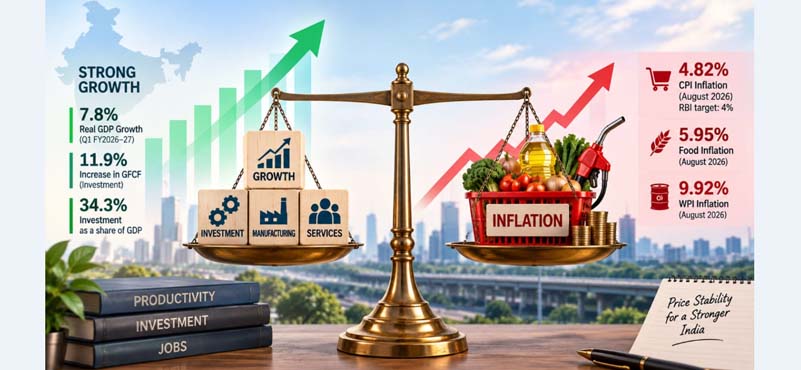
India has entered the second half of FY2026–27 with an unusual combination of strong economic growth and renewed inflationary pressures. Real GDP grew by 7.8% in Q1 FY2026–27, while real GVA increased by 8.2% and gross fixed capital formation (GFCF) by 11.9%. Investment’s share of GDP rose to 34.3%, with manufacturing and services also recording strong growth. At the same time, inflation has become less comfortable, with consumer inflation moving above the Reserve Bank of India’s 4% target and wholesale and producer prices showing much stronger pressures.
The central question for monetary policy is therefore whether the current pressures from food, energy, commodities and manufactured products will prove temporary or persistent and broad-based.
CPI Inflation: A Significant Reversal
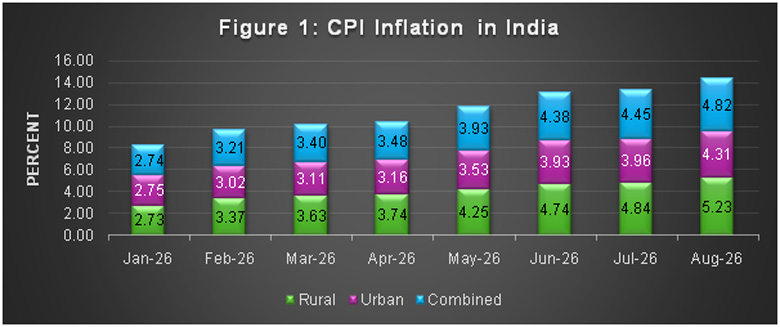
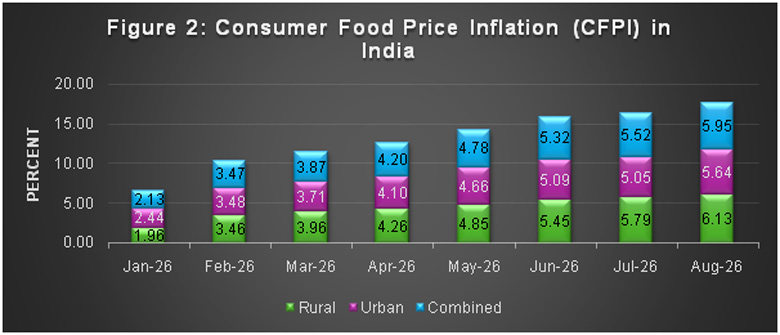
CPI inflation increased steadily from 2.74% in January 2026 to 4.82% in August (Figure 1), while food inflation rose to 5.95% (Figure 2). CPI inflation has consequently remained above the RBI’s 4% target for three consecutive months.
Food remains an important source of pressure, but the pattern is uneven. Prices of onion, garlic and ginger rose sharply, while tomato and potato recorded substantial declines. This dispersion suggests that the increase in headline inflation cannot simply be attributed to excessive aggregate demand. At the same time, the persistence of elevated food inflation means that it cannot be dismissed as entirely temporary.
There is also a significant rural–urban divergence. Rural CPI inflation reached 5.23% in August, compared with 4.31% in urban India (Figure 1), while rural food inflation stood at 6.13%, against 5.64% in urban areas (Figure 2). Higher rural inflation was visible across several consumption categories and could affect rural purchasing power and demand.
Inflation Is Becoming More Broad-Based
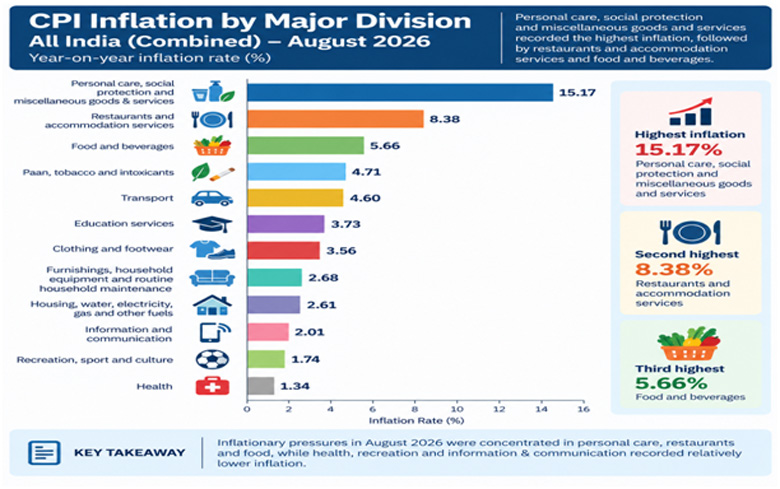
The August data indicate that inflation is extending beyond food. Restaurants and accommodation recorded inflation of 8.38%, while personal care, social protection and miscellaneous goods and services recorded 15.17% (Figure 3). Transport, education and clothing also showed relatively elevated inflation.
Figure 3
This broadening is important because inflation becomes more persistent when price pressures begin influencing services and non-food prices. Higher transport and logistics costs can raise production costs, while businesses may pass higher input costs through to consumers. Yet broadening does not necessarily mean that inflation has become predominantly demand-driven. The origin and persistence of the pressures remain crucial.
Core Inflation: Precious Metals Complicate the Picture
The assessment of underlying inflation requires particular care. Conventional core inflation rose to 4.2% in August from 3.86% in July, but excluding precious-metal jewellery, it remained much lower at around 3.1%. Silver jewellery inflation reached 107.11%, while gold, diamond and platinum jewellery inflation was 35.53%.
Consequently, the conventional core measure may overstate the breadth of underlying domestic inflation. Core inflation excluding precious metals provides a useful gauge of underlying pressures, particularly in the present circumstances. If it continues to rise, evidence of genuinely broad-based inflation would strengthen. If it remains close to 3%, the case for interpreting the current episode as primarily demand-driven remains less compelling.
WPI and PPI: Stronger Signals from the Production Economy
The wholesale price data present a considerably stronger inflation signal. WPI inflation reached 9.92% in August, compared with 3.98% in March (Table 1). Fuel and Power inflation was 22.93%, while Manufactured Products inflation stood at 8.37%.
Table 1
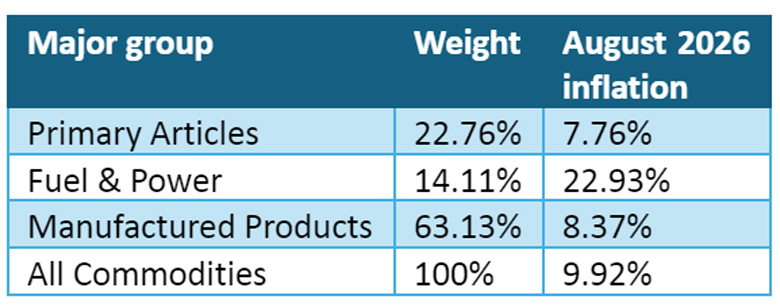
Manufactured products account for more than 63% of the WPI basket, and several industrial categories recorded double-digit inflation, including chemicals and chemical products, textiles, rubber and plastics, electrical equipment and basic metals.
This suggests that inflationary pressures are moving through the production system, although unevenly. Computer and electronic products, for example, recorded deflation of 0.47%. The emerging picture is therefore one of broadening but differentiated inflation.
The Output Producer Price Index adds another dimension. The All-Commodity Output PPI rose from 109.9 in July to 110.8 in August, with increases in agriculture, mining and manufacturing.
The experimental manufacturing Input PPI, however, declined from 105.9 to 104.2. This does not imply that input pressures have disappeared: input prices increased in several manufacturing sectors, while the Input PPI for coke and refined petroleum products declined sharply and significantly influenced the aggregate index. The evidence therefore does not point to a uniform acceleration of costs across the production chain.
Oil, the Rupee and the External Environment
Elevated crude oil prices add another layer of risk. Higher oil prices can affect inflation through petroleum products, transport, logistics, manufacturing inputs and producer prices. They can also increase the oil import bill, place pressure on the rupee and raise the domestic cost of imported goods and intermediate inputs.
The external environment became more challenging following the US Federal Reserve’s 25-basis-point rate increase on 16 September 2026, which raised the federal funds target range to 3.75–4.00%. Higher US rates can influence interest-rate differentials, capital flows, the rupee and domestic financial conditions.
However, the Fed’s decision does not mean that the RBI must automatically follow with a rate increase. Indian monetary policy remains primarily responsive to domestic inflation and growth conditions.
Strong Growth Changes the Policy Trade-off
The inflation challenge would be different if the economy were simultaneously weakening. Instead, Q1 FY2026–27 GDP grew 7.8%, GFCF increased 11.9%, manufacturing grew 9.2% and services 10%.
Strong growth provides greater room for monetary policy to focus on price stability. But the strength of investment also makes calibration important. Tighter financial conditions could eventually affect borrowing costs and investment decisions at a time when investment is becoming an increasingly important driver of growth.
What Should the RBI Watch?
The RBI’s assessment should increasingly look beyond headline CPI and focus on persistence, breadth and transmission.
First, underlying inflation: Particular attention should be paid to whether core inflation excluding precious metals moves materially above its current level of around 3%. A sustained increase would strengthen evidence that inflation is becoming broad-based.
Second, food-price normalisation: The RBI needs to distinguish temporary food shocks from persistent inflation. If food prices moderate as supply conditions improve, headline CPI could ease without substantial monetary intervention.
Third, energy-price persistence: A sustained period of elevated crude prices would have wider implications for inflation, the current account and the rupee.
Fourth, producer-to-consumer transmission: WPI, Output PPI and Input PPI should increasingly be assessed together. Their evolution can help determine whether higher producer prices are being absorbed through margins or passed on to consumers.
Fifth, inflation expectations and domestic demand: If households and businesses begin incorporating higher inflation into wage and price-setting decisions, temporary shocks could become more persistent. Strong GDP, investment and credit growth also mean that demand conditions need to remain part of the assessment.
Taken together, these indicators provide a more nuanced basis for determining the monetary-policy stance. Persistent core inflation excluding precious metals, sustained crude prices, continued high WPI and evidence of producer-to-consumer pass-through would indicate stronger underlying inflation risks. Conversely, moderation in food prices, stable underlying inflation and easing producer pressures would provide greater scope for patience.
Inflation and the Investment Cycle
The monetary-policy debate is closely linked to India’s emerging investment-led growth cycle. If inflation remains contained, productive investment can expand capacity and productivity, strengthening the economy’s supply response. If energy and input costs remain elevated, however, margins could come under pressure and investment incentives could weaken.
This creates a two-way relationship between inflation and growth. Higher input costs can weaken investment and constrain future supply, while productive investment can expand capacity and enable the economy to accommodate stronger demand without persistent inflation.
Conclusion
India’s inflation environment has become more complex. CPI inflation is above the RBI’s 4% target, WPI is close to 10%, energy prices are elevated and Output PPI confirms continuing producer-price pressures. Yet the decline in aggregate manufacturing Input PPI and the relatively moderate core inflation excluding precious metals suggest that inflation is not uniformly accelerating across the economy.
For the RBI, the challenge is therefore one of calibration rather than a mechanical response to any single indicator. The key is to determine whether current pressures are becoming persistent and embedded in expectations, while preserving the investment momentum supporting medium-term growth.
The next phase of monetary-policy management will require closer integration of CPI, core inflation, WPI, Output PPI, Input PPI, crude prices, exchange-rate developments, credit conditions and real economic activity. The objective is to preserve price stability without unnecessarily disrupting India’s investment-led expansion.
ABOUT THE AUTHOR
 Dr Debesh Roy is the Founder-Chairman of the Institute for Pioneering Insightful Research Pvt. Ltd. (InsPIRE), Greater Noida, an independent research and consulting firm (website: https://inspire-solutions.in/). He has over three-and-a-half decades of professional experience, including 32 years at NABARD. Dr Roy holds a PhD in economics, and has extensive experience in macroeconomic policy, international trade, agriculture & agri-business, rural infrastructure, financial inclusion, climate policy and sustainability. (Email ID: debeshroy_chairman@inspire-solutions.in )