
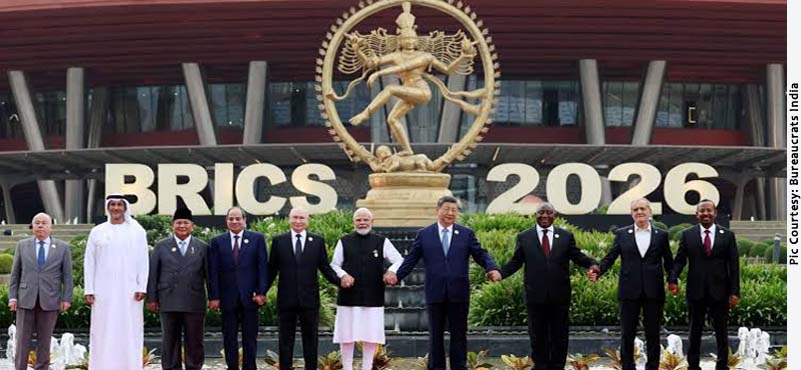
The Main Reasons for the Creation of the Original BRIC(S)
One of the main reasons for the creation of the original Brazil, Russian Federation, India, China (BRIC) Group was that global institutions created in the aftermath of World War II no longer adequately reflected the distribution of economic and political power in the world. The original BRIC informally first met on the sidelines of the UN General Assembly in New York in 2006. Their first Summit was in Yekaterinburg, Russia in 2009. South Africa joined in 2011 to make them the BRICS while another six countries were invited to join between 2024 and 2025, bringing the total membership to eleven. There are also now ten additional partner countries, agreed in 2025 and 2026.
The particular focus of the BRIC founders in 2006 (Presidents Lula of Brazil, Hu Jintao of China and Medvedev of the Russian Federation and Prime Minister Manmohan Singh of India), was on the four institutions vital to global governance – the United Nations (UN) Security Council, the International Monetary Fund (IMF), the World Bank (WB) and the World Trade Organization (WTO).
The 2009 Yekaterinburg Summit laid out a wide-ranging agenda but central to BRIC conception and creation were three overarching objectives: “a fairer world order”, “a more diversified international monetary system” and a “more democratic and just multipolar world order”. The argument for the greater inclusion in global governance institutions and mechanisms of China, India and Brazil in 2006, was largely based on their population and economic size.
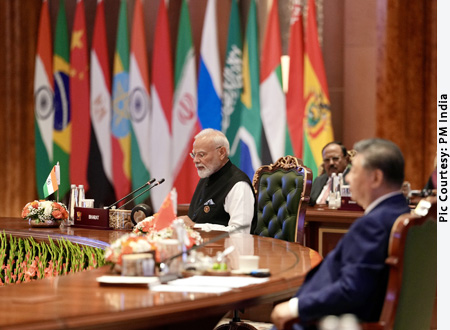 While there were other objectives set out even at the outset of BRIC creation, it is appropriate to judge the results of the recent XVIIIth BRICS Summit in New Delhi, India on 12-13 September 2026 and the 140-point, 45-page BRICS New Delhi Declaration (12 September 2026) by whether the agreements provide any new value added in terms of proposed agreed joint action to advance strategies that address the original overarching global rationales and purposes that led to BRIC creation. An objective analysis will demonstrate that, sadly, neither the Summit nor the Declaration pass this litmus test.
The final New Delhi Declaration appears to largely reiterate earlier statements which were previously put on paper numerous times at many similar Summits with respect to the original three overarching objectives, most recently in Rio de Janeiro in 2025 during Brazil’s chair ship of the BRICS Summit by President Lula, the only remaining political leader left in top country leadership position from the original four visionaries.
Sadly, President Lula was conspicuous by his absence from the New Delhi summit. This was particularly unfortunate since Brazil is now, arguably, under his leadership, the most credible member of the original quartet. If present, he may have been able to bring much needed historical perspective and focus on the vision of the original BRICS founders into both the Summit meetings and Declaration.
Little Evidence of New Concrete Joint Action to Address the Three Original BRIC(S) Objectives
While some argue that the value of repeating statements in declarations is that they could stay alive, the real value added of subsequent declarations is if statements made in earlier declarations are built upon and translated into concrete joint action to operationalize them. There was little evidence of this in New Delhi in the three overarching areas.
To long term observers and actors on these issues, there is also little new in the statements themselves other than a strong focus on criticizing and calling out Trump 2.0 unilateral tariffs and trade aggression as illegal under international trade law and criticizing unilateral economic and secondary sanctions (at the behest of Russia and Iran) in general but not specific terms.
These paragraphs, while welcome since the BRICS as a Group has now endorsed them, are also not entirely new, having been officially stated elsewhere either individually, bilaterally or in other global forums by China (unilateral tariffs), Russia and Iran (sanctions) and some other countries, including some from the Global North such as Canada. No joint or collective action-oriented agreements on any of these areas were included in the Declaration. These could and probably should have included BRICS’ consensus agreement to condemn the proposed US Lindsey O. Graham Sanctioning Russia and Iran Act of 2026 which had passed the Senate by a bipartisan Senate vote of 86-11 last month and was due for a US Congress vote in mid-September as well as consensus and a paragraph in the final Declaration on not implementing US sanctions imposed on Iran. Agreement on such joint action would have added new value but would, no doubt, be looked upon unkindly by President Trump. Hence, India, as Chair, clearly did not desire agreement on such joint action and other members did not press for it.
To be fair, the 45-page BRICS New Delhi Declaration covers a vast array of other important substantive areas, some of which like China’s offer of open access Artificial Intelligence (AI) are new in a BRICS Summit. Various other paragraphs cover issues ranging from health to climate change, energy, critical minerals, Palestine, Gaza and even West Asia on which the Summit succeeded in getting a paragraph jointly agreed by Iran, UAE and Saudi Arabia at the highest political level which had evaded the BRICS Foreign Ministers when they met in May this year. While diplomatically useful showing BRICS unity between its competing members in West Asia, this paragraph may be of limited practical value in the context of the continuing war in the Middle East which has recently expanded to cover Yemen and the Red Sea.
While continuing progress was also made on trade related cross-border payments interoperability in the local currencies of BRICS members, this is likely to have only a marginal impact on the role of the US dollar as the world’s reserve currency, although it could have more implications for the Society for Worldwide Interbank Financial Telecommunications system (SWIFT) messaging system which such local currency transactions could bypass. More importantly, the idea of a collective BRICS non-dollar currency, as hinted at earlier by some original BRICS members, was clearly taken off the table, if it ever was on it.
While President Trump will, no doubt, be happy with this outcome which India delivered during its chair ship, many BRICS supporters will be disappointed since whether the dollar continues as the world’s currency of last resort does go to the heart of the grave global monetary imbalances in favour of the USA that the original BRIC founding vision sought to address but has, so far, made little progress on.
The New Delhi Declaration, importantly, also reiterated the current and future centrality of multilateralism, the UN Charter, and upholding international law, recognizing the UN as the main current and future global governance body. While welcome, this can be regarded as hypocritical since some BRICS members, now largely an illiberal grouping itself, have been called out for violating the UN Charter and international human rights and humanitarian law numerous times, with President Putin having been designated a war criminal by the International Criminal Court (ICC) for some of his actions in Ukraine. In fact, many BRICS members unashamedly violate some of what they have collectively agreed and called for in many other paragraphs of the New Delhi Declaration as well.
While overall, some of what is in the Declaration, even though it is not central to either the original purpose or vision of the BRIC(S) is welcome, it begs the question of whether the Grouping is getting diverted from its core original purpose and objectives.
The Limitations of the Broader BRICS Grouping
The limitations of the broader BRICS Group were made clear by both the stalemate and notable omissions of key players in the West Asia and Ukraine crisis. Months were spent to get agreement on a brief West Asia focused paragraph, but neither the USA nor Israel, whose illegal invasion of Iran had triggered the crisis were named or shamed, while Ukraine equally shockingly, if unsurprisingly, was not even mentioned in the final Declaration, presumably because of an informal Russian Federation “veto” which India acceded to well in advance of the Summit.
The contradictions between BRICS’ members are also becoming more apparent, especially with its expansion but not only because of that. While this was most apparent this year on the West Asia crisis, it is true in many economic areas as well including but not limited to strategic minerals where China’s interests may vary from those of India and other BRICS members. Also, China has consistently opposed India’s inclusion as a Permanent Member of the UN Security Council, a key demand of India, so the agreed Declaration, unsurprisingly, has vague language in this area.
There also appears to be an identity crisis. Has the BRICS as it currently stands become a Grouping of the South, or does it still claim to be a group of emerging countries as originally envisioned or has that now become emerging and developing countries (EMDEs)? While the South-South rhetoric, focus and joint actions of the BRICS in the economic and development areas seems to be growing, with the New Delhi Declaration being overwhelmingly focused on these areas, the Russian Federation was never part of the Global South, China is understandably not regarded by many countries as part of the Global South now, nor are relatively oil rich UAE and Saudi Arabia. Some of these countries were never part of the Non-Aligned Movement (NAM) or the G77, the main existing South grouping, the decline of whose political influence in international fora contributed to the creation of the original five BRICS.
Is the New Delhi Declaration Providing Real Value Added With Respect to the Three Original BRICS Objectives?
A key question which needs to be asked after the New Delhi Summit and Declaration is whether the BRICS as a separate grouping now provide a real substantive value added on the big geopolitical issues and imbalances which were critical to its founding vision. The “cut and paste” or repetition of paragraphs from earlier Declarations and forums in these areas indicates that little significant progress has been made on these overarching issues two decades after BRIC creation.
Moreover, in terms of value added on the big geoeconomic issues like trade and Bretton Woods Institution (BWI) reform, is the Declaration saying anything different from what they individually or collectively say at the UN in New York, the WTO in Geneva or the World Bank or IMF in Washington DC or at G20 Summits of which the original five are all members and have recently held the Presidency of? Also, even more importantly, why do they not seek to work as a collective BRICS bloc in all these forums with one voice, and not individually at present?
These questions have taken on particular importance after the New Delhi Summit because it made clear, probably once and for all, that the BRICS will never confront the US or even the EU as a bloc as a collective group in any of these global governance bodies. The clutter of actions agreed in the Declaration, even if they have increased to cross one hundred, seem to be in easier and less contentious South-South economic and development cooperation areas.
The various omissions or commissions by the BRICS in its September 2026 New Delhi Summit and Declaration, the now obvious and visible contradictions between its members and confusion about its identity reduce both the Group’s credibility and effectiveness. While there is still value in having the BRICS as a South-South economic and development cooperation forum (notwithstanding that some of its core members are not from the Global South), this was neither its original primary purpose nor its core vision.
This article is a slightly updated and modified version, with a changed title, of an Op Ed by the same author which first appeared in The Wire, India with the heading Did the BRICS Advance their Founders’ Vision and Objectives in New Delhi? on 16 September 2026.
ABOUT THE AUTHOR

Kamal Malhotra is Distinguished Visiting Professor at the NALSAR University of Law, Hyderabad, India and a Non-Resident Senior Fellow at TEPAV, The Economic Policy Research Foundation of Turkey. He was a Non-Resident Senior Fellow, Boston University between 2022-2025.
Mr Malhotra retired from the United Nations in September 2021 after a rich career including as its Head and Representative of the Secretary General in Vietnam, Turkiye and Malaysia. He was UNDPs Senior Adviser on Inclusive Globalization prior to that. Other positions held include Director, Overseas and Aboriginal Programme, OXFAM Australia and Director, International Institute of Rural Reconstruction, Philippines. Mr Malhotra also co-founded and co-directed Focus on the Global South.